Yellow Oleander
Thevetia peruviana
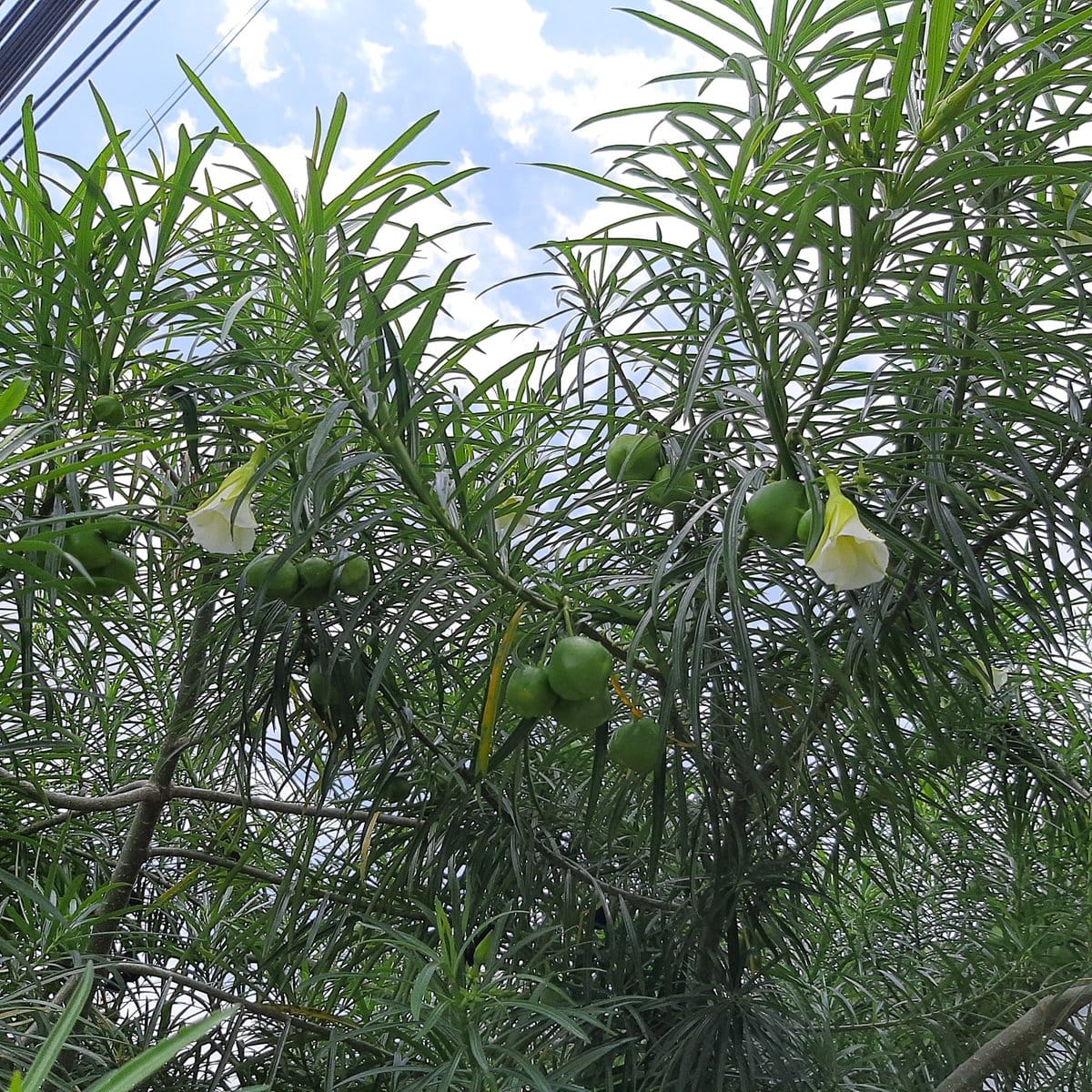
Quick facts
Native Region
Tropical Americas
Max Height
3-8 meters
Family
Apocynaceae
Conservation
NE — Not Evaluated
Uses
Safety Information
CRITICAL DANGER
This beautiful ornamental is EXTREMELY DANGEROUS and responsible for numerous deaths worldwide. Seeds are the primary danger—children mistake them for edible nuts. Common in landscaping throughout Costa Rica, often planted in schools, parks, and residential areas without adequate warning. Should NOT be planted where children have access. All plant parts toxic if ingested. Keep fallen seeds away from children and pets. Symptoms appear within 1-6 hours: nausea, vomiting, diarrhea, abdominal pain, irregular heartbeat, confusion, seizures, death. If ingestion suspected, seek emergency medical care IMMEDIATELY—this is life-threatening and requires cardiac monitoring.
Toxicity Details
ALL PARTS EXTREMELY TOXIC. Contains cardiac glycosides (thevetin, peruvoside, neriifolin) similar to digitalis that affect heart function. Seeds are the most dangerous—they resemble almonds or 'lucky nuts' and are a common cause of fatal poisonings worldwide, particularly in children. Just 1-2 seeds can kill a child; 8-10 seeds can kill an adult. Causes severe cardiac arrhythmias (irregular heartbeat), nausea, vomiting, dizziness, and death from cardiac arrest. Also contains cerberin, a highly toxic compound. Leaves, flowers, and sap are also poisonous. This is one of the most common causes of plant poisoning deaths in tropical regions. Often mistaken for edible nuts.
Skin Contact Risks
Sap can cause mild skin irritation in some individuals. Handling the plant generally safe if parts are not eaten. However, wash hands thoroughly after contact and avoid touching eyes or mouth.
Allergenic Properties
Some individuals may experience mild allergic reactions to pollen or sap. Generally low allergen risk compared to toxicity risk.
Wildlife & Pet Risks
Highly toxic to all domestic animals including dogs, cats, horses, cattle, and birds. Even small amounts can be fatal. Seeds, leaves, and flowers all pose danger. Keep all pets away from this plant.
First Aid & Emergency Response
• If ingested, seek immediate medical attention. Do not induce vomiting unless directed by medical professional.
• If sap contacts skin, wash immediately with soap and water. Seek medical attention if blistering or severe irritation occurs.
• If sap enters eyes, flush immediately with clean water for 15 minutes and seek emergency medical care.
Costa Rica Emergency: 911
Costa Rica Poison Control: 2223-1028
Season
Flowering
All
Fruiting
All
How to identify
Yellow Oleander (Chirca)
Yellow Oleander (Thevetia peruviana), also called Lucky Nut or Chirca, is one of the most dangerous ornamental plants commonly found in tropical landscapes. Despite its beautiful bright yellow trumpet flowers, ALL PARTS are extremely toxic, containing cardiac glycosides that cause potentially fatal heart arrhythmias. The seeds are the most dangerous—they resemble almonds or "lucky nuts" and are responsible for numerous fatal poisonings worldwide, especially in children. This plant is commonly planted in schools, parks, and gardens throughout Costa Rica, often without adequate warnings.
Quick Reference
iNaturalist Observations
Community-powered species data
📸 Photo Gallery
Whole tree
📷 (c) kavery5304, some rights reserved (CC BY-NC)(CC BY-NC)
View source ↗Leaves
📷 (c) Margaret, some rights reserved (CC BY-NC)(CC BY-NC)
View source ↗Whole tree
📷 (c) Arthur de Jesús Chavarría Pérez, some rights reserved (CC BY)(CC BY)
View source ↗Leaves
📷 (c) Javier Lezama, some rights reserved (CC BY-NC)(CC BY-NC)
View source ↗Whole tree
📷 (c) Jefferson Smith, some rights reserved (CC BY-NC)(CC BY-NC)
View source ↗Photos sourced from iNaturalist's community science database. Browse all observations →↗
Taxonomy & Classification
Why Is This Plant So Dangerous?
The "Lucky Nut" Tragedy
The seeds are responsible for most poisonings:
- Appearance: Triangular, compressed, resemble almonds or cashews
- Name: Called "lucky nuts" — ironically deadly
- Size: 2-3 cm long, hard outer shell
- Fatal Dose: 1-2 seeds can kill a child; 8-10 seeds can kill an adult
- Accumulation: Seeds fall and pile up under plants for months
- Attraction: Children and uninformed adults mistake them for edible nuts
Cardiac Glycosides
Contains powerful heart toxins that work like uncontrolled heart medication:
- Thevetin A & B: The most abundant cardiac glycosides — primary toxic compounds
- Peruvoside: Another cardiac glycoside — studied as potential cardiac drug
- Neriifolin: Heart-affecting compound shared with related species
- Cerberin: Highly toxic alkaloid also found in the "Suicide Tree" (Cerbera manghas)
- Mechanism: All compounds inhibit the sodium-potassium ATPase pump in heart muscle cells, forcing the heart into irregular, dangerous rhythms that can cause cardiac arrest
A Global Public Health Problem
Yellow Oleander poisoning is a significant worldwide issue:
- Leading Cause: One of the top causes of plant poisoning deaths in tropical regions
- Sri Lanka: Accounts for over 50% of plant poisoning hospital admissions
- India: Major cause of deliberate self-harm using plant toxins
- Children: Most vulnerable group due to the seed's nut-like appearance
- Accidental: Commonly mistaken for edible plants by tourists and newcomers to tropical areas
Physical Description
Growth Form
Leaves
- Shape: Linear to lanceolate (lance-shaped), 10-15 cm long, 1-2 cm wide
- Color: Dark glossy green above, paler beneath
- Arrangement: Spirally arranged, crowded at branch tips in dense clusters
- Texture: Leathery, smooth, with a prominent midvein
- Margins: Entire (smooth edges)
- Petioles: Very short or nearly sessile (leaves attach almost directly to the stem)
- Persistence: Evergreen — retains leaves year-round
- Distinguishing feature: Leaves release milky latex when broken, distinguishing from similar-looking plants
Flowers
- Color: Bright yellow, sometimes peachy-yellow or apricot; pink or white cultivars also exist
- Shape: Funnel-shaped (infundibuliform), 5-lobed
- Size: 6-8 cm long, 4-5 cm across
- Fragrance: Sweetly scented, particularly in the evening
- Arrangement: Terminal or axillary cymes, usually 2-5 flowers per cluster
- Season: Blooms year-round in the tropics, with peaks during rainy season
- Pollination: Insects, particularly moths attracted to evening fragrance
Fruit and Seeds
- Fruit type: Fleshy drupe, 3-5 cm diameter
- Fruit color: Green, turning yellow-brown to black when ripe
- Shape: Rounded to triangular, somewhat compressed
- Seeds: 1-2 per fruit, triangular, compressed, with a hard outer shell
- Seed color: Yellow-brown to grayish when dry
- Resemblance: Seeds closely resemble almonds or cashews — this is the primary danger
- Persistence: Seeds remain toxic even when dried, and can remain viable in soil for months
- Dispersal: Falls below parent plant; also spread by water (floats)
Milky Sap
- Type: White milky latex (abundant)
- Present in: All parts — stems, leaves, flowers, roots
- Exuded: Immediately when any part is broken or cut
- Content: Contains cardiac glycosides at lower concentrations than seeds
- Skin effect: Can cause mild irritation; latex is sticky and difficult to remove
Geographic Distribution
Geographic Distribution
Yellow Oleander in Costa Rica
Extremely Common — Found Throughout the Country:
Important: Unlike native species with limited distribution, Yellow Oleander is planted everywhere in Costa Rica. You will encounter it in most urban and suburban areas. Learn to recognize it to protect children and pets.
Habitat & Ecology
Why It's So Common
Despite extreme toxicity, Yellow Oleander is one of the most widely planted ornamentals in the tropics because:
- Drought Tolerance: Survives extended dry periods with minimal watering — ideal for Guanacaste's dry season
- Low Maintenance: Requires almost no care after establishment
- Fast Growth: From seed to flowering shrub in 2-3 years
- Continuous Bloom: Produces showy flowers year-round
- Soil Tolerance: Grows in poor, rocky, sandy, or alkaline soils
- Salt Tolerance: Moderate resistance to coastal salt spray
- Pest Resistance: Few pests or diseases — the toxins protect the plant
- Heat Tolerance: Thrives in full tropical sun
Ecological Role
As an introduced species, Yellow Oleander has a limited but notable ecological role:
- Pollinator Resource: Flowers provide nectar for butterflies, hawk moths, and other pollinators
- No Native Herbivores: Virtually no animals in Costa Rica feed on this toxic plant
- Invasive Potential: Can naturalize along roadsides and disturbed areas in some tropical regions, though not typically considered highly invasive in Costa Rica
- Soil Stabilization: Root system helps prevent erosion on slopes and embankments
Toxicology
Toxic Compounds
How Cardiac Glycosides Kill
Fatal Doses
Symptoms of Poisoning
First Aid & Emergency Response
- Costa Rica Emergency: 911
- Costa Rica Poison Control: 2223-1028
- INS Emergency: 800-8000-911
If Seeds or Plant Parts Are Eaten
- CALL EMERGENCY IMMEDIATELY: 911
- Costa Rica Poison Control: 2223-1028
- DO NOT WAIT for symptoms to appear — poisoning is time-sensitive
- DO NOT INDUCE VOMITING (vomiting can trigger vagal response and worsen cardiac arrhythmias)
- If person is conscious and can swallow:
- Give activated charcoal if available (within 1-2 hours of ingestion)
- Give water or milk to dilute
- GET TO HOSPITAL IMMEDIATELY — this is a cardiac emergency
- Monitor pulse and breathing while waiting for emergency services
- Bring sample of plant or seeds for identification
Critical Information for Medical Team
Provide as much of this information as possible:
- Sample of plant or seeds (for positive identification)
- Exact or estimated time of ingestion
- Approximate amount consumed (number of seeds, leaves, etc.)
- Patient's weight and age (especially critical for children)
- Current symptoms and time of symptom onset
- Any pre-existing heart conditions or medications
Hospital Treatment Protocol
Recognition & Prevention
How to Identify
Warning Systems
Unlike the native Manchineel, Yellow Oleander often has no warning signs:
- No Standard Marking: Most planted specimens are unmarked
- No Red X: Unlike Manchineel, there is no tradition of marking this plant
- No Warning Signs: Rarely posted, even in schools and parks
- Need for Change: Public health advocates recommend warning signage
Prevention Strategies
Safer Alternatives for Yellow Flowers
Uses
Traditional and Historical Uses (DO NOT ATTEMPT)
The following uses are documented for historical and educational purposes only. DO NOT attempt any of these. All parts of Yellow Oleander are potentially lethal.
- Folk Medicine: Used in traditional medicine in parts of India and Southeast Asia for treating skin conditions, fever, and heart ailments — extremely dangerous and has caused many deaths
- Rodenticide: Seeds used historically to poison rats and other vermin
- Insecticide: Seed and leaf extracts used as natural pesticide in some farming communities
- Arrow Poison: Some indigenous groups reportedly used the sap to poison projectiles
- Deliberate Self-Harm: Tragically, one of the most commonly used plants for suicide in South and Southeast Asia, particularly Sri Lanka and India — public health organizations work to restrict access
Modern Research
- Pharmaceutical Research: Thevetin and peruvoside are being studied as potential controlled-dose cardiac medications
- Anti-Cancer Properties: Some cardiac glycosides from Thevetia show promising anti-tumor activity in laboratory studies
- Biofuel: Seed oil is being investigated as a potential biodiesel feedstock — the plant's hardiness and low water requirements make it attractive for this purpose
- Biopesticide: Extracts are being studied as eco-friendly alternatives to synthetic insecticides
Cultural & Historical Significance
Discovery and Naming
The plant's scientific history reflects colonial-era exploration of the Americas:
- André Thevet (1502-1590): French Franciscan friar and royal cosmographer who documented the plant during his 1555-1556 travels in Brazil. The genus Thevetia honors his contributions
- Linnaeus (1753): Initially described the plant as Cerbera thevetia — the genus Cerbera references Cerberus, the multi-headed dog guarding the underworld in Greek mythology, alluding to the plant's deadly nature
- Colonial Documentation: European naturalists quickly noted both the plant's beauty and extreme danger in their catalogues of New World flora
The "Lucky Nut" Paradox
The common name "Lucky Nut" is deeply ironic:
- Origin: In some Caribbean and Latin American cultures, the dried seeds were carried as lucky charms
- Shape: The distinctive triangular seeds were considered unusual and attractive
- Charm: Seeds were strung as bracelets or carried in pockets for good luck
- Tragic Irony: The seeds most commonly handled as talismans are precisely the most toxic part of the plant
- Modern Warning: Health organizations now discourage the practice of carrying or handling seeds
In Costa Rica
- Ubiquitous Ornamental: Planted throughout the country since at least the early 20th century
- Name Variants: Known locally as "chirca," "chirca amarilla," or "codo de fraile"
- Growing Awareness: Costa Rican poison control centers have increased public education efforts
- Schools Issue: The practice of planting Yellow Oleander in schoolyards is increasingly being questioned and reversed
Legal and Ethical Considerations
Should It Be Restricted?
Current Status in Costa Rica
- No nationwide ban on planting Yellow Oleander
- Public health education increasingly focuses on plant poisoning awareness
- Some schools and institutions have voluntarily removed specimens
- Poison control centers (2223-1028) actively track Yellow Oleander cases
- No legal requirement for warning signs on private property
Medical Significance
Epidemiology
Yellow Oleander poisoning is a significant public health issue in tropical regions:
- Sri Lanka: Over 50% of all plant-poisoning hospital admissions involve Thevetia peruviana; accounts for thousands of cases annually
- India: Major cause of plant-related poisoning, particularly in southern states
- Central America: Pediatric poisonings are the primary concern, mostly accidental
- Costa Rica: Cases are tracked by poison control but comprehensive epidemiological data is limited
Treatment Advances
- Digoxin-specific Fab Fragments (DigiFab): The most effective antidote, originally developed for digoxin overdose but effective against all cardiac glycosides. A randomized trial in Sri Lanka showed 46% reduction in mortality when used for oleander poisoning
- Activated Charcoal: Multi-dose activated charcoal reduces cardiac glycoside absorption and enterohepatic recirculation
- Detection: Blood tests can measure cardiac glycoside levels using digoxin immunoassay (cross-reactivity allows detection)
- Prognosis: With early treatment and cardiac monitoring, survival rates exceed 90%; without treatment, mortality can exceed 50%
Conservation Status
- Not Endangered: Extremely common cultivated plant found throughout the tropics
- No Conservation Concern: Populations are stable and self-sustaining
- Management Priority: Public health and safety, NOT conservation
- Invasive Potential: Can naturalize in favorable conditions but not typically classified as invasive in Costa Rica
Cultivation & Safe Management
Yellow oleander is widely planted as an ornamental for its year-round flowering. Safe management requires strict awareness of its extreme toxicity — all parts are lethal if ingested.
Propagation
- Seeds: Collect mature drupes (black, globe-shaped); remove fleshy outer layer. Sow 2 cm deep in moist, well-drained potting mix. Germination in 2–4 weeks at 25–30 °C. Wear gloves — seeds are the most toxic part
- Stem cuttings: 20–30 cm semi-hardwood cuttings taken in early wet season root readily in sand/perlite under partial shade; rooting hormone not required. Wear nitrile gloves when cutting; sap causes skin irritation
- Air layering: Girdle a branch, wrap with moist sphagnum moss and plastic; roots form in 6–8 weeks. This method produces larger transplants quickly
Site Selection & Planting
NEVER plant Yellow Oleander where children or pets have access. Do not plant near schools, playgrounds, livestock pens, or food gardens. All plant parts — flowers, leaves, sap, seeds — contain lethal cardiac glycosides. A single seed can kill a child. Site selection is as much a safety decision as a horticultural one.
Maintenance
- Watering: Drought-tolerant once established (1–2 years). Water deeply every 2 weeks during establishment; reduce to monthly or rainfall-only afterward
- Fertilisation: Apply balanced slow-release fertiliser (10-10-10) twice yearly (beginning and end of wet season) at 100 g per tree for optimal flowering
- Pruning: Responds well to hard pruning for hedge formation. Prune after main flowering flush to shape. ALWAYS wear nitrile gloves and eye protection — sap is caustic and toxic. Bag and seal all clippings for disposal; never burn
- Pest management: Very few pest or disease problems. Occasionally affected by oleander caterpillar (Syntomeida epilais) — handpick wearing gloves; avoid broad-spectrum insecticides that harm pollinators
Companion Planting
Seasonal Care Calendar
Removal & Disposal
If a Yellow Oleander must be removed (e.g., new proximity to children's play area):
- PPE required: Nitrile gloves, sealed eye protection, long sleeves, respiratory protection during chipping
- Do NOT burn: Smoke contains volatile cardiac glycosides that cause severe respiratory distress
- Root removal: Extract completely — root fragments can resprout; remaining root pieces in soil retain toxicity
- Disposal: Bag all material in sealed heavy-duty waste bags; dispose through municipal green waste (not home composting)
- Tool cleaning: Wash all tools thoroughly with soap and water; sap residue remains toxic when dried
External Resources
Community observations, photos, and distribution data
Global observations
Global Biodiversity Information Facility occurrence data
GBIF
Comprehensive botanical and distribution information
USDA Database
Clinical review of cardiac glycoside poisoning from Thevetia peruviana
PubMed Central
World Health Organization information on cardiac glycoside poisoning
WHO
Botanical nomenclature and type specimen information
Missouri Botanical Garden
Conservation status and species assessment
Critical Safety Summary
🚫 NEVER:
- Let children play near this plant or handle fallen seeds
- Eat seeds, leaves, flowers, or any plant part
- Use in traditional or folk medicine
- Plant in schools, playgrounds, or child-accessible areas
- Assume the name "lucky nut" means it is safe
- Burn plant material in bonfires (smoke carries toxins)
✅ ALWAYS:
- Teach children to NEVER eat unknown seeds, nuts, or berries
- Regularly sweep up and dispose of fallen seeds if plant is present
- Seek immediate emergency medical care if ingestion is suspected — call 911 or Poison Control at 2223-1028
- Consider removing the plant from properties with children or pets
- Choose safer yellow-flowering alternatives for landscaping
- Inform visitors and neighbors about the plant's toxicity
⚠️ REMEMBER:
- Just 1-2 seeds can kill a child
- Beautiful flowers do not mean the plant is safe
- Symptoms may not appear for 1-6 hours — do not wait
- This is a cardiac emergency requiring hospital monitoring
- Early treatment saves lives — the antidote (DigiFab) is highly effective
This common ornamental has caused many deaths worldwide. If you have children or pets, seriously consider removing it from your property.
Safety Information Disclaimer
Safety information is provided for educational purposes only. Individual reactions may vary significantly based on age, health status, amount of exposure, and individual sensitivity. Always supervise children around plants. Consult a medical professional or certified arborist for specific concerns. The Costa Rica Tree Atlas is not liable for injuries or damages resulting from interaction with trees described in this guide.
• Always supervise children around plants
• Consult medical professional if unsure
• Seek immediate medical attention if poisoning occurs
Information compiled from authoritative toxicology sources, scientific literature, and medical case reports.
Help improve this page
Know something about this tree? Share local knowledge, suggest a correction, or submit a photo to improve this guide for everyone.