Caña India
Dracaena fragrans
Quick facts
Native Region
Tropical Africa
Max Height
6-15 meters (20-50 feet)
Family
Asparagaceae
Conservation
LC — Least Concern
Uses
Safety Information
Toxicity Details
Caña India (Dracaena) is mildly toxic if ingested. The leaves contain saponins which can cause stomach upset, vomiting, and diarrhea in humans if consumed. However, the plant is not typically eaten by people (bitter taste). Most concerning is TOXICITY TO PETS - particularly cats and dogs. Ingestion causes drooling, vomiting, dilated pupils, increased heart rate, and loss of appetite in pets. While rarely fatal, it causes significant distress and requires veterinary care.
Skin Contact Risks
Mild skin irritation possible from sap, particularly in sensitive individuals. May cause contact dermatitis. The sap is sticky. Most people handle the plant without issue when propagating cuttings for living fences.
Wildlife & Pet Risks
TOXIC TO CATS AND DOGS - causes gastrointestinal upset, drooling, dilated pupils. Also toxic to horses if ingested in quantity. Keep away from domestic animals. Birds and wild animals typically do not consume this plant.
Season
Flowering
Jan-Mar, Dec
Fruiting
Feb-Apr
How to identify
Caña India (Corn Plant)
The Caña India (Dracaena fragrans), though native to tropical Africa, has become so deeply integrated into Costa Rican rural life that it defines the country's agricultural landscape. Rows of these tall, palm-like plants mark property boundaries, form living fences, and during the dry season release an intoxicating sweet fragrance from their night-blooming flowers. Simultaneously, this same species reigns as one of the world's most popular houseplants — a NASA-certified air purifier found in offices and homes across every continent. Few plants so completely bridge the gap between rural agricultural infrastructure and urban interior design.
Quick Reference
iNaturalist Observations
Community-powered species data
📸 Photo Gallery
Whole tree
📷 (c) heidys, some rights reserved (CC BY-NC)(CC BY-NC)
View source ↗Leaves
📷 no rights reserved(CC0)
View source ↗Whole tree
📷 no rights reserved(CC0)
View source ↗Leaves
📷 (c) Jenaro Campos Zamora, some rights reserved (CC BY-NC)(CC BY-NC)
View source ↗Whole tree
📷 (c) Eric Koberle, some rights reserved (CC BY-NC)(CC BY-NC)
View source ↗Photos sourced from iNaturalist community science database. View all observations →↗
Taxonomy and Classification
Common Names
The Asparagaceae Family and Monocot Botany
Etymology
- Dracaena: From Greek drakaina (female dragon) — referring to the red resin ("dragon's blood") produced by some species in the genus
- fragrans: Latin for "fragrant" — referring to the intensely sweet-scented night-blooming flowers
- Caña India: Spanish for "Indian cane" — a misnomer, as the plant is native to Africa, not India; likely named via colonial-era Asian trade routes
- Corn Plant: English common name from the resemblance of the strap-shaped leaves to those of maize (Zea mays)
Physical Description and Botany
Overall Form
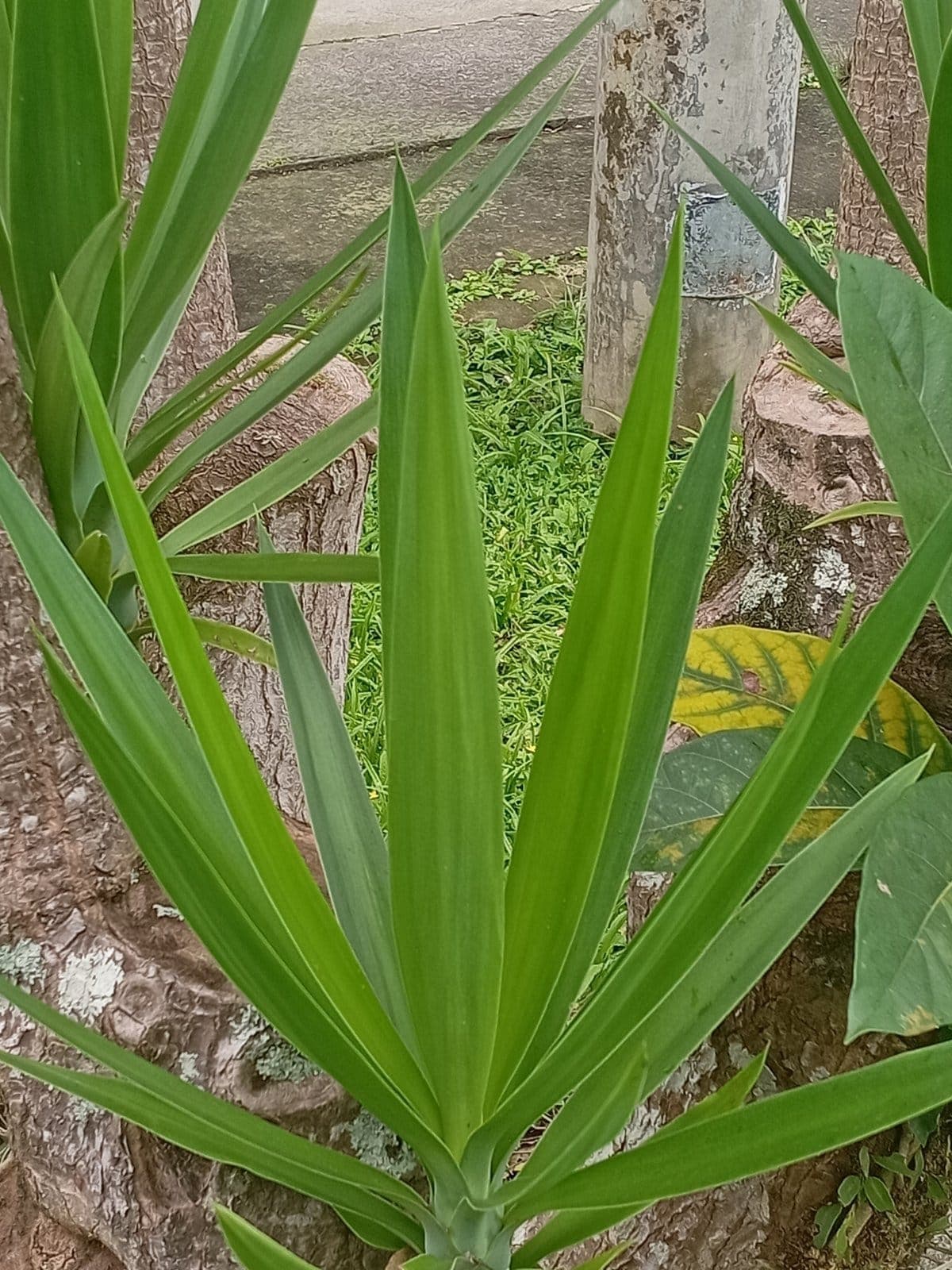
Caña India grows as an unbranched or sparingly branched tree-like monocot with a distinctive rosette of long, strap-shaped leaves at the crown. The thick, woody stem stores water and is marked with prominent ring-like leaf scars from shed leaves. The plant can reach impressive heights (up to 15 m) over many decades. In cultivation as living fence posts, multiple trunks often grow close together from cuttings planted in a line, creating the characteristic dense, vertical hedgerow appearance that defines Costa Rica's agricultural landscape.
Trunk and Secondary Growth
Trunk: Gray, smooth, marked with distinctive horizontal ring-like scars left by shed leaves. The trunk stores significant water reserves, contributing to the species' remarkable drought tolerance. Young plants are unbranched; branching typically occurs only after flowering or damage to the apical meristem.
Anomalous secondary growth: Unlike most monocots, Dracaena fragrans continues to increase in trunk diameter over time through a secondary meristem in the stem cortex. This "monocot cambium" produces additional vascular bundles and supportive tissue, allowing the plant to become genuinely woody and self-supporting at heights that would be impossible for a typical monocot. This is why a Caña India fence post, despite being a relative of grasses and lilies, can stand as a sturdy, long-lived wooden pillar for decades.
Leaves
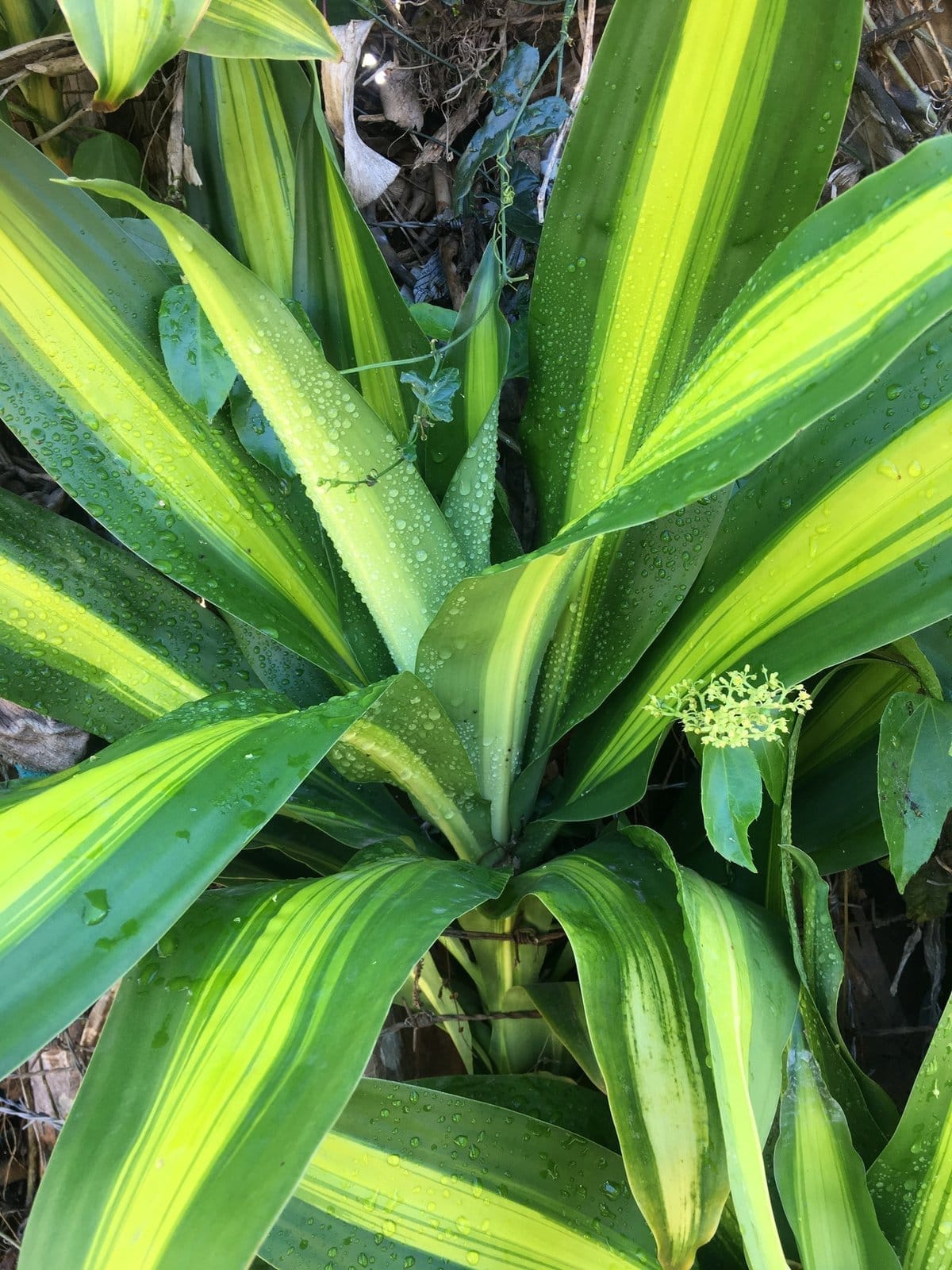
The leaves are long, strap-shaped (linear-lanceolate), and arranged in a dense spiral rosette at the stem tip. They are glossy dark green with prominent parallel venation — a hallmark monocot trait. As the plant grows taller, lower leaves are shed, leaving the characteristic ring scars on the trunk. Numerous ornamental cultivars exist with variegated foliage, including 'Massangeana' (yellow central stripe), 'Lindenii' (white-edged), and 'Lemon Lime' (bright yellow margins), though wild-type all-green forms dominate in Costa Rican living fences.
Flowers
Flowers are borne in large terminal panicles (30-90 cm long) that emerge from the center of the leaf rosette. Individual flowers are small (~1 cm), tubular, white to pale pink, with parts in threes (6 tepals) — the classic monocot floral plan. The flowers are nocturnally fragrant — opening and releasing their intensely sweet, honey-like scent primarily at night to attract moth pollinators. After flowering, the stem typically branches, producing two or more rosettes where previously there was one.
Fruit and Seeds
Berries: Globose, 1-2 cm in diameter, turning bright orange-red when ripe. Each fruit contains 1-3 seeds. Fruits are eaten by birds, which serve as dispersal agents in the species' native African range. In Costa Rica, fruiting is relatively uncommon, as most plants are propagated vegetatively from cuttings and may not flower regularly.
The Magical Night Fragrance
Costa Rica's Seasonal Perfume
During the dry season (December-March), flowering Caña India releases one of Costa Rica's most memorable fragrances. The small white flowers open at night and release an intensely sweet, almost honey-like scent that can be detected from hundreds of meters away. For many Costa Ricans, this fragrance is deeply connected to memories of rural life, Christmas celebrations, and the warm dry season. Entire neighborhoods can be perfumed by a single flowering row of Caña India.
Fragrance Chemistry and Pollination
The night fragrance is a complex volatile cocktail dominated by linalool (a floral terpene alcohol), geraniol (a rose-scented monoterpene), benzyl acetate (a jasmine-like ester), and various sesquiterpenes. This chemical blend is specifically tuned to attract hawk moths (Sphingidae) — large nocturnal moths that hover while feeding, extending extremely long proboscides to reach nectar deep in the tubular flowers. This pollination strategy, called sphingophily, explains the flower's white color (visible in moonlight), strong night fragrance (detectable over long distances in darkness), and narrow tubular shape (excluding less efficient pollinators).
Geographic Distribution
Geographic Distribution
Distribution in Costa Rica
Caña India is found throughout Costa Rica wherever there is human settlement. It's most abundant in the Central Valley and mid-elevation agricultural zones, but thrives in coastal areas and some montane regions. You'll rarely find it truly wild in Costa Rica — it is almost always associated with cultivation. Despite being introduced, it is so ubiquitous that many Costa Ricans assume it is native.
Living Fences: A Costa Rican Tradition
Cercas Vivas — Sustainable Rural Infrastructure
The living fence (cerca viva) is a cornerstone of sustainable Costa Rican agriculture. Caña India, along with Poró (Erythrina spp.) and other species, creates fences that never need replacing, provide wildlife corridors, prevent erosion, mark boundaries, and contribute to the farm's productivity — all from simple cuttings stuck directly in the ground. This practice predates colonial settlement and represents one of the most elegant examples of agroecological infrastructure in the Neotropics.
How Living Fences Work
Indoor Plant Fame
While Costa Ricans know Caña India as a fence post, the rest of the world knows it as one of the most popular indoor plants ever. It thrives in low light, tolerates neglect, and purifies indoor air. In NASA's famous Clean Air Study, Dracaena fragrans was identified as one of the most effective plants for removing formaldehyde, trichloroethylene, and benzene from indoor air. This research helped launch Dracaena to global superstardom in the houseplant industry.
Air Purification Science
NASA's 1989 Clean Air Study tested the ability of common houseplants to remove volatile organic compounds (VOCs) from sealed chambers. Dracaena fragrans 'Massangeana' was among the top performers, removing significant quantities of formaldehyde (common in building materials and furniture) and trichloroethylene (a solvent found in paints and adhesives). While later research has shown that the air-purifying effect in real-room conditions is modest compared to ventilation, the study cemented Dracaena's reputation and drove massive commercial demand.
Popular Cultivars
Pet Safety
Despite being safe for humans and widely planted in Costa Rica, Caña India contains steroidal saponins that are toxic to cats and dogs. The ASPCA lists Dracaena fragrans as toxic to both species. Symptoms of ingestion include drooling, vomiting, dilated pupils, increased heart rate, and loss of appetite. While rarely fatal, ingestion causes significant distress and requires veterinary care. Indoor plants should be placed out of reach of pets, and outdoor plantings should be in areas pets cannot access.
Saponin Toxicity
The toxic compounds are steroidal saponins — a class of plant glycosides concentrated in the leaves. When ingested, saponins interact with cell membranes in the gastrointestinal tract, causing irritation and disrupting normal function. Cats are particularly sensitive. The bitter taste of the leaves typically deters most animals from eating large quantities, but kittens and puppies may chew on the strap-like leaves during play. Horses are also reportedly sensitive to Dracaena saponins if they consume foliage in significant quantity.
Habitat and Ecology
Native African Habitat
In its native range across tropical Africa — from Guinea and Sierra Leone in the west to Ethiopia and Sudan in the east, and south to Mozambique — Dracaena fragrans grows as an understory to mid-canopy plant in tropical and subtropical moist forests. It thrives in the dappled light beneath taller trees, which explains its remarkable tolerance of low light conditions as an indoor plant. In Africa, it occurs naturally from sea level to about 2,400 m elevation, demonstrating the broad ecological amplitude that has made it so successful as a cultivated species worldwide.
Ecological Services in Costa Rica
Though introduced, Caña India provides genuine ecological services in its adopted home. Living fence rows support epiphytic communities (mosses, lichens, small ferns) on their bark, provide structural perching and nesting sites for birds, and produce nectar-rich flowers that feed nocturnal moths and other pollinators during the dry season. The root systems stabilize soil along field boundaries and stream banks. In a landscape where native forest has been largely converted to pasture, even non-native living fence species contribute meaningful habitat value.
Growing Caña India
Caña India may be the easiest plant in the world to propagate. Simply cut a section of stem (any length from 15 cm to 2 m), insert it in soil, and it will root. This works with no rooting hormone, in any season, in nearly any soil type. This extraordinary ease of vegetative propagation is why it became so universally popular for living fences — a farmer needs nothing more than a machete and a neighbor's plant to establish an entire fence line.
Propagation
Cultivation Requirements
Indoor Care
For indoor cultivation, Caña India prefers bright indirect light but tolerates low light conditions well. Water when the top 2-3 cm of soil dries out. Avoid overwatering — the most common cause of indoor Dracaena failure is root rot from waterlogged soil. Brown leaf tips usually indicate low humidity or fluoride sensitivity (use distilled or filtered water if tap water is heavily fluoridated). Feed with dilute liquid fertilizer monthly during the growing season.
Cultural Significance
A Bridge Between Two Worlds
The Caña India occupies a unique dual identity. In Costa Rica and tropical Latin America, it is rural infrastructure — a fence post, a property marker, a windbreak. Farmers discuss it in practical terms: which cutting stock grows straightest, how deep to plant the posts, when to expect flowering. There is nothing decorative about a caña india fence row along a dusty pasture road. Yet that same species, in a ceramic pot on the 42nd floor of a Tokyo or New York office building, is luxury interior design — carefully positioned to soften architectural lines, chosen from expensive cultivar catalogs, tended by professional plant care services. The gap between these two identities — peasant infrastructure and corporate décor — reflects the remarkable versatility of this plant and the globalization of botanical culture.
The Scent of Costa Rican Memory
For many Costa Ricans, especially those who grew up in rural areas, the night fragrance of flowering Caña India is one of the most powerfully nostalgic scents. It is associated with the dry season, Christmas preparations, coffee harvest, and warm evenings on the farm porch. The scent appears in Costa Rican literature, music, and personal narratives as a sensory anchor to rural childhood and a fading traditional way of life.
Similar Species
External Resources
Community observations and photos worldwide
Global distribution records and specimen data
Interior Landscape Plants for Indoor Air Pollution Abatement (1989)
Toxicity information for cats and dogs
Nomenclatural records and synonymy
Accepted name, synonyms, and distribution data
Conservation status and species assessment
References
-
Wolverton, B.C., Johnson, A., & Bounds, K. (1989). Interior Landscape Plants for Indoor Air Pollution Abatement. NASA Technical Report. NASA/ALCA.
-
Harvey, C.A., Villanueva, C., Villacís, J., et al. (2005). Contribution of live fences to the ecological integrity of agricultural landscapes. Agriculture, Ecosystems & Environment 111: 200-230.
-
Budnick, W.R., Beer, F., & Donoso, M. (2019). Living fences as corridors for birds in agricultural landscapes. Tropical Conservation Science 12: 1-12.
-
Chen, W., & Viljoen, A.M. (2010). Geraniol — A review of a commercially important fragrance material. South African Journal of Botany 76(4): 643-651.
-
Lu, Y., Foo, L.Y. (2001). Antioxidant activities of polyphenols from sage (Salvia officinalis). Food Chemistry 75(2): 197-202.
-
ASPCA Animal Poison Control Center. Toxic and Non-Toxic Plants: Corn Plant (Dracaena fragrans). American Society for the Prevention of Cruelty to Animals.
-
Bos, J.J. (1984). Dracaena in West Africa. Agricultural University Wageningen Papers 84(1): 1-126.
-
Hammel, B.E., Grayum, M.H., Herrera, C., & Zamora, N. (eds.) (2003-2015). Manual de Plantas de Costa Rica (Volumes I-VIII). Missouri Botanical Garden Press.
Safety Information Disclaimer
Safety information is provided for educational purposes only. Individual reactions may vary significantly based on age, health status, amount of exposure, and individual sensitivity. Always supervise children around plants. Consult a medical professional or certified arborist for specific concerns. The Costa Rica Tree Atlas is not liable for injuries or damages resulting from interaction with trees described in this guide.
• Always supervise children around plants
• Consult medical professional if unsure
• Seek immediate medical attention if poisoning occurs
Information compiled from authoritative toxicology sources, scientific literature, and medical case reports.
Help improve this page
Know something about this tree? Share local knowledge, suggest a correction, or submit a photo to improve this guide for everyone.