Flor de Itabo
Yucca guatemalensis
Quick facts
Native Region
Mexico and Central America
Max Height
6-12 meters (20-40 feet)
Family
Asparagaceae
Conservation
DD — Data Deficient
Uses
Safety Information
Toxicity Details
The flowers and young flower buds of Yucca guatemalensis are edible and widely consumed in Central American cuisine after proper preparation (removal of pistil and stamens, boiling). However, the roots contain saponins that are toxic if consumed in significant quantities, causing digestive irritation, nausea, and vomiting. Raw flowers may also cause mild digestive upset in sensitive individuals. All Yucca species contain steroidal saponins — the risk is primarily from root ingestion. Cooked flowers are considered safe food.
Skin Contact Risks
Low skin irritation risk. The leaf tips are sharply pointed and can cause puncture wounds if handled carelessly. Leaf edges may cause minor cuts. The sap can cause mild skin irritation in sensitive individuals. Wear gloves when pruning or handling leaves.
Allergenic Properties
Low allergen risk. The flowers produce moderate pollen but are primarily pollinated by yucca moths (Tegeticula), not wind. Occasional mild reactions in individuals handling large quantities of flowers. Overall allergen risk is minimal for the general population.
Structural Hazards
The leaves terminate in sharp, rigid spines that can cause painful puncture wounds, especially at eye level on mature plants. This is the primary safety concern. Care should be taken when planting near walkways, play areas, or areas frequented by children. The sharp leaf tips can be trimmed off for safety in residential settings.
Wildlife & Pet Risks
Saponins in roots and leaves can be toxic to dogs and cats if consumed in quantity, causing vomiting, drooling, and diarrhea. The sharp leaf tips may injure animals. Keep pets away from the plant or trim leaf spines. Birds and bats may consume fruits without issue.
Season
Flowering
Feb-May
Fruiting
May-Jul
How to identify
Flor de Itabo (Spineless Yucca)
Flor de Itabo (Yucca guatemalensis) is a dramatic tropical tree-yucca that holds deep cultural significance across Central America. Its spectacular spikes of white bell flowers are not just beautiful — they are a beloved traditional food, prepared in dishes from Costa Rica to El Salvador, where the plant is honored as the national flower. With its distinctive silhouette, extreme drought tolerance, and almost zero maintenance requirements, the Itabo is one of the most enduring plants in the Central American landscape.
Quick Reference
Key Information
Overview
Yucca guatemalensis (syn. Yucca elephantipes), known as Flor de Itabo or Izote throughout Central America, occupies a unique place in the region's culture and ecology. This large, tree-like yucca is native to Mexico and Central America, where it has been cultivated for centuries as a living fence, food source, and ornamental plant.
The plant's most distinctive feature is its dramatic flower spikes — towering panicles of creamy-white, bell-shaped flowers that emerge from the center of each leaf rosette during the dry season. These flowers are more than just beautiful; they are a traditional delicacy across Central America. In Costa Rica, Guatemala, El Salvador, and Honduras, the unopened flower buds are harvested, cleaned, and prepared in various dishes — often sautéed with eggs, added to soups, or battered and fried.
In El Salvador, the Izote is designated as the national flower, reflecting its profound cultural importance. In Costa Rica, it is a familiar sight in rural landscapes, where it serves as living fence posts along property boundaries. The thick, succulent stems are simply cut and pushed into the ground, where they root readily and grow into permanent, virtually indestructible fence posts that flower annually.
The architectural form of the Itabo — with its thick, grayish trunk topped by rosettes of sword-like leaves and dramatic flower spikes — makes it a striking landscape focal point. It is increasingly used in modern garden design worldwide as a specimen plant, both outdoors in tropical climates and indoors as a large houseplant in temperate regions.
📸 Photo Gallery
Whole tree
📷 (c) induni_ana, some rights reserved (CC BY-NC)(CC BY-NC)
View source ↗Leaves
📷 (c) induni_ana, some rights reserved (CC BY-NC)(CC BY-NC)
View source ↗Flowers
📷 (c) luiscamacho, some rights reserved (CC BY-NC)(CC BY-NC)
View source ↗Whole tree
📷 (c) marcosvives, some rights reserved (CC BY-NC)(CC BY-NC)
View source ↗Leaves
📷 (c) Luis Caldera, some rights reserved (CC BY-NC)(CC BY-NC)
View source ↗Photos sourced from iNaturalist's community science database. Browse all observations →↗
Taxonomy & Classification
Common Names by Region
Taxonomic Notes
This species has had a complex taxonomic history. It was described by Baker in 1872 as Yucca guatemalensis, but for much of the 20th century was more widely known as Yucca elephantipes (referring to the elephant-foot-like trunk base). Recent taxonomy has restored Y. guatemalensis as the accepted name. The species is also sometimes listed as Yucca gigantea. Unlike many yucca species that depend on yucca moths for pollination, Y. guatemalensis is pollinated by various insects and does not require a specific obligate pollinator, which has facilitated its spread far beyond its native range.
Physical Description
Plant Form
Flor de Itabo is a large, tree-like yucca reaching 6–12 meters in height. It develops a thick, rough-barked trunk (20–40 cm diameter) that may be single or branched, with each branch terminating in a dense rosette of sword-shaped leaves. Old specimens develop a swollen trunk base (the "elephant foot" referenced in the synonym elephantipes). The overall form is architectural and sculptural — unmistakable in the landscape.
Trunk and Bark
The trunk is woody, light gray to brown, with a rough, corky texture marked by the scars of fallen leaves in a distinctive diamond pattern. The trunk is relatively soft internally, composed of pithy, fibrous tissue rather than true wood. This makes it easy to cut for propagation but less suitable for timber use. On old specimens, the trunk base may develop a swollen, bulbous shape.
Leaves
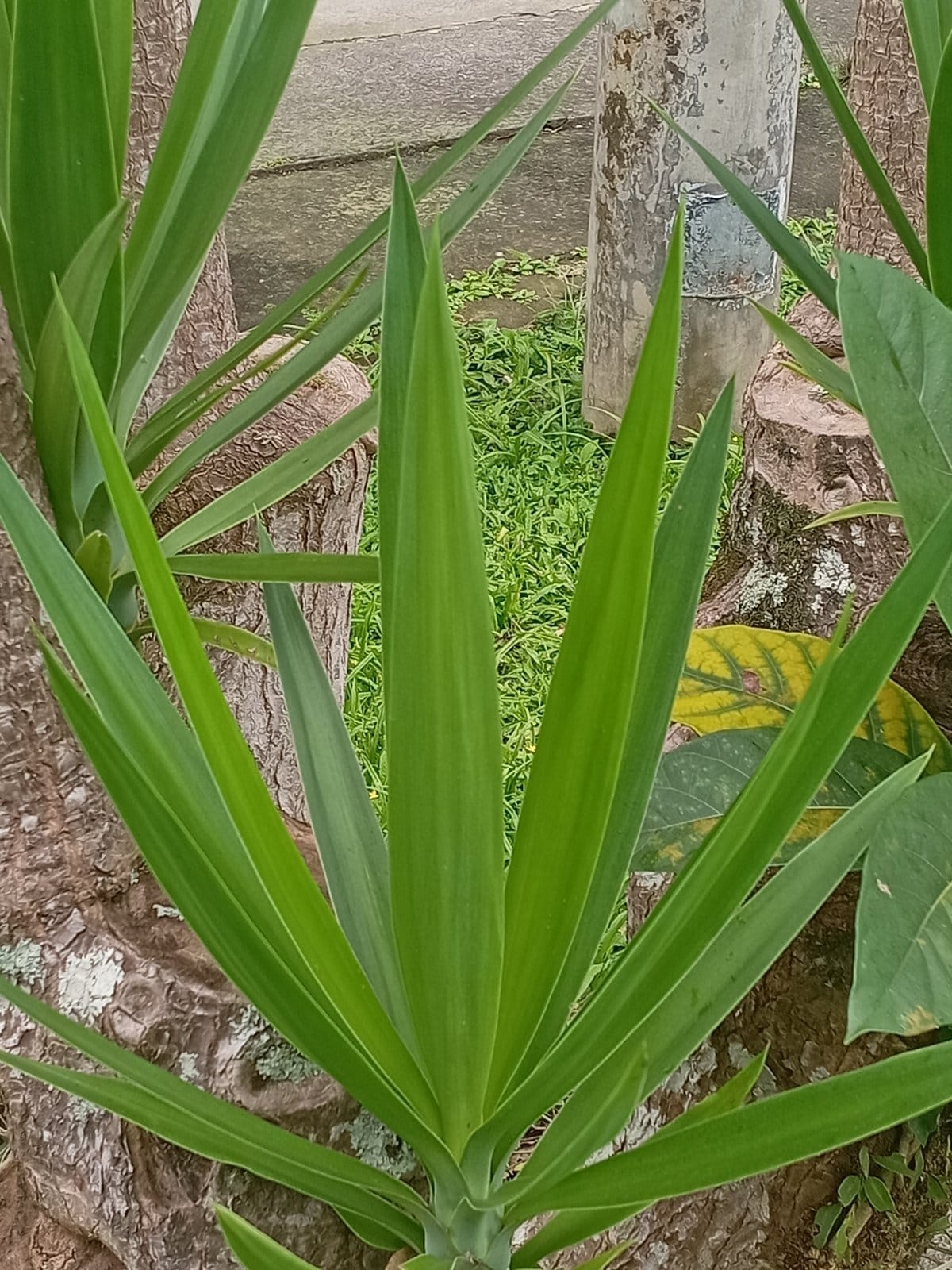
Leaves are borne in dense terminal rosettes of 30–60 leaves each. Individual leaves are strap-shaped to lanceolate, 60–120 cm long and 5–8 cm wide, leathery and somewhat flexible (unlike the rigid, dagger-like leaves of desert yuccas). The leaf color is deep glossy green. The leaf tip has a small, short spine that is softer than in other yucca species (hence "spineless yucca"), though it can still cause puncture wounds. Margins are smooth to minutely serrate.
Flowers
The flowers are the plant's most spectacular and culturally important feature. They are produced in massive, erect panicles (flower spikes) 60–150 cm tall that emerge from the center of each leaf rosette. Each panicle bears hundreds of individual bell-shaped, creamy-white to greenish-white flowers, each 4–6 cm long and 3–4 cm wide, pendant (hanging downward). The flowers are slightly fragrant, especially in the evening. Peak flowering occurs during the dry season, typically February–May in Costa Rica.
Fruit and Seeds
The fruit is a fleshy, oblong berry, 5–8 cm long and 3–5 cm wide, green when young and turning black when ripe. Each fruit contains numerous flat, black seeds 5–8 mm in diameter. Fruit production is variable and many cultivated specimens produce flowers but do not set fruit, possibly due to the absence of specific pollinators.
Geographic Distribution
Range in Costa Rica
In Costa Rica, Flor de Itabo is found throughout the Pacific slope and Central Valley, primarily as a cultivated plant rather than a truly wild species. It is most abundant in the rural landscapes of Guanacaste and the Nicoya Peninsula, where it forms living fence lines along pasture boundaries that can persist for decades. It is also commonly grown in home gardens in the Central Valley for its edible flowers.
The plant is less common on the Caribbean slope and in very wet, low-elevation areas, where excessive moisture can cause root rot. However, it grows successfully at higher elevations around the Central Valley (San José, Heredia, Cartago) up to approximately 2,000 meters.
Broader Distribution
Yucca guatemalensis is native to southeastern Mexico (Oaxaca, Chiapas, Veracruz, Yucatan), Guatemala, Belize, Honduras, El Salvador, and possibly Nicaragua and Costa Rica. It has been so widely cultivated for so long that its exact natural range is difficult to determine. The species is now grown throughout the tropics and subtropics worldwide and is one of the most popular indoor plants in temperate countries, sold as "Yucca Cane" in the houseplant trade.
Habitat & Ecology
Ecological Role
In its native and cultivated range, Flor de Itabo provides important ecological services:
- Pollinator resource: The large flower spikes produce abundant nectar and pollen during the dry season, supporting bees, bats, and other pollinators
- Habitat: Dense leaf rosettes provide shelter for small lizards, tree frogs, and invertebrates
- Erosion control: The dense root system stabilizes soil on slopes and riverbanks
- Living fence function: Provides habitat connectivity in agricultural landscapes, serving as biological corridors
Wildlife Associations
- Pollinators: Various bees, bats, and moths visit the flowers; yucca moths (Tegeticula) may be present but are not required for pollination in this species
- Birds: Orioles, tanagers, and hummingbirds visit flowering spikes
- Reptiles: Anoles and geckos shelter in leaf rosettes
- Insects: Various moth larvae feed on leaves and flowers
Ecological Adaptations
Flor de Itabo's success in dry environments is due to its succulent physiology:
- Water storage: Thick trunk and leaves store water for extended dry periods
- CAM photosynthesis: Capable of switching to Crassulacean Acid Metabolism under drought stress, opening stomata at night to reduce water loss
- Thick cuticle: Waxy leaf surface minimizes evapotranspiration
- Deep root system: Access to subsurface moisture
- Vegetative reproduction: Ability to regenerate from stem cuttings ensures survival even when above-ground portions are damaged
Uses & Applications
Edible Flowers
The most culturally important use of Flor de Itabo is as food. The flower buds and opened flowers are a beloved traditional food across Central America:
Preparation: Flowers are harvested before fully opening. The pistils and stamens are removed (they are bitter), and the petals are washed and boiled briefly to remove any residual bitterness. Prepared flowers are then used in various dishes:
- Tortitas de Izote: Flower petals mixed with egg batter and fried — a classic Salvadoran dish
- Revueltas con huevo: Flowers sautéed with scrambled eggs
- Sopas: Added to soups and stews as a nutritious vegetable
- Encurtidos: Pickled flower buds as a condiment
- Pupusas de Izote: Flowers used as stuffing in pupusas (El Salvador)
The flowers are nutritious, containing protein, vitamins (A, C, B-complex), minerals (calcium, iron), and fiber. They have a mild, slightly sweet flavor reminiscent of artichoke hearts.
Living Fences
Perhaps the most practical traditional use of Itabo is as living fence posts. Across rural Central America, the method is simple and remarkably effective:
- Cut trunk sections 1.5–2.5 m long
- Push the cut end 30–50 cm into the soil
- String barbed wire between living posts
- Posts root, leaf out, and become permanent living structures
These living fences can persist for 50–100+ years, requiring no replacement. They flower annually, providing food, and their roots help stabilize soil. This practice is a brilliant example of sustainable, low-cost agricultural infrastructure.
Sources: Useful Tropical Plants - Yucca guatemalensis↗, Tropicos taxon record↗, GBIF species profile↗
Cultural & Historical Significance
Flor de Itabo holds extraordinary cultural significance throughout Central America. In El Salvador, the Flor de Izote was declared the national flower in 1958, representing the country's natural heritage and resilience. The flower appears in Salvadoran art, poetry, and gastronomy.
In Costa Rica, the Itabo is inseparable from the rural landscape. Its presence along property lines, in home gardens, and at farmstead entrances reflects generations of practical horticultural wisdom. The plant symbolizes permanence and self-sufficiency — once planted, it endures for decades without any care, providing food and function.
Indigenous Uses
Pre-Columbian peoples of Mesoamerica cultivated and used yuccas extensively:
- Food: Flower consumption predates European contact by centuries
- Fiber: Leaf fibers extracted for rope, cloth, and sandals
- Soap: Root saponins used as natural soap and detergent
- Medicine: Root preparations used for arthritis, skin conditions, and inflammation
- Ritual: Associated with fertility and agricultural prosperity in some cultures
Modern Cultural Significance
Today, the Itabo remains a living symbol of Central American identity:
- Traditional recipes featuring Izote flowers are celebrated as intangible cultural heritage
- Commercially sold in Central American markets during flowering season
- Increasingly recognized in gourmet cuisine as an artisanal ingredient
- Living fence tradition recognized as a model of sustainable agriculture
Conservation Status
Yucca guatemalensis (also widely treated under the synonyms Y. gigantea Lem. and Y. elephantipes Regel ex Trel.) is currently Data Deficient (DD) on the IUCN Red List — the assessment reflects taxonomic uncertainty about the species' wild range, not a population concern. In cultivation, the species is abundant across Central America and far beyond, with extreme ease of propagation; living fences and edible-flower plantings ensure broad ex situ representation. Wild populations on rocky slopes and dry forests of southern Mexico and Guatemala are not known to be in decline, but rigorous wild-population data is what the DD status is asking for.
Growing Flor de Itabo
Site Selection
Choose a location with full sun to partial shade and well-drained soil. The plant is exceptionally tolerant of poor, rocky, and sandy soils but absolutely cannot tolerate waterlogged conditions. Allow adequate space for the mature plant's rosettes (2–3 m clearance) and consider the sharp leaf tips when choosing a location relative to walkways and play areas.
Propagation
Stem Cuttings (Primary Method): The easiest and most common method. Cut trunk sections of any size (from 30 cm to 2+ meters) and push into moist soil. Cuttings root readily in 4–8 weeks. Larger cuttings produce established plants more quickly. No rooting hormone needed. This is the method used for creating living fences.
From Seed: Seeds germinate in 4–6 weeks. Soak seeds 24 hours before planting. Start in well-drained seed mix. Seedlings grow slowly and take many years to reach landscape size. Seed propagation is primarily for genetic diversity in collections.
Planting and Care
- Stem cuttings can be planted year-round but root best at the start of the rainy season
- Water sparingly — overwatering is the primary cause of failure
- No fertilizer needed; excessive fertility can reduce the plant's natural character
- Remove dead lower leaves periodically for aesthetic purposes
- Trim sharp leaf tips if planted near walkways or areas with children
Companion Planting for Living Fences
- Fence-line backbone: Combine with Jocote and Madero Negro to build multi-species living fences that provide flowers, forage, and resilient boundary structure.
- Dryland orchard edges: Use Flor de Itabo on the windward side of small orchards to reduce heat stress on young fruit trees while keeping low irrigation demand.
- Pollinator and food matrix: Interplant with herbaceous species that benefit from partial shelter (for example culinary herbs and seasonal vegetables) near homestead systems.
- Avoid: Dense, shade-casting trees planted immediately south or west of Itabo rows in narrow spaces; reduced light lowers flowering and edible bud production.
Care Calendar
Pest and Disease Management
Flor de Itabo is remarkably pest-resistant. Issues are rare:
- Agave snout weevil (Scyphophorus acupunctatus): Can bore into the trunk crown, potentially killing the plant; remove and destroy affected material
- Scale insects: May appear on leaves; treat with horticultural oil
- Root rot (Phytophthora, Fusarium): Only in waterlogged soils; ensure excellent drainage
- Leaf spot fungi: Occasional in very humid conditions; remove affected leaves
Where to See Flor de Itabo
In Costa Rica
- Guanacaste Province: Living fence lines throughout rural areas
- Nicoya Peninsula: Traditional homesteads and property boundaries
- Central Valley: Home gardens and older residential neighborhoods
- San José parks: Occasionally planted as ornamental specimens
- Rural roads nationwide: Common along farm boundaries on the Pacific slope
Best Viewing Season
February through May, when the dramatic flower spikes emerge from the leaf rosettes. The peak is typically March–April. Visit during morning hours when the flowers are freshest. Central market towns may have fresh Itabo flowers for sale during this period.
Advanced Care Guidance
Site Design and Planting
- Plant in full sun with excellent drainage, especially on slopes or raised beds in high-rainfall zones.
- Maintain 2.5-3.5 m spacing to allow basal rosette expansion and flower-stalk development.
- Use mineral-rich, low-compaction soils; avoid persistently wet planting pits.
Watering Program
- Establishment (0-6 months): Moderate watering 1-2 times per week.
- After establishment: Water every 10-14 days in dry season; reduce sharply in rainy months.
- Critical rule: Do not overwater, as crown and root rot risk increases in saturated soils.
Fertilization Schedule
- Apply compost plus a low-nitrogen blend (8-12-12) at planting.
- Fertilize once at rainy-season onset and again in mid-season if growth is weak.
- Avoid frequent high-nitrogen feeding, which delays flowering and weakens leaf architecture.
Pruning and Structure
- Remove spent flower stalks after bloom to redirect energy to offsets and root reserve.
- Clean only dead or damaged leaves; avoid cutting healthy leaf rosettes.
- In ornamental plantings, maintain clear basal area for airflow and pest visibility.
Pest and Disease Management
- Monitor mealybugs, snails, and occasional leaf spot in shaded humid microclimates.
- Improve drainage and light exposure to reduce fungal pressure.
- Use manual removal and targeted biological controls before broad-spectrum treatments.
Companion Planting
- Recommended companions: Agaves, native grasses, Sardinillo, and other dry-forest-adapted nectar plants.
- Agroecological role: Supports pollinators and provides edible flowers in resilient home gardens.
- Avoid nearby: High-water tropical fruit species that require constant irrigation.
Seasonal Care Calendar (Costa Rican Conditions)
- Dry season (Dec-Apr): Minimal irrigation, weed suppression, and edible flower harvest planning.
- Early rains (May-Jul): Planting window, light fertilization, and offset management.
- Peak rains (Aug-Oct): Drainage supervision and rot surveillance.
- Transition (Nov): Sanitation cleanup and bloom-cycle preparation.
Growth Timeline and Harvest Notes
- Strong establishment within first year in sunny, drained sites.
- Flower stalk production generally begins between years 2-4 depending on moisture and fertility.
- Harvest edible flowers early in the morning for best texture and culinary quality.
Similar Species and Common Confusions
Key Distinction
Flor de Itabo is distinguished from other large-leaved rosette plants by the combination of: (1) a thick woody trunk that branches with age, (2) spineless leaf tips (safe to handle), (3) large showy white bell-shaped flowers in tall upright panicles, and (4) a strong tradition of eating the flowers in Costa Rican and Guatemalan cuisine. Cabuya (Furcraea) has dangerously sharp spine-tipped leaves and is grown for fiber, not food.
Field Identification Checklist
- Habitat: Dry forest edges, living fences, home gardens, roadsides (0-1,500 m, mainly Pacific slope)
- Growth form: Tree-like rosette plant 4-10 m tall with thick corky trunk, often branched
- Leaves: Sword-shaped, 50-100 cm long, in dense terminal rosettes; flexible, spineless tips
- Trunk bark: Corky, rough, grayish-brown; old leaf bases visible on younger trunks
- Inflorescence: Tall erect panicle (50-100 cm) of large white bell-shaped flowers
- Flower season: Primarily dry season (December-April); flowers open at night
- Fruit: Fleshy capsule 5-8 cm, oblong, green ripening to brown (rarely seen — many flowers harvested before fruiting)
- Cultural context: If near a home or kitchen garden, residents likely harvest the flowers for cooking
- Living fence: Often planted in rows as living fence posts — check for alignment with other fence plants
- Branching pattern: Older plants develop multiple rosette heads on branching trunks (candelabra effect)
Living Fence Establishment Protocol
Planning
- Spacing: 1.5-2.5 m between posts for a dense fence; 3-4 m for open silvopastoral boundaries
- Orientation: North-south rows maximize light capture for pasture grass between posts
- Material: Use stem cuttings 1-2 m long, 5-10 cm diameter (larger is better for survival)
Installation Steps
Advantages Over Dead Posts
- Self-renewing: living posts last decades vs. 3-5 years for treated wooden posts
- Produces edible flowers (income/food source)
- Supports pollinators (especially moths and bats)
- Carbon sequestration and microhabitat creation
- Low maintenance once established
Edible Flower Harvest and Preparation
Harvest Protocol
- Timing: Harvest flower buds and newly opened flowers in early morning before heat
- Selection: Choose buds just before opening or flowers open less than 24 hours
- Method: Cut flower stalks with clean knife; handle gently to avoid bruising
- Sustainability: Leave at least 40% of flower stalks for seed production and pollinator support
Traditional Preparation
- Removing bitterness: Remove pistils and any green parts; soak in salted water 15-30 minutes
- Classic recipe (flor de itabo en huevo): Batter-dipped flowers fried in oil — perhaps the most common preparation in Costa Rica
- Soup/stew ingredient: Add cleaned flowers to chicken or vegetable soups in the last 10 minutes of cooking
- Modern: Tempura-style, in salads, or as a pizza topping
Research Priorities in Costa Rica
- Pollinator ecology: Document moth and bat pollinator species visiting Itabo flowers at night; assess impact of flower harvesting on pollinator populations
- Nutritional analysis: Profile protein, vitamin, and mineral content of Itabo flowers for food security documentation
- Living fence performance: Compare Itabo fence longevity, carbon storage, and biodiversity support vs. other living fence species (Madero Negro, Indio Desnudo)
- Propagation optimization: Test hormone treatments and cutting sizes for maximum rooting success in different soil types
- Genetic diversity: Survey genetic variation among cultivated populations across Costa Rica — most plants are clonally propagated
- Sustainable harvest rates: Determine maximum flower harvest percentage that maintains plant vigor and seed production over 10+ years
- Ethnobotanical documentation: Record traditional knowledge of Itabo flower preparation, storage, and medicinal uses among rural communities before it is lost
External Resources
References
- Avendaño Arrazate, C. H., et al. (2018). Yucca in Mesoamerica: Diversity, uses, and conservation. Genetic Resources and Crop Evolution, 65, 1667–1684.
- García-Mendoza, A. J. (2011). Flora del Valle de Tehuacán-Cuicatlán. Agavaceae. UNAM.
- Lassetter, J. S., & Adcock, M. N. (2012). Taxonomic revision of Yucca guatemalensis. Phytologia, 94(1), 1–25.
- Holdridge, L. R., & Poveda, L. J. (1975). Árboles de Costa Rica. Centro Científico Tropical.
- Balick, M. J., & Cox, P. A. (1996). Plants, People, and Culture: The Science of Ethnobotany. Scientific American Library.
Safety Information Disclaimer
Safety information is provided for educational purposes only. Individual reactions may vary significantly based on age, health status, amount of exposure, and individual sensitivity. Always supervise children around plants. Consult a medical professional or certified arborist for specific concerns. The Costa Rica Tree Atlas is not liable for injuries or damages resulting from interaction with trees described in this guide.
• Always supervise children around plants
• Consult medical professional if unsure
• Seek immediate medical attention if poisoning occurs
Information compiled from authoritative toxicology sources, scientific literature, and medical case reports.
Help improve this page
Know something about this tree? Share local knowledge, suggest a correction, or submit a photo to improve this guide for everyone.