Rainbow Eucalyptus
Eucalyptus deglupta
Quick facts
Native Region
Philippines, Indonesia (Sulawesi, Seram), Papua New Guinea
Max Height
60-75 meters
Family
Myrtaceae
Conservation
VU — Vulnerable
Uses
Safety Information
Toxicity Details
Eucalyptus deglupta leaves contain low to moderate levels of eucalyptus oils (cineole and related terpenoids). Ingestion of large quantities of leaves could cause mild gastrointestinal upset in humans. The oils are not as concentrated as in temperate eucalyptus species. Overall human ingestion risk is low.
Skin Contact Risks
Contact with bark, leaves, and sap is generally non-irritating. The shedding bark is smooth and inert. Sawdust from milling can cause mild respiratory or skin irritation in workers without protective equipment. No significant dermatitis risk for casual contact.
Allergenic Properties
Pollen production is moderate and flower scent mild. Eucalyptus pollen is not a major allergen in most populations. Wood dust is a minor occupational irritant. Risk is low for general public interaction.
Structural Hazards
Rainbow Eucalyptus grows extremely fast and can develop brittle wood and weak branch attachments. Large branches may shed without warning, especially during storms or after drought stress. Very tall specimens pose significant structural risks in urban areas. Regular arborist inspections are essential for trees near buildings and paths.
Wildlife & Pet Risks
Eucalyptus oils in leaves and bark can be harmful to some animals if consumed in quantity. Koalas have evolved tolerance, but Costa Rican wildlife has not. Dense eucalyptus plantations can reduce native biodiversity; mixed planting with native species is recommended. Flowers do provide nectar for some pollinator species.
Season
Flowering
Feb-May
Fruiting
Jun-Sep
How to identify
Rainbow Eucalyptus (Eucalipto)
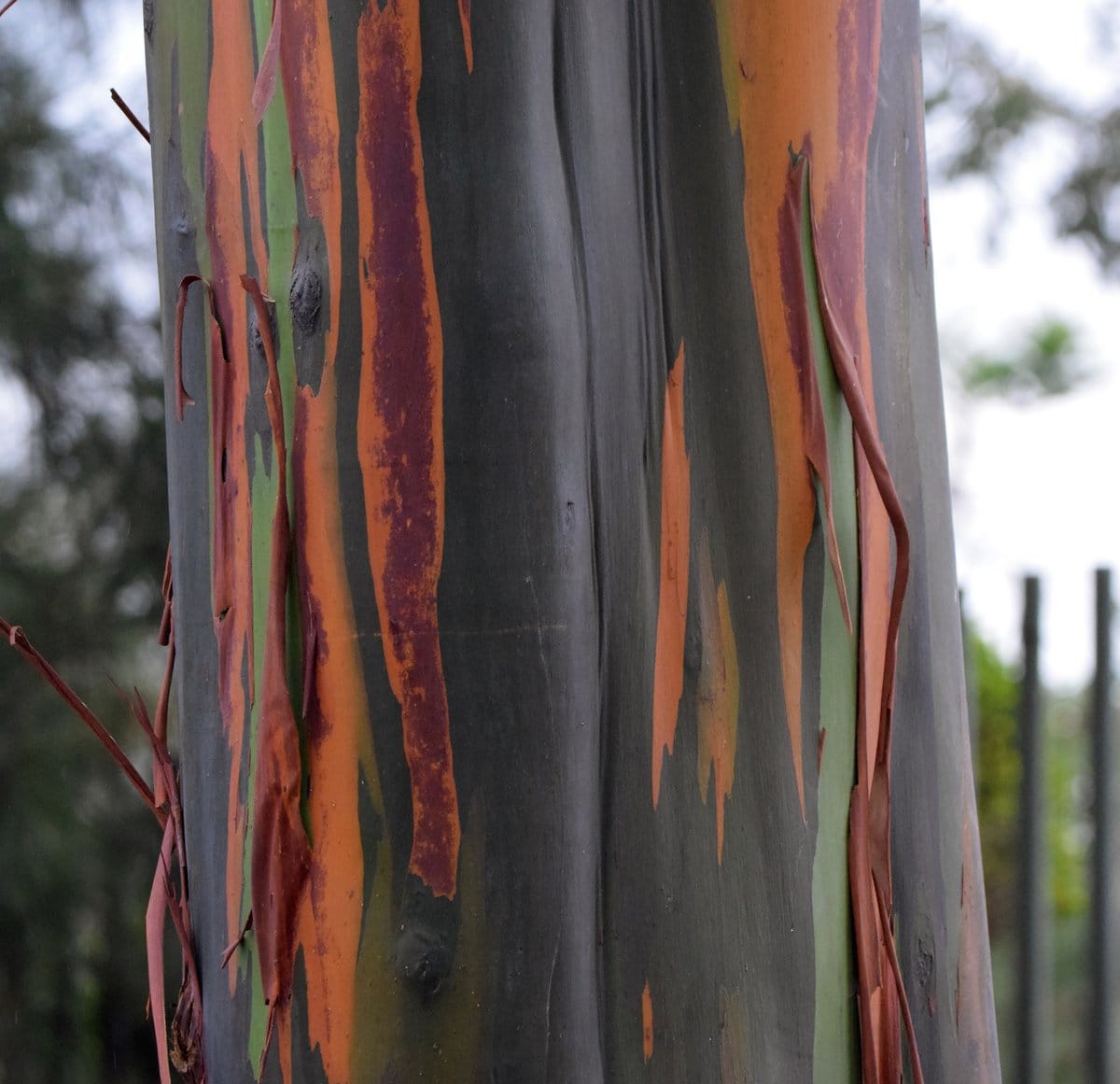
Rainbow Eucalyptus (Eucalyptus deglupta), known in Costa Rica as Eucalipto, is perhaps the most visually extraordinary tree on Earth. Its smooth bark peels in strips to reveal a stunning palette of green, blue, orange, maroon, and purple — a natural work of art. Unlike most eucalyptus species, this one is truly tropical, native to the rainforests of Southeast Asia. In Costa Rica, it graces botanical gardens, parks, and plantations across the humid lowlands.
Quick Reference
iNaturalist Observations
Community-powered species data
📸 Photo Gallery
Whole tree
📷 (c) Mike Stewart, some rights reserved (CC BY-NC)(CC BY-NC)
View source ↗Leaves
📷 (c) David Rankin, some rights reserved (CC BY-NC)(CC BY-NC)
View source ↗Bark
📷 (c) mkkennedy, some rights reserved (CC BY-NC)(CC BY-NC)
View source ↗Whole tree
📷 (c) A Emmerson, some rights reserved (CC BY-NC)(CC BY-NC)
View source ↗Leaves
📷 (c) David Rankin, some rights reserved (CC BY-NC)(CC BY-NC)
View source ↗Photos are linked from the iNaturalist community archive. Field verification and local attribution review are recommended before using images for printed educational assets.
Taxonomy & Classification
Geographic Distribution
Global Context
Eucalyptus deglupta is native to the islands of Mindanao (Philippines), Sulawesi and Seram (Indonesia), and parts of Papua New Guinea. Unlike most eucalyptus species confined to Australia, E. deglupta evolved in the equatorial rainforests of insular Southeast Asia. It has been planted across the wet tropics worldwide — in Hawaii, Central America, Brazil, West Africa, and India — primarily for pulpwood production and ornamental display.
Distribution in Costa Rica
In Costa Rica, Rainbow Eucalyptus appears in:
- Caribbean lowlands (Limón province — most extensive plantations)
- Southern Pacific lowlands (Osa Peninsula area, humid plantations)
- Central Valley botanical gardens (ornamental specimens at parks and estates)
- Northern Zone (experimental plantings in humid zones)
- University and institutional campuses (demonstration and educational plantings)
The species requires consistent humidity and is absent from the dry Pacific (Guanacaste) except where artificially irrigated.
Naturalization and Spread
Unlike some Australian eucalyptus species that become invasive in fire-prone landscapes, E. deglupta has shown limited naturalization tendency in Costa Rica. Its requirement for high rainfall and intolerance of drought and fire constrain its spread. However, monitoring in humid lowland forest edges is still recommended as a precaution.
Habitat & Ecology
Environmental Preferences
Unique Bark Ecology
The rainbow bark phenomenon occurs because E. deglupta continuously sheds its outer bark in thin strips throughout the year. Freshly exposed inner bark is bright green (photosynthetically active), then gradually matures through blue, purple, orange, and maroon as it ages and oxidizes. Because different strips shed at different times, the trunk displays a mosaic of colors simultaneously.
Ecological Functions
Ecological Concerns
Like other eucalyptus species, E. deglupta leaf litter contains compounds that can inhibit germination and growth of understory plants (allelopathy). This effect is generally milder than in Australian eucalyptus species but should be considered in mixed planting designs. High water consumption can also affect local water tables in dry periods.
Botanical Description
Uses & Applications
Ornamental and Landscape Use
Rainbow Eucalyptus is planted worldwide primarily for its bark display. In Costa Rica, it appears as a statement specimen in:
Industrial Pulpwood
Globally, E. deglupta is one of the most important tropical pulpwood species:
Additional Uses
Cultural & Economic Significance
Sources: FAO Forestry↗, Plants of the World Online (Kew) — Eucalyptus deglupta↗, GBIF — Eucalyptus deglupta↗
The Rainbow Bark as Cultural Icon
Rainbow Eucalyptus has become a social media and tourism phenomenon. Its bark is widely photographed and shared online, making it one of the most visually recognized tropical trees in the world. In Costa Rica, tourist-oriented botanical collections feature the species prominently.
Economic Context in Costa Rica
Conservation Status
Eucalyptus deglupta is assessed as Vulnerable (VU) by the IUCN Red List under criterion A2cd, reflecting population decline in its native Southeast Asian range from logging of old-growth lowland rainforest and habitat conversion. Costa Rican plantation populations are abundant and not threatened — the IUCN status applies to the species globally based on its wild range, not to introduced cultivated populations.
Conservation and Ethical Considerations
While E. deglupta plantations can rehabilitate degraded land and reduce pressure on native timber harvesting, they should not replace native forest ecosystems. In Costa Rica's wet lowlands, native species like Vochysia guatemalensis, Terminalia amazonia, and Carapa guianensis provide superior ecological value. Rainbow Eucalyptus is best positioned as a complement to — not a substitute for — native restoration.
Conservation Status
Status: Vulnerable (VU)
The current external biodiversity status used by the atlas audit maps Eucalyptus deglupta to Vulnerable rather than Least Concern in the public-facing status fields for this page. That precautionary status does not mean the species is rare in cultivation in Costa Rica; it reflects the GBIF-linked conservation signal currently returned for the species in the audit pipeline, so the atlas should surface VU consistently until that external assessment trail is reviewed again.
Sources: GBIF species profile — Eucalyptus deglupta↗, IUCN Red List search — Eucalyptus deglupta↗, Plants of the World Online (Kew) — Eucalyptus deglupta↗
Safety & Public Health Considerations
Household Safety Matrix
Pet Safety
Eucalyptus oils are toxic to cats and dogs. While E. deglupta has lower oil concentrations than temperate species, fallen leaves should be cleared from areas where pets graze or play. Symptoms of eucalyptus poisoning in pets include drooling, vomiting, diarrhea, and lethargy. Contact a veterinarian immediately if ingestion is suspected.
Structural Safety for Very Tall Trees
- Rainbow Eucalyptus can grow to enormous size rapidly
- Branch shedding ("limb drop") is a known eucalyptus trait
- Schedule annual arborist inspections for urban specimens
- Maintain adequate clearance from buildings, power lines, and paths
- Root plates may lift in shallow soils during storms
Cultivation Guide (Costa Rica)
The Rainbow Bark: Understanding the Science
The rainbow effect is not pigmentation in the traditional sense. It results from the physical interaction of light with different stages of bark tissue: chlorophyll (green), oxidized tannins (orange-brown), and structural color effects. The continuous asynchronous bark shedding creates the mosaic pattern.
Factors Affecting Bark Color Intensity
Identification Guide
Where to See Rainbow Eucalyptus in Costa Rica
External Resources
Observations, photos, and community identification records
Community science
Accepted taxonomy and global distribution
Royal Botanic Gardens, Kew
Global occurrence records and distribution data
GBIF
Global context for eucalyptus plantation management
FAO
Conservation status and species assessment
References
📚 Scientific References & Further Reading
Eldridge, K., Davidson, J., Harwood, C. & van Wyk, G. (1993). Eucalypt Domestication and Breeding. Oxford University Press
Jacobs, M.R. (1981). Eucalypts for Planting. FAO Forestry Series No. 11
Turnbull, J.W. & Pryor, L.D. (1984). Choice of Species and Seed Sources. In: Eucalyptus for Wood Production, CSIRO
CATIE (2003). Árboles de Centroamérica: un manual para extensionistas. CATIE, Turrialba, Costa Rica
Rainbow Eucalyptus is a tree that stops people in their tracks. Its natural bark mosaic is unmatched in the plant kingdom, and its extreme growth rate can transform degraded land in just a few years. In Costa Rica, it shines as an ornamental specimen and niche pulpwood species — a spectacular introduced complement to the country's extraordinary native tree diversity.
Safety Information Disclaimer
Safety information is provided for educational purposes only. Individual reactions may vary significantly based on age, health status, amount of exposure, and individual sensitivity. Always supervise children around plants. Consult a medical professional or certified arborist for specific concerns. The Costa Rica Tree Atlas is not liable for injuries or damages resulting from interaction with trees described in this guide.
• Always supervise children around plants
• Consult medical professional if unsure
• Seek immediate medical attention if poisoning occurs
Information compiled from authoritative toxicology sources, scientific literature, and medical case reports.
Help improve this page
Know something about this tree? Share local knowledge, suggest a correction, or submit a photo to improve this guide for everyone.