Anona Colorada
Annona purpurea
Quick facts
Native Region
Central America, Southern Mexico
Max Height
10-15 meters (33-49 feet)
Family
Annonaceae
Conservation
LC — Least Concern
Uses
Safety Information
CAUTION
Fruit flesh is SAFE and nutritious—rich in vitamin C, B vitamins, and antioxidants. Seeds are TOXIC—always remove completely before consumption. Never swallow seeds whole or chew them. Traditional medicinal uses of crushed seeds should only be done with expert guidance. Seeds contain annonacin and other acetogenins toxic to insects and harmful to humans and domestic animals if ingested. Teach children proper seed removal. Some researchers caution against excessive consumption of Annona fruits due to potential neurotoxic effects of acetogenins, though this primarily concerns seeds and concentrated extracts, not occasional fruit consumption.
Toxicity Details
Seeds contain toxic acetogenins (annonacin and related compounds) and MUST NEVER be eaten. While the fruit flesh is safe and delicious, seeds are poisonous and can cause severe gastrointestinal distress, vomiting, and neurological symptoms if consumed. Like other Annona species, seeds have been traditionally used as insecticides and fish poison, demonstrating their toxicity. Children must be carefully supervised and taught to spit out all seeds when eating the fruit. Remove all seeds before giving fruit to children. The toxic acetogenins in seeds are water-soluble and can leach into surrounding tissue if seeds are crushed.
Skin Contact Risks
No skin irritation reported. Fruit flesh and skin are safe to handle. The creamy flesh can stain hands slightly but washes off easily.
Allergenic Properties
No significant allergenic compounds identified in fruit flesh. Rare cases of oral sensitivity have been reported in individuals allergic to other tropical fruits. The fruit is generally well-tolerated.
Structural Hazards
No structural risks. This is a medium-sized tree with moderately strong branching. Branches are flexible and rarely break. The spreading crown provides good shade but does not pose hazards.
Wildlife & Pet Risks
Seeds are toxic to most domestic animals including dogs, cats, and birds. Monkeys, bats, and some wild birds naturally consume the fruit and disperse seeds safely, but pets should not be allowed access to seeds. Fruit pulp is generally safe for wildlife.
First Aid & Emergency Response
• If ingested, seek immediate medical attention. Do not induce vomiting unless directed by medical professional.
• If sap contacts skin, wash immediately with soap and water. Seek medical attention if blistering or severe irritation occurs.
• If sap enters eyes, flush immediately with clean water for 15 minutes and seek emergency medical care.
Costa Rica Emergency: 911
Costa Rica Poison Control: 2223-1028
Season
Flowering
Mar-Jun
Fruiting
Jul-Nov
How to identify
Anona Colorada (Red Custard Apple)
The Anona Colorada (Annona purpurea), also called Soncoya or Red Custard Apple, is a magnificent wild fruit tree native to the wet lowland forests of Central America. This lesser-known member of the Annona family produces remarkably large fruits—often exceeding 20 cm in diameter—with distinctive red-purple flesh that gives the tree its Spanish name "colorada" (reddish). While less cultivated than its relatives (guanábana and common anona), the Anona Colorada is prized by those who know it for its sweet, aromatic flesh with subtle floral notes. In Costa Rica, the tree grows naturally in Pacific and Caribbean lowland forests and occasionally appears in local markets during its season, commanding premium prices.
Quick Reference
iNaturalist Observations
Community-powered species data
📸 Photo Gallery
Whole tree
📷 (c) Dom Bozhor, some rights reserved (CC BY-NC)(CC BY-NC)
View source ↗Leaves
📷 (c) Francisco Mendoza, some rights reserved (CC BY-NC)(CC BY-NC)
View source ↗Whole tree
📷 (c) Francisco Mendoza, some rights reserved (CC BY-NC)(CC BY-NC)
View source ↗Leaves
📷 (c) Eduardo Chacón Madrigal, some rights reserved (CC BY)(CC BY)
View source ↗Whole tree
📷 (c) Marco Acuña, some rights reserved (CC BY-NC)(CC BY-NC)
View source ↗Photos sourced from iNaturalist's community science database. Browse all observations →↗
Taxonomy and Classification
- Annona: From Taíno "anón" (indigenous Caribbean fruit name) - purpurea: Latin for "purple" (referring to the reddish-purple flesh color)
- Colorada: Spanish for "reddish" (the most common Costa Rican name) - Soncoya: Indigenous Mexican name still used in parts of Central America
Common Names
The Annona Family in Costa Rica
The genus Annona includes approximately 170 species worldwide, with several growing naturally or cultivated in Costa Rica. A. purpurea is one of the less-cultivated wild species that deserves wider recognition.
The name "anona" is used loosely in Costa Rica for multiple Annona species. A. purpurea is specifically called "anona colorada" (red anona) due to its distinctive reddish flesh. Always check the flesh color and fruit size—A. purpurea fruits are notably larger (15-25 cm) than common anona (A. reticulata, 8-15 cm) and have red-purple rather than white-cream flesh.
Physical Description
General Form
The Anona Colorada is a medium-sized deciduous to semi-deciduous tree with a broad, spreading crown. It grows naturally in the understory and mid-canopy of wet tropical forests but reaches full stature in open areas. The tree has a straight to slightly crooked trunk and develops a relatively open, wide-spreading canopy with age.
Identification Features
Bark and Trunk
- Bark color: Gray-brown to dark brown
- Texture: Smooth when young, becoming slightly rough and fissured with age
- Branching: Open, spreading habit; lateral branches grow horizontally
- Form: Usually single-trunked; trunk diameter 20-40 cm at maturity
- Lenticels: Prominent on young branches
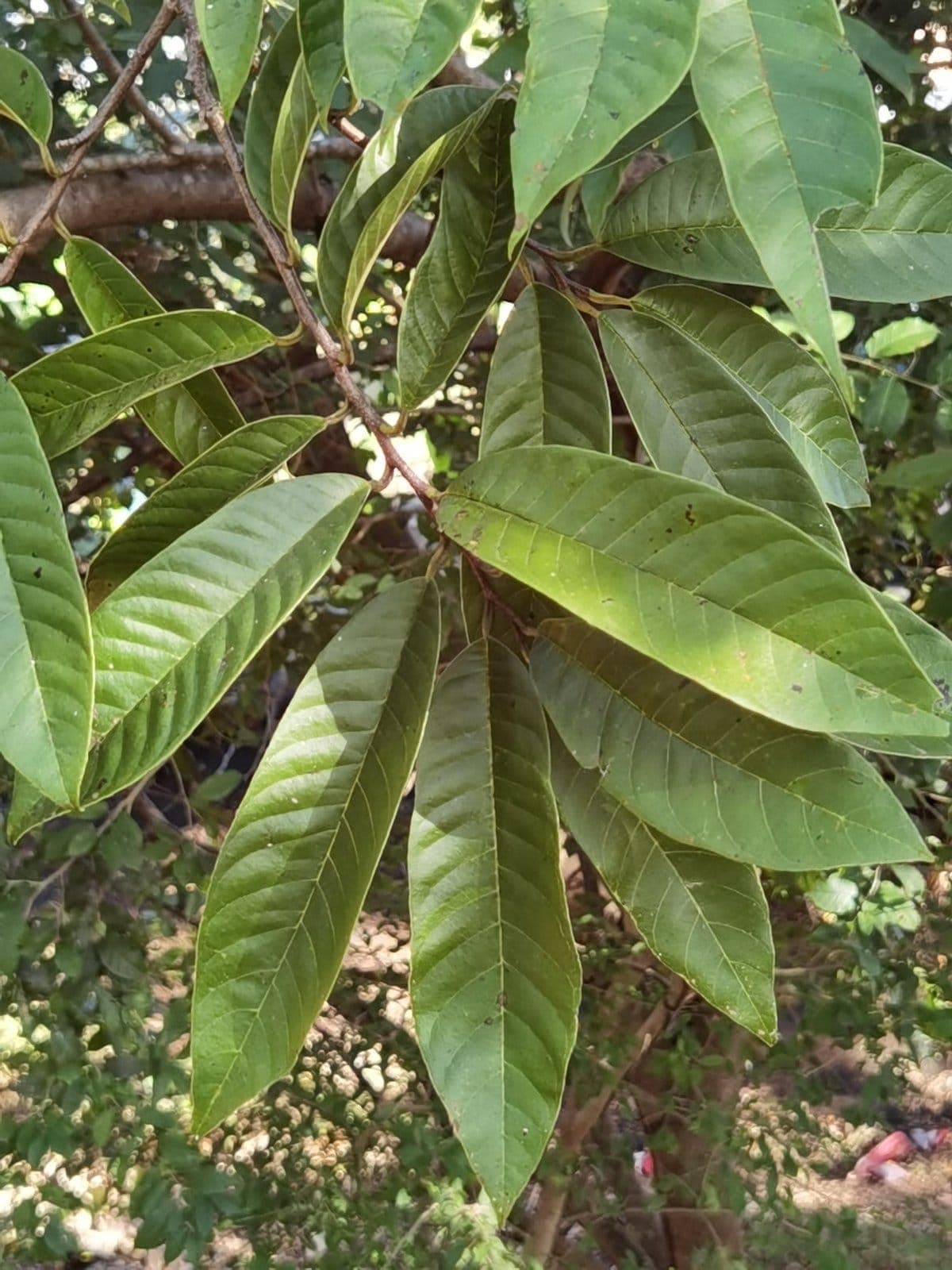
Leaves
- Type: Simple, alternate arrangement
- Shape: Oblong to elliptic-lanceolate
- Size: 15-30 cm long, 5-10 cm wide (larger than common anona)
- Texture: Leathery, slightly pubescent (hairy) on underside when young
- Color: Dark green above, paler beneath
- Venation: Prominent midrib and lateral veins
- Petiole: Short, 5-10 mm
- Leaf drop: Briefly deciduous during dry season
Flowers
- Location: On trunk and older branches (cauliflorous) or in leaf axils
- Size: 3-4 cm long, larger than common anona flowers
- Color: Greenish-yellow to yellow-brown, fleshy thick petals
- Structure: 3 outer petals (thick, triangular), 3 inner petals (smaller)
- Fragrance: Strong, sweet, slightly fruity (attracts beetle pollinators)
- Timing: March-June, sometimes sporadically year-round in wet areas
- Pollination: Primarily beetles; hand pollination improves fruit set
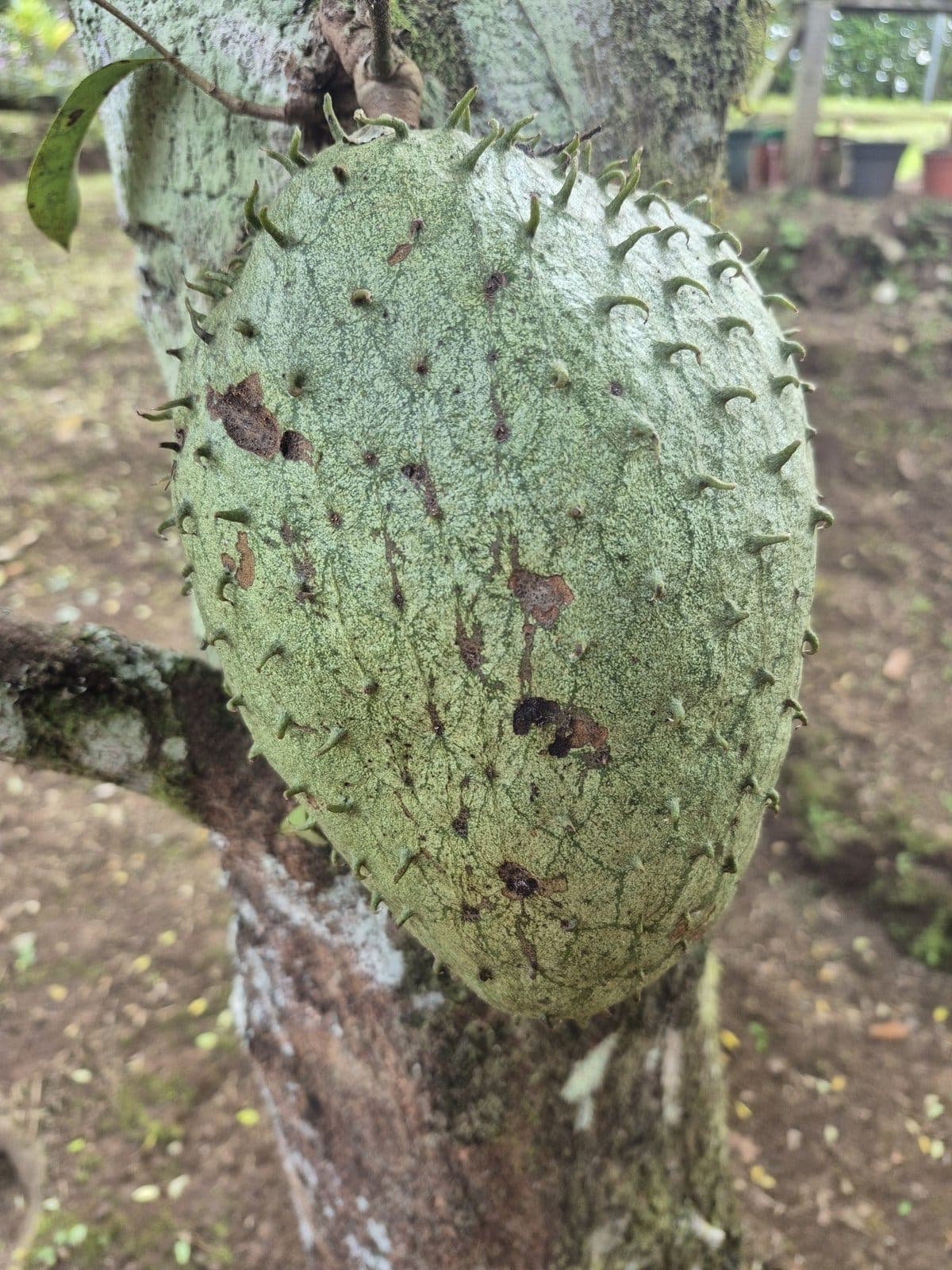
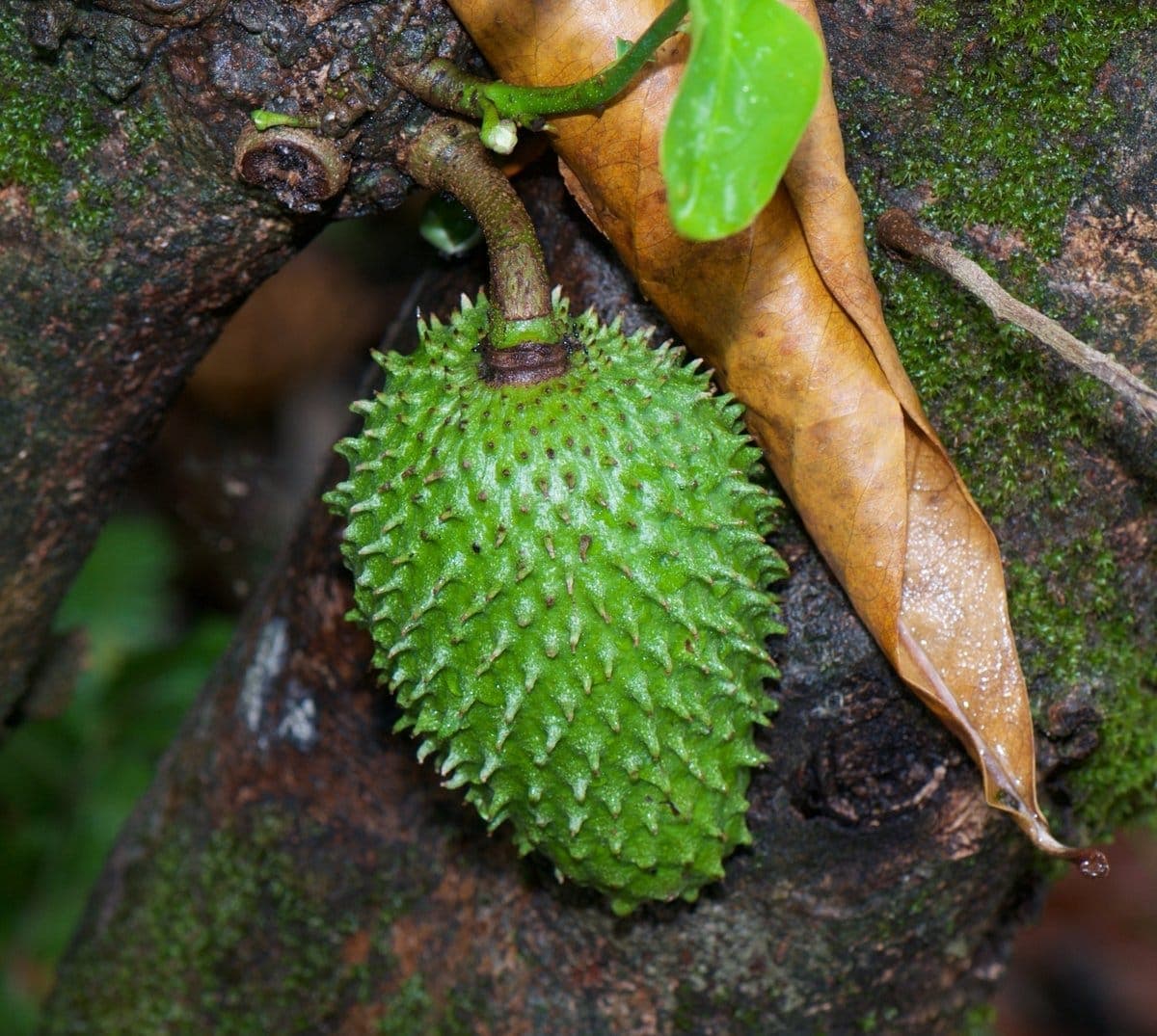
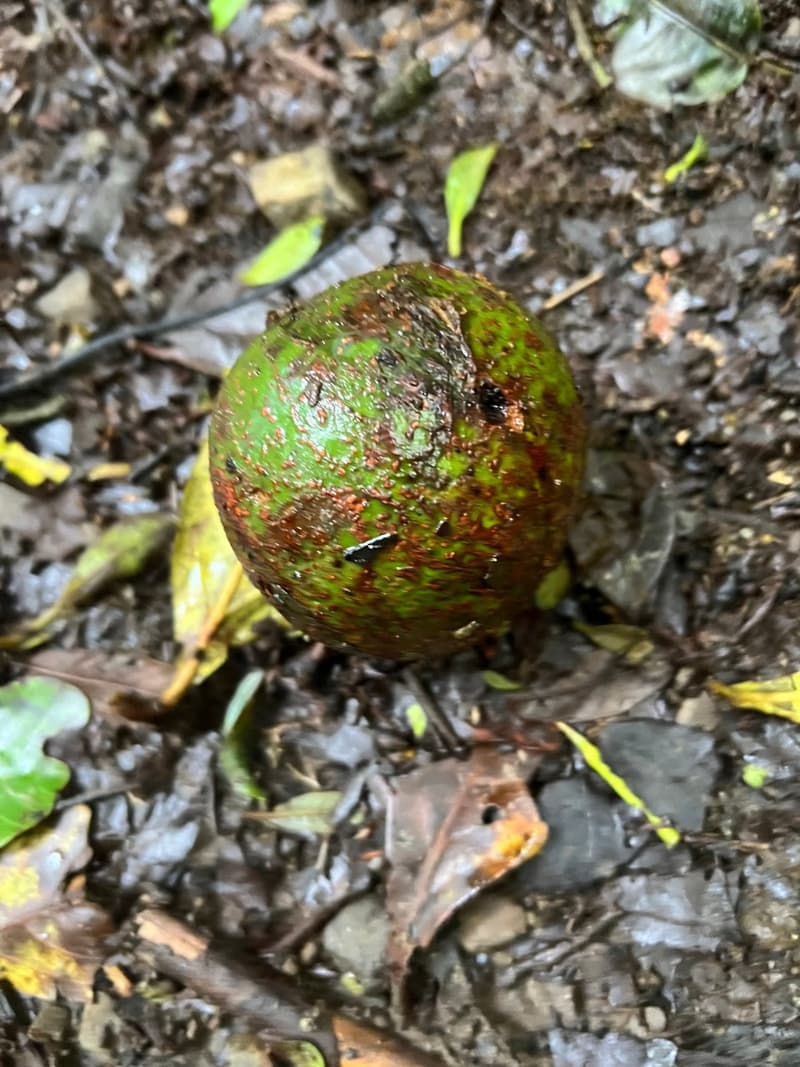
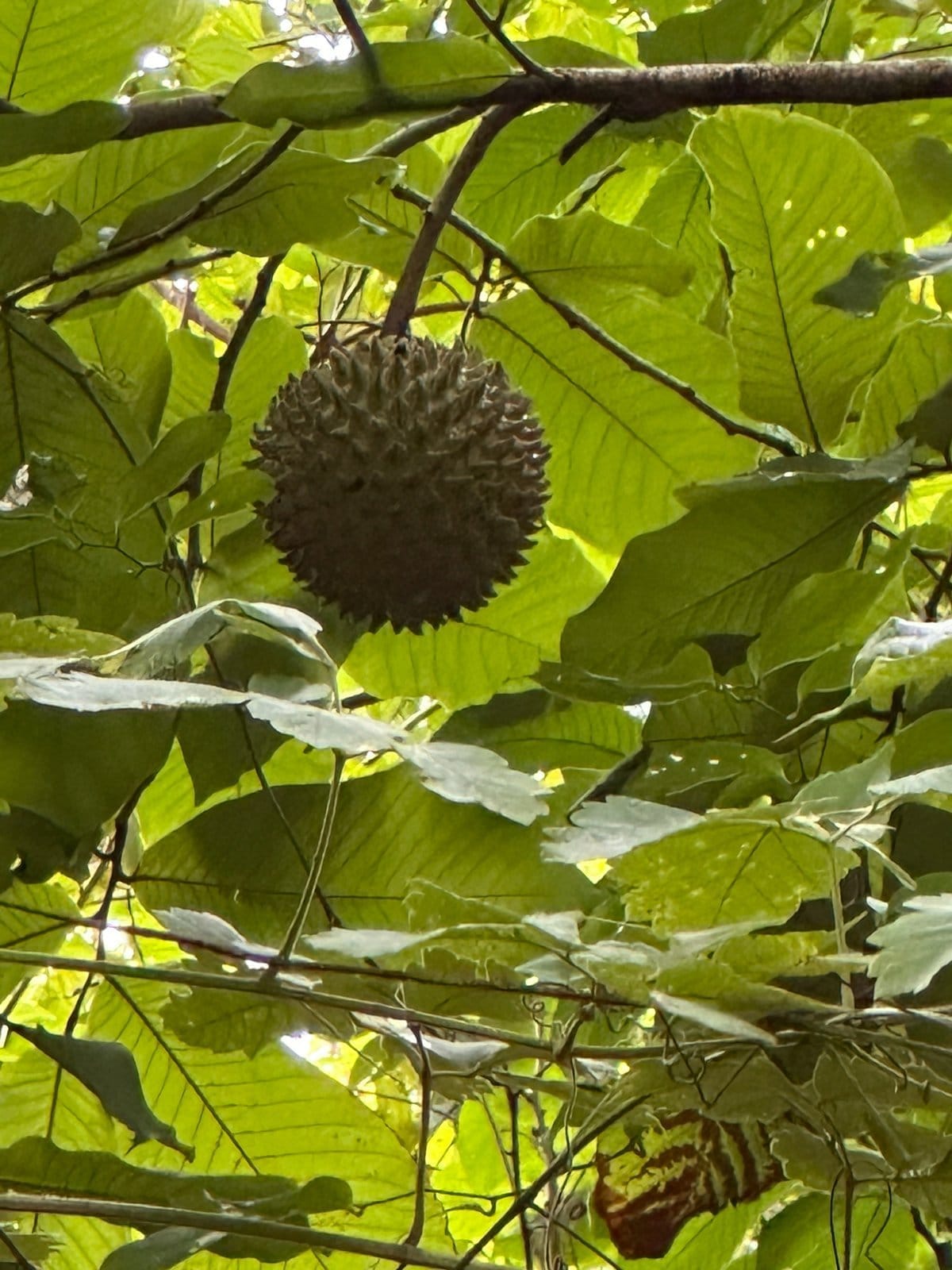
Fruit (KEY IDENTIFIER)
- Shape: Globose to ovoid (round to egg-shaped), NOT heart-shaped like A. reticulata
- Size: 15-25 cm diameter (LARGE—much bigger than common anona)
- Weight: Typically 1-2 kg, occasionally 3 kg
- Skin: Smooth to slightly warty (areoles visible), purplish-brown when ripe
- Flesh color: RED-PURPLE TO DEEP PINK (distinctive feature, hence "colorada")
- Flesh texture: Soft, creamy, custard-like with some fiber
- Seeds: Black, numerous (50-200+), embedded in flesh, arranged in segments
- Taste: Sweet with floral, slightly acidic notes; aromatic
- Aroma: Strong, tropical fruit scent when fully ripe
Ripe fruit characteristics:
- Color change: Green → purplish-brown to dark brown
- Softness: Yields to gentle thumb pressure (like a ripe avocado)
- Fragrance: Strong, sweet tropical aroma noticeable from distance
- Skin: Areoles (segments) slightly separate, skin may show cracks
- Harvest timing: Pick when fruit just begins to soften; will finish ripening off tree
Handle carefully—ripe fruits bruise easily and attract fruit flies! Harvest slightly underripe if fruit flies are a problem.
Geographic Distribution
Native Range
Distribution in Costa Rica
Annona purpurea occurs naturally in wet tropical lowland forests on both the Pacific and Caribbean slopes, though it is more common on the Pacific side. It is not as widely cultivated as other Annona species but can be found in home gardens, agroforestry systems, and local markets.
Elevation and Climate
Elevation Range
- Optimal: 0-600 m
- Range: 0-1200 m
- Upper limit: Rarely above 1200 m; prefers warm lowlands
Climate Requirements
- Temperature: 24-32°C (75-90°F) year-round
- Rainfall: 2000-4000+ mm annually (WET climates)
- Seasonality: Prefers consistent moisture; tolerates short dry season
- Humidity: High (70-90%)
Habitat Preferences
- Forest type: Wet tropical forests, rainforest
- Light: Understory to canopy
- Soil moisture: Consistently moist
- Disturbance: Tolerates moderate disturbance, secondary forests
Conservation Status
- IUCN: Least Concern (LC)
- Threats: Habitat loss from deforestation
- Population trend: Stable but declining locally
- Cultivation: Could benefit from wider cultivation
While Annona purpurea is not currently threatened globally, it is becoming less common in Costa Rica due to conversion of wet lowland forests to agriculture (especially palm oil and pineapple plantations). The species benefits from protection in reserves like Corcovado National Park and from planting in agroforestry systems.
Ecology and Habitat
Forest Role
Annona purpurea plays an important role in wet tropical forest ecosystems as a mid-canopy fruiting tree that provides food for wildlife during its extended fruiting season (July-November).
Ecological Functions
- Food source: Fruits feed monkeys, bats, birds, coatis, agoutis
- Seed dispersal: Large seeds dispersed by mammals (monkeys, tapirs in intact forests)
- Pollinator support: Flowers provide food for beetle pollinators
- Canopy layer: Contributes to forest structure
- Pioneer potential: Can establish in secondary forests
Wildlife Interactions
Pollinators:
- Nitidulid beetles (primary pollinators)
- Other beetle species attracted to fermenting flower scent
- Hand pollination often needed in cultivation
Seed Dispersers:
- White-faced capuchin monkeys
- Howler monkeys
- Coatis (Nasua narica)
- Agoutis (Dasyprocta punctata)
- Fruit-eating bats
- Crested guans and other large birds
Reproductive Biology
Like other Annona species, A. purpurea has a two-stage pollination process called protogyny:
- Female phase (2-3 hours early morning): Stigmas are receptive; flower is slightly open and emits strong, sweet scent to attract beetles. Temperature inside flower increases slightly.
- Male phase (next day or later same day): Stamens release pollen; flower opens wider.
This mechanism promotes cross-pollination but can result in poor fruit set without abundant beetle pollinators. In cultivation, hand pollination dramatically improves yields. Collect pollen from male-phase flowers in early morning and apply to receptive stigmas of female-phase flowers using a soft brush.
Soil and Water Relations
Unlike some Annona species that tolerate dry seasons, A. purpurea is adapted to WET tropical climates and performs poorly in areas with extended dry periods unless heavily irrigated.
Traditional and Modern Uses
Culinary Uses
The Anona Colorada is primarily valued for its edible fruit, which is consumed fresh or used in beverages.
How to Prepare and Eat Anona Colorada
Selection:
- Choose fruits that yield slightly to pressure
- Avoid fruits with dark spots or mold
- Ripe fruits have strong aromatic scent
Preparation:
- Allow fruit to ripen at room temperature until soft (1-3 days if picked slightly underripe)
- Refrigerate ripe fruit if not eating immediately (best eaten cold)
- Cut fruit in half or into quarters with sharp knife
- Scoop out red-purple flesh with spoon
- CRITICAL: Remove and discard all black seeds as you eat—seeds are TOXIC
Tips:
- The flesh stains hands and clothing pink/red—wash promptly
- Texture improves when fruit is chilled
- Can freeze flesh (without seeds) for later use in smoothies
- Slightly underripe fruit is less sweet but still pleasant
- Overripe fruit ferments quickly—eat promptly
Nutritional Profile
Traditional Medicine
In traditional medicine systems of Central America, various parts of Annona purpurea have been used, though scientific validation is limited.
Fruit pulp (no seeds): Considered nutritious and safe; no medicinal claims beyond general health benefits of fresh fruit.
Seeds (TOXIC): Traditionally crushed and used externally as:
- Insecticide for crop pests
- Fish poison for traditional fishing (now illegal)
- Head lice treatment (extremely cautious external use only)
Bark and leaves: Limited traditional use; some reports of decoctions for digestive issues (not scientifically validated).
IMPORTANT: Do NOT attempt traditional medicinal uses without expert guidance. Seeds are POISONOUS if ingested. Modern medicine offers safer alternatives for all conditions traditionally treated with Annona preparations.
Modern Research Interest
Recent scientific research on Annona species, including A. purpurea, focuses on:
- Acetogenin compounds: Found in seeds, leaves, and bark; showing potential anticancer and pesticidal properties in laboratory studies
- Antioxidant activity: Fruit flesh contains phenolic compounds with antioxidant effects
- Antimicrobial properties: Extracts from leaves and seeds show activity against some pathogens
- Neurotoxicity concerns: Excessive consumption of Annona seeds or concentrated extracts may be linked to atypical Parkinsonism in some populations (primarily concerning habitual consumers of seed-containing preparations, not occasional fruit consumption)
While A. purpurea has potential pharmaceutical applications, casual fruit consumption (with seeds properly removed) poses no identified health risks and provides nutritional benefits.
Conservation Status
Not Evaluated
IUCN Red List Status
Current Status
Threats
- Habitat loss: Conversion of wet lowland forests to agriculture (oil palm, pineapple, cattle pasture) reduces wild populations
- Limited cultivation: Not widely planted compared to other Annona species; genetic diversity in cultivation is limited
- Market demand: Limited commercial market may reduce incentive for cultivation and conservation
- Seed disperser decline: Reduction in monkey and large bird populations affects natural regeneration
Conservation Recommendations
In Situ Conservation
- Protected areas: Ensure presence in wet forest reserves
- Habitat restoration: Include in reforestation projects
- Wildlife corridors: Maintain connectivity for seed dispersers
- Sustainable harvesting: Promote harvest of wild fruits without harming trees
Ex Situ Conservation & Cultivation
- Germplasm banks: Collect seeds/grafts from diverse populations
- Agroforestry: Promote planting in shade-grown coffee and cacao systems
- Home gardens: Encourage cultivation in suitable climates
- Market development: Increase demand to incentivize planting
One of the most effective ways to conserve Annona purpurea is to promote its cultivation in appropriate climates. Planting trees in home gardens, agroforestry systems, and community orchards:
- Preserves genetic diversity outside wild populations
- Provides income/food security for farmers
- Reduces pressure on wild trees
- Creates appreciation for the species
If you live in a wet tropical lowland area, consider planting an Anona Colorada!
Sources: IUCN Red List↗, GBIF species profile↗, iNaturalist observations↗, Useful Tropical Plants↗
Growing Guide
Is Anona Colorada Right for Your Site?
Annona purpurea is NOT for everyone. Success requires:
✅ Warm tropical climate (24-32°C year-round, no frost)
✅ High rainfall or irrigation (2000+ mm/year, consistently moist)
✅ Wet lowland conditions (0-1200m elevation)
✅ Patience (4-6 years from seed to first fruit)
❌ Will NOT thrive in:
- Dry climates without heavy irrigation
- Areas with cool winters
- Highland areas above 1200m
- Locations with hard freezes or frosts
If your area has a pronounced dry season, choose Annona reticulata (common anona) or A. muricata (guanábana) instead—they tolerate drought better.
Propagation
From Seed (Most Common)
Advantages: Easy, inexpensive, widely accessible
Disadvantages: Slow to fruit (4-6 years), variable fruit quality
Process:
- Collect seeds from ripe, high-quality fruit
- Clean pulp from seeds immediately (ferment overnight if needed)
- Plant FRESH within 1-2 weeks (viability drops rapidly)
- Plant 1-2 cm deep in well-draining potting mix
- Keep warm (25-30°C) and moist
- Germination: 30-60 days (can be slow and erratic)
- Transplant seedlings when 20-30 cm tall
Seed storage: Seeds lose viability within weeks; DO NOT dry seeds—plant fresh or store in moist medium for short periods only.
Grafting (Recommended for Improved Quality)
Advantages: Faster fruiting (3-4 years), consistent fruit quality
Disadvantages: Requires skill, rootstock, and scion material
Rootstocks:
- Annona glabra (Pond Apple): Tolerates wet, heavy soils; good vigor
- Annona muricata (Guanábana): Good compatibility, disease resistance
- Annona reticulata (Common Anona): Moderate success
Grafting methods:
- Cleft grafting (most common)
- Veneer grafting
- Budding (shield budding)
Timing: Best during active growth (early wet season)
Air Layering
Possible but labor-intensive; roots develop in 2-3 months on healthy branches. Results in larger plants faster than seeds but is time-consuming.
Site Selection and Planting
Planting Steps:
- Timing: Plant at start of rainy season (May-June in Costa Rica) or year-round with irrigation
- Site prep: Clear weeds in 2 m radius around planting site
- Hole: Dig 60 cm x 60 cm x 60 cm; mix excavated soil with 2-3 buckets of compost
- Planting depth: Plant at same depth as in container; don't bury trunk
- Water: Water deeply immediately after planting
- Mulch: Apply 10-15 cm thick organic mulch in 1.5 m radius (keep mulch 10 cm away from trunk to prevent rot)
- Stake: Stake young trees if windy; remove stakes after 6-12 months
Care and Maintenance
Watering
Unlike some Annona species, A. purpurea does NOT tolerate drought well. Consistent moisture is ESSENTIAL for good growth and fruit production.
- Young trees (0-3 years): Water 2-3 times per week, more in dry weather
- Established trees: Water deeply once per week in rainy season, 2-3 times per week in dry season
- Fruiting season: Increase watering—consistent moisture improves fruit size and prevents fruit drop
- Mulching: Maintain thick (10-15 cm) organic mulch layer to retain moisture
Fertilization
Organic options: Compost, aged manure, bone meal, rock phosphate, wood ash (for potassium)
Pruning
- Young trees (0-3 years): Train to central leader or open vase shape; remove crossing branches
- Mature trees: Prune annually (late dry season/early wet season) to:
- Maintain desired height (3-4 m for easier harvest)
- Improve air circulation (reduces anthracnose)
- Remove dead, diseased, or crossing wood
- Thin dense canopy to allow light penetration
- Fruiting wood: Flowers form on older wood and trunk; don't over-prune
Hand Pollination (Recommended for Best Yields)
Hand Pollination Technique
Why hand pollinate?: Beetle pollinators may be scarce in cultivation, resulting in poor fruit set. Hand pollination can double or triple yields.
Steps:
- Identify female-phase flowers (early morning, 6-8 AM): Slightly open, strong scent, stigmas visible and moist/receptive
- Collect pollen: Find male-phase flowers (more open, stamens shedding yellow pollen). Collect pollen on soft brush or Q-tip.
- Transfer pollen: Gently brush pollen onto stigmas of female-phase flowers
- Timing: Pollinate in early morning when flowers are most receptive
- Repeat: Do this daily during flowering season for best results
Results: Properly pollinated flowers develop into fruits within weeks. Not all pollinated flowers will set fruit—some natural drop is normal.
Pests and Diseases
Harvesting
Timing: July-November (peak August-October in Costa Rica)
Indicators of readiness:
- Fruit begins to soften slightly (yields to gentle thumb pressure)
- Skin color darkens from green to purplish-brown
- Strong aromatic fragrance
- Areoles (fruit segments) may start to separate slightly
Harvest method:
- Use pruners to cut stem (don't pull or twist—damages tree and fruit)
- Harvest when fruit JUST begins to soften
- Can harvest slightly underripe—will ripen off tree in 1-3 days
- Handle gently—bruises easily
Post-harvest:
- Ripen at room temperature if harvested slightly underripe
- Refrigerate ripe fruit if not eating immediately (keeps 2-3 days)
- Wash hands after handling—flesh can stain skin pink/red
Expected yield: Mature tree (10+ years) can produce 50-150 fruits per year, depending on care, pollination success, and climate.
Agroforestry and Companion Planting
Annona purpurea fits well into diverse agroforestry systems in wet tropical lowlands.
Suitable Systems
- Shade-grown coffee: Provides shade and fruit; requires pruning to manage shade levels
- Cacao agroforestry: Medium-sized shade tree; non-competitive root system; nitrogen-fixing companions (Inga spp.) recommended
- Home gardens: Ornamental and productive; medium size suits home landscapes
- Living fences and borders: Can be planted along property lines; needs space
- Multi-story fruit orchards: Integrates with shorter trees (citrus, sapote) and taller timber species
Good Companion Plants
In agroforestry, pair A. purpurea with nitrogen-fixing trees (especially Inga species) to improve soil fertility and support long-term productivity. The combination of fruit trees + nitrogen fixers + understory crops creates a resilient, productive system.
Comparison with Related Species
Annona purpurea is often confused with other Annona species. Here's how to distinguish them:
Key Differences in Costa Rican Annona Species
The easiest way to distinguish A. purpurea from other species: cut open the fruit. The distinctive red-purple flesh is unique to A. purpurea among Costa Rican Annona species. Additionally, A. purpurea fruits are generally larger than A. reticulata and rounder (less heart-shaped).
Where to See Anona Colorada in Costa Rica
Annona purpurea is less commonly encountered than its cultivated relatives, but can be found:
Wild/Natural Areas
- Corcovado National Park (Osa Peninsula): Occurs naturally in wet lowland forests
- Piedras Blancas National Park (Osa Peninsula): Wet forests
- Tortuguero National Park (Caribbean): Occasionally in wet forests
- Carara National Park: Transition forest areas
- Private reserves in wet lowland regions often have wild trees
Cultivated Settings
- Home gardens in Pacific wet lowlands (around Golfito, Puerto Jiménez, Palmar Sur)
- Caribbean lowlands (Talamanca, Limón) in small-scale agroforestry
- San Carlos region (northern lowlands): Occasionally planted
- Local fruit markets during season (August-October): Ask for "anona colorada" or "soncoya"
Botanical Collections
- CATIE (Centro Agronómico Tropical de Investigación y Enseñanza) (Turrialba): Likely present in tropical fruit collections (confirm before visiting)
- Universidad de Costa Rica (Finca Experimental): May have specimens
The best way to experience Annona purpurea is to visit local fruit markets in the Osa Peninsula (Puerto Jiménez, Golfito) or Limón/Talamanca regions during the fruiting season (August-October). Ask vendors for "anona colorada"—they'll know it by the red flesh. Another option: seek out small fincas and ask farmers—many know where wild trees grow.
Cultural Significance and Traditional Knowledge
Indigenous and Local Knowledge
Annona purpurea has been used by indigenous peoples of Central America for centuries, though specific traditional knowledge varies by region.
- Food source: Valuable wild fruit collected during fruiting season
- Medicinal use: Limited documented traditional medical use (primarily seeds as external parasite treatment—dangerous)
- Fish poison: Seeds traditionally used to stun fish in rivers (now generally illegal)
- Name origins: "Soncoya" is an indigenous Nahuatl-origin word still used in Mexico and parts of Central America
In Costa Rican Culture
While not as culturally prominent as guanábana or common anona, A. purpurea is appreciated by rural communities familiar with it:
- Seasonal treat: Eaten fresh when encountered during fruiting season
- Local markets: Commands premium prices due to scarcity and distinctive flavor
- Home remedy: Some preparation of fruit (not seeds) as nutritious food for convalescence (no documented medicinal properties beyond nutrition)
In Costa Rica, Annona purpurea is known primarily to rural farmers, foragers, and fruit enthusiasts rather than being a widely cultivated commercial crop. This obscurity makes it a delightful discovery for those who encounter it!
Sources: iNaturalist observations↗, GBIF species profile↗, Liaw et al. (2010)↗, Cordell et al. (1995)↗
Advanced Care Guidance
Site Design and Planting
- Establish in warm, humid lowland or premontane sites with 6-8 m spacing for airflow and pollinator movement.
- Prioritize deep, organic-rich soils with reliable drainage; avoid compacted planting pits and prolonged standing water.
- Plant at rainy-season onset (May-June) and protect juvenile trunks from weed competition and browsing damage.
Watering Program
- Establishment (0-8 months): Deep watering 2 times per week during dry intervals.
- Juvenile phase (8-24 months): Water every 7-10 days during strong dry-season heat.
- Mature trees: Maintain moderate moisture through flowering and fruit fill; avoid severe drought stress.
Fertilization Schedule
- At planting, incorporate compost plus a low-dose starter blend (10-30-10) to support root development.
- Apply balanced fertilizer (15-15-15) at early and mid rainy season for stable canopy and fruit set.
- Add potassium-forward support (12-8-20) late rainy season to improve fruit quality and sugar-acid balance.
Pruning and Structure
- Formatively prune in years 1-3 to maintain a strong central framework and manageable harvest height.
- Remove crossing, shaded, or diseased branches after major harvest windows.
- Keep canopy open enough for beetle pollinator activity and reduced fungal pressure.
Pest and Disease Management
- Monitor for fruit flies, anthracnose, and scale insects during humid periods.
- Remove fallen or damaged fruit quickly to reduce reinfestation pressure.
- Combine sanitation pruning with mulch renewal and biological controls before chemical treatments.
Companion Planting
- Recommended companions: Cacao, guaba species, poro, banana, and pollinator-attracting herbs.
- Agroforestry role: Mid-canopy fruit tree for diversified humid tropical systems with staggered harvests.
- Avoid nearby: Highly competitive shallow-rooted grasses and species requiring prolonged drought.
Seasonal Care Calendar (Costa Rican Conditions)
- Dry season (Dec-Apr): Supplemental irrigation, mulch maintenance, and structural scouting.
- Early rains (May-Jul): Main planting window, fertilization, and formative pruning.
- Peak rains (Aug-Oct): Disease monitoring, drainage checks, and careful fruit sanitation.
- Transition (Nov): Light pruning, soil amendment, and planning for next flowering cycle.
Growth Timeline and Harvest Notes
- Trees usually begin bearing in years 3-5 under warm, humid conditions.
- Productive canopies stabilize around years 6-8 with regular nutrition and light management.
- Harvest at full physiological maturity to maximize flavor while minimizing post-harvest breakdown.
External Resources
Global biodiversity occurrence data and distribution maps
Community observations and photos
References and Further Reading
Scientific Literature
-
Taxonomic References:
- Fries, R. E. (1939). Revision of the Genus Annona. Acta Horti Bergiani.
- Rainer, H. (2007). Monographic studies in the genus Annona L. (Annonaceae): Inclusion of the genus Rollinia A.St.-Hil. Annalen des Naturhistorischen Museums in Wien.
-
Ethnobotany and Traditional Use:
- Sousa, O. V., et al. (2010). Antifungal activity of Annona species. Molecules.
- Cordell, G. A., et al. (1995). Medicinal plants and traditional medicine in Latin America. Fitoterapia.
-
Phytochemistry and Pharmacology:
- Liaw, C. C., et al. (2010). Annonaceous acetogenins from the leaves of Annona purpurea. Journal of Natural Products.
- McLaughlin, J. L. (2008). Paw paw and cancer: Annonaceous acetogenins from discovery to commercial products. Journal of Natural Products.
-
Cultivation and Horticulture:
- Crane, J. H., & Pena, J. E. (2020). Annona Species (Atemoya, Sugar Apple, and Soursop). University of Florida IFAS Extension.
- Nakasone, H. Y., & Paull, R. E. (1998). Tropical Fruits. CAB International.
Online Resources
- iNaturalist: Annona purpurea observations↗
- Tropicos (Missouri Botanical Garden): Taxonomic database for Annona purpurea
- Useful Tropical Plants Database: Annona purpurea↗
- CATIE (Costa Rica): Tropical fruit research and germplasm collections
Conservation Status
- IUCN Red List: Annona purpurea assessment↗ (Listed as Least Concern)
Summary
Identification: Medium tree (10-15 m) with large (15-25 cm) round fruits and distinctive red-purple flesh—the easiest identifying feature.
Ecology: Native to wet tropical lowlands (0-1200m) of Central America; requires consistently moist conditions and does NOT tolerate drought well. Important wildlife food source.
Uses: Prized edible fruit eaten fresh or in beverages; sweet, aromatic flavor with floral notes. Seeds are TOXIC—must be removed before consumption.
Cultivation: Requires warm, wet tropical climate with high rainfall or irrigation. Moderate difficulty; benefits from hand pollination to improve fruit set. Suitable for wet-climate home gardens and agroforestry.
Conservation: Least Concern (LC) but declining locally due to habitat loss. Wider cultivation could support conservation and provide income.
Why grow it?: Delicious, distinctive fruit; medium-sized tree suitable for home gardens in suitable climate; under-cultivated species with commercial potential. A hidden gem for wet tropical regions!
Document Information:
- Last Updated: January 22, 2025
- Content Status: Complete
- Bilingual Pair: Anona Colorada (Spanish)
- Scientific Review: Community-contributed content; please report errors or suggest improvements
Safety Information Disclaimer
Safety information is provided for educational purposes only. Individual reactions may vary significantly based on age, health status, amount of exposure, and individual sensitivity. Always supervise children around plants. Consult a medical professional or certified arborist for specific concerns. The Costa Rica Tree Atlas is not liable for injuries or damages resulting from interaction with trees described in this guide.
• Always supervise children around plants
• Consult medical professional if unsure
• Seek immediate medical attention if poisoning occurs
Information compiled from authoritative toxicology sources, scientific literature, and medical case reports.
Help improve this page
Know something about this tree? Share local knowledge, suggest a correction, or submit a photo to improve this guide for everyone.