Palma Suita
Geonoma congesta
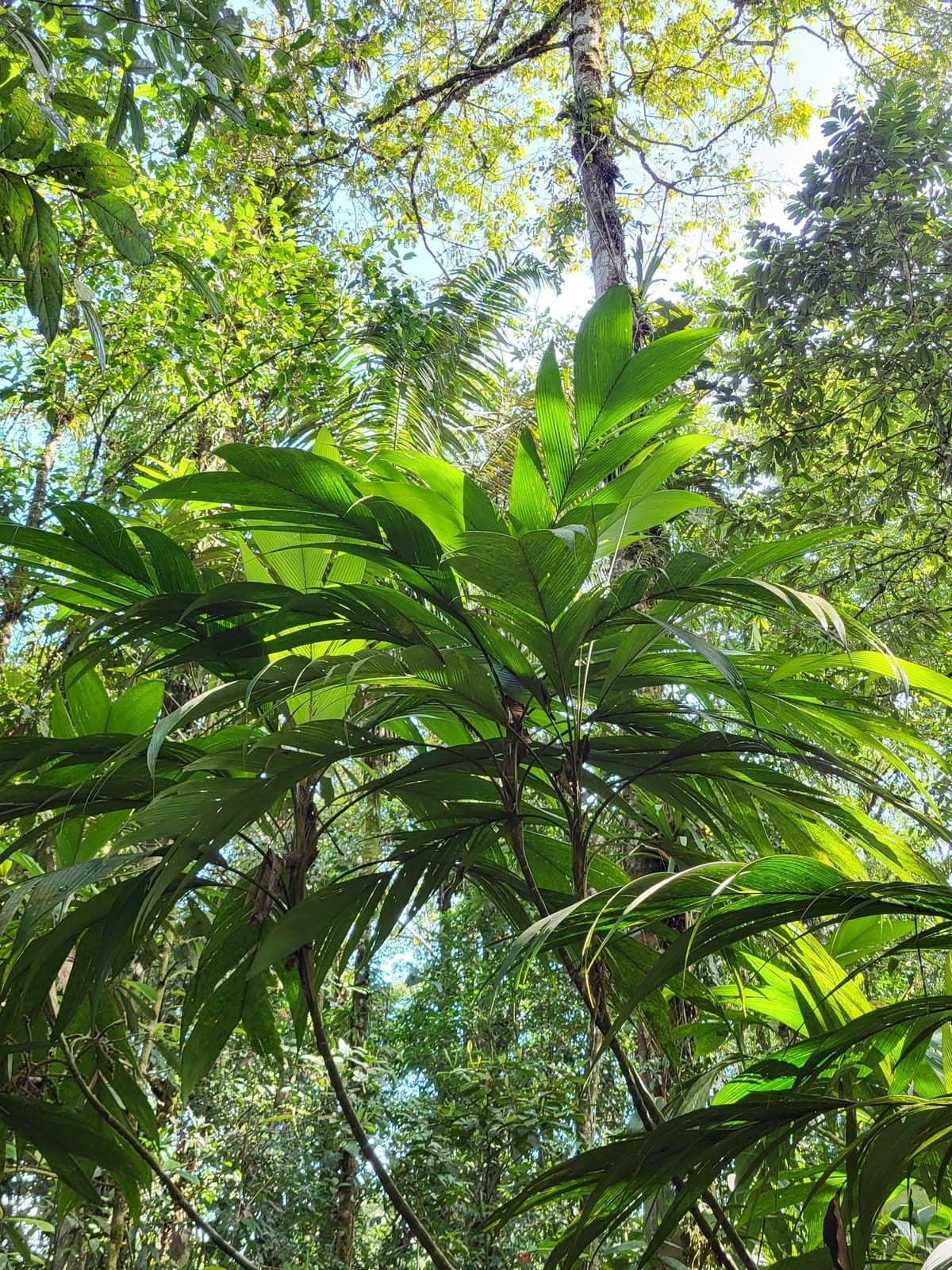
Quick facts
Native Region
Central America (Honduras to Panama)
Max Height
2-6 meters (7-20 feet)
Family
Arecaceae
Conservation
LC — Least Concern
Uses
Safety Information
Toxicity Details
Geonoma congesta is completely non-toxic. The small, round, black or dark purple fruits are edible though not typically consumed by humans — they are bland and thin-fleshed. All parts of the plant (leaves, trunk, roots) are chemically inert and safe. No toxic compounds have been identified. The palm heart is technically edible but tiny and not worth harvesting.
Skin Contact Risks
Low skin contact risk. The leaves and trunk are smooth and unarmed — no spines, thorns, or irritating hairs. The leaf surfaces are waxy but non-irritating. The small petioles are smooth. This is one of the most touchable palms in the forest. No dermatological reactions have been reported from handling any part of this palm.
Allergenic Properties
Low allergen risk. Flowers are small and primarily insect-pollinated, producing minimal airborne pollen. Not a significant allergen source. No cross-reactivity concerns.
Structural Hazards
Negligible structural risks. This is a small palm (2-6 m tall) with lightweight leaves and tiny fruits. No risk of falling branches or dangerous fruit. The slender trunk is not strong enough to cause damage if it falls. One of the safest palms structurally.
Wildlife & Pet Risks
Completely safe for all wildlife. Fruits are an important food for small birds (tanagers, manakins) and small terrestrial mammals. The palm harbors no toxic or irritating compounds.
Season
Flowering
Jan-Jun
Fruiting
Jun-Nov
How to identify
Palma Suita (Suita Palm)
Palma Suita (Geonoma congesta) is the quiet beauty of Costa Rica's forest understory. While giant Raphia palms hold world records and royal palms line grand avenues, the modest Suita Palm thrives in the darkest corners of the rainforest — one of the most shade-tolerant palms on Earth. Its graceful, sometimes undivided leaves and slender trunk create an elegant silhouette in the dim understory light. For centuries, rural communities have harvested its leaves for thatching, making the Suita one of the most culturally important understory palms in Central America.
Quick Reference
Key Information
📸 Photo Gallery
Overview
Geonoma congesta belongs to one of the largest and most complex genera of New World palms. The genus Geonoma contains around 60-70 species, nearly all of which are small understory palms of tropical forests. They are notoriously difficult to identify because their leaf shape varies dramatically — even within a single species, leaves may be simple (undivided), bifid (split into two), or irregularly divided into several segments of different sizes.
The Suita Palm is one of the most common and widespread Geonoma species in Central America, found from Honduras south through Costa Rica and into Panama. In Costa Rica, it is abundant in tropical wet forests on both the Caribbean and Pacific slopes, from sea level up to about 1,400 meters. It is one of the most frequently encountered understory palms in the country — a familiar companion on any forest trail through wet lowland or premontane forest.
The common name "suita" comes from the Huetar indigenous language and has been adopted throughout Costa Rica to refer to several small palm species used for thatching. Geonoma congesta is the principal "suita" palm in most regions. The leaves have been used for centuries to thatch the roofs of traditional rural houses, ranches, and shelters. A well-made suita-leaf roof can last 5-8 years and provides excellent waterproofing and insulation in the humid tropics.
One of the most remarkable features of G. congesta is its extreme shade tolerance. It thrives in light levels that would stress most other plants — the deep, filtered light beneath the closed canopy of primary rainforest. This adaptation makes it an ideal candidate for deeply shaded tropical gardens, where few other ornamental plants will grow.
📸 Photo Gallery
Whole tree
📷 (c) salzgurke, some rights reserved (CC BY-NC)(CC BY-NC)
View source ↗Leaves
📷 (c) salzgurke, some rights reserved (CC BY-NC)(CC BY-NC)
View source ↗Whole tree
📷 (c) James Ojascastro, some rights reserved (CC BY-NC-SA)(CC BY-NC-SA)
View source ↗Leaves
📷 (c) salzgurke, some rights reserved (CC BY-NC)(CC BY-NC)
View source ↗Whole tree
📷 no rights reserved(CC0)
View source ↗Photos sourced from iNaturalist's community science database. Browse all observations →↗
Taxonomy and Classification
Common Names by Region
Taxonomic Notes
Geonoma is one of the most taxonomically challenging palm genera due to extreme morphological plasticity. Leaf shape, which is usually a reliable identification character in palms, varies widely within Geonoma species — individual plants of the same species may have simple, bifid, or pinnately divided leaves depending on age, light conditions, and genetics. G. congesta is among the more distinctive species, tending toward robust, often pinnately divided leaves, but even this species shows considerable variation. Several subspecies have been described but their validity is debated.
Physical Description
Growth Form
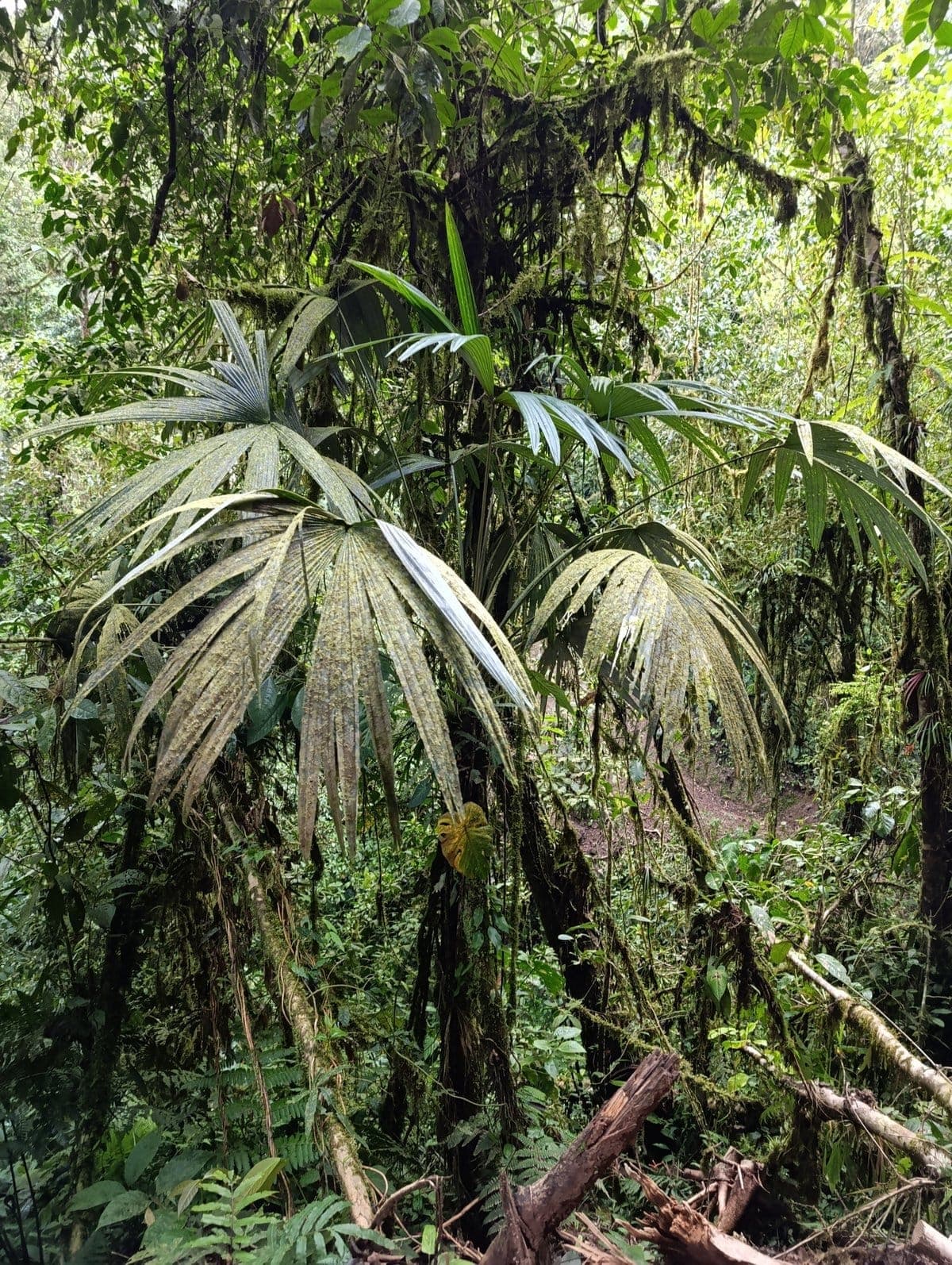
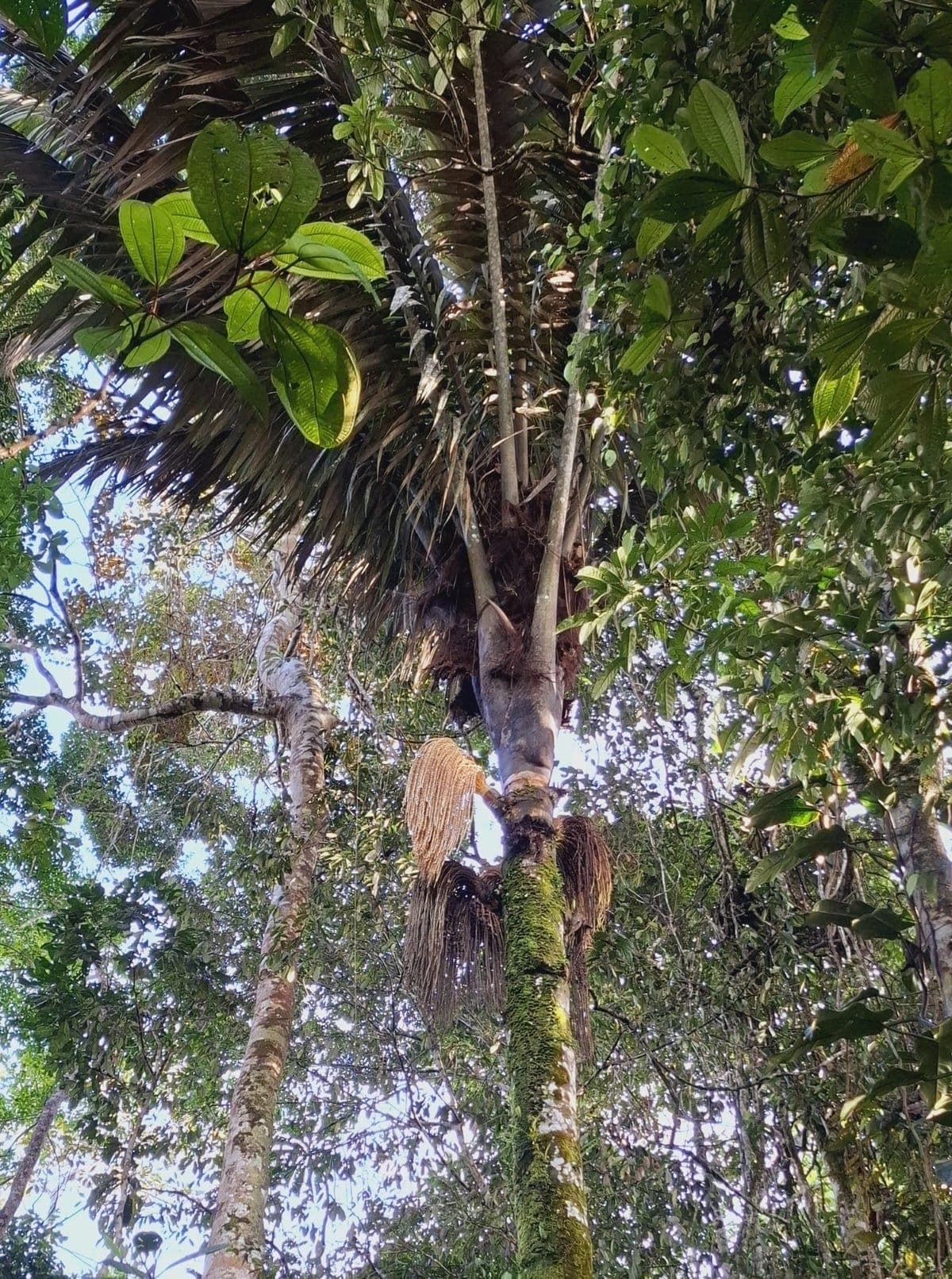
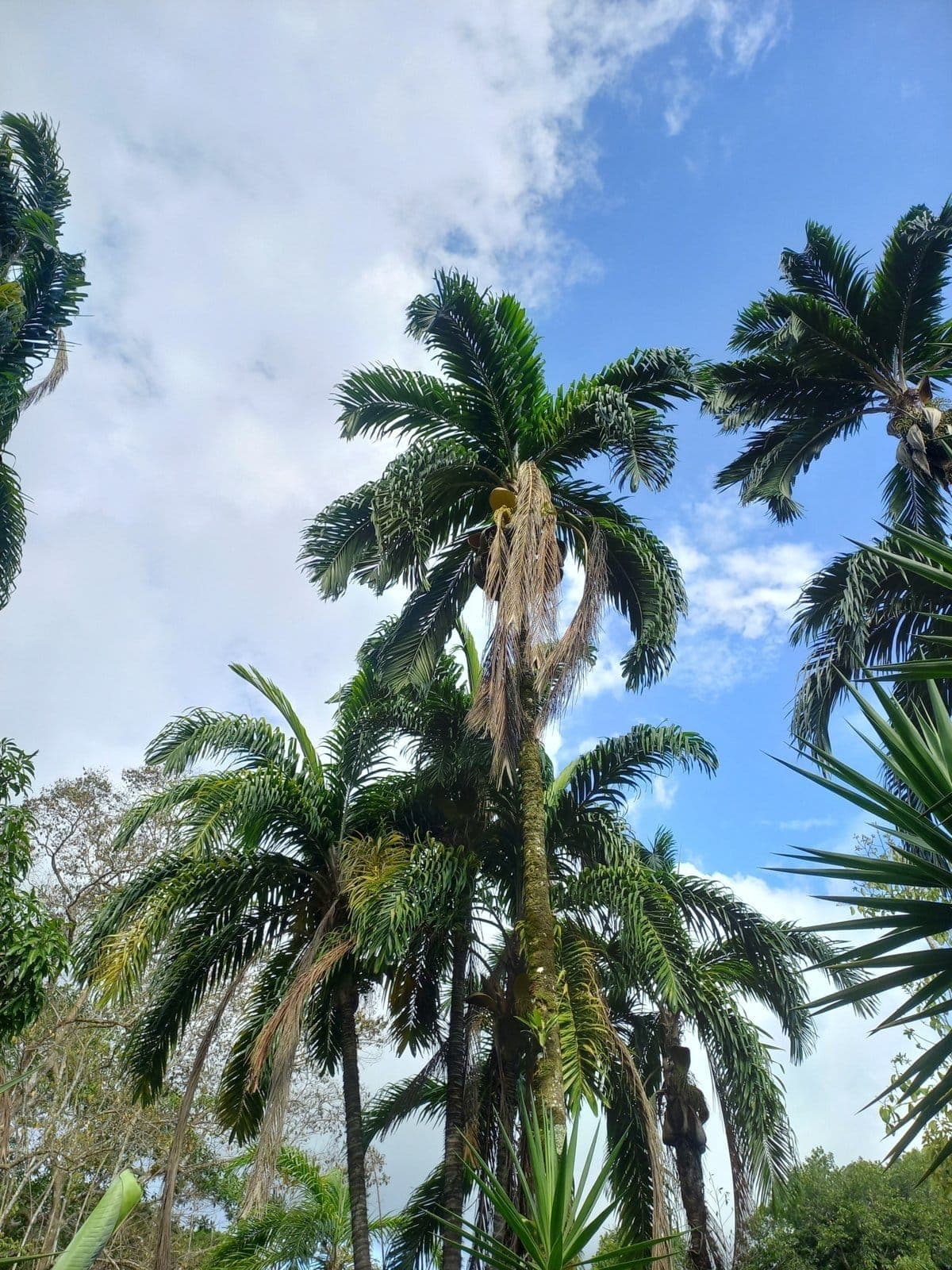
The Suita Palm is a small, slender, single-stemmed understory palm with an elegant, almost delicate appearance. The overall form is simple: a thin, smooth, ringed trunk topped by a loose crown of 6-15 leaves that arch gracefully outward. The palm rarely exceeds 6 meters in height under forest canopy and is often much shorter (2-4 m).
Trunk
The trunk is remarkably slender — only 2-5 cm in diameter — smooth, green when young aging to gray-brown, and prominently marked with leaf scar rings. The trunk is flexible and can sway without breaking in wind. It is unarmed (no spines) and pleasant to touch.
Leaves (Fronds)
The leaves are the most variable feature. They can be:
- Simple (undivided): A single, broad, oblong blade with a pointed tip — looking like a giant, dark green feather without individual barbs
- Bifid: Split into two large segments
- Irregularly pinnate: Divided into 3-12 segments of varying widths — some broad, some narrow
A single plant may produce leaves of different forms at different stages of growth, or in response to different light levels. Leaf length is typically 40-80 cm. Leaves are dark green, glossy above, and sometimes paler below. The petiole is smooth and 20-40 cm long.
Flowers
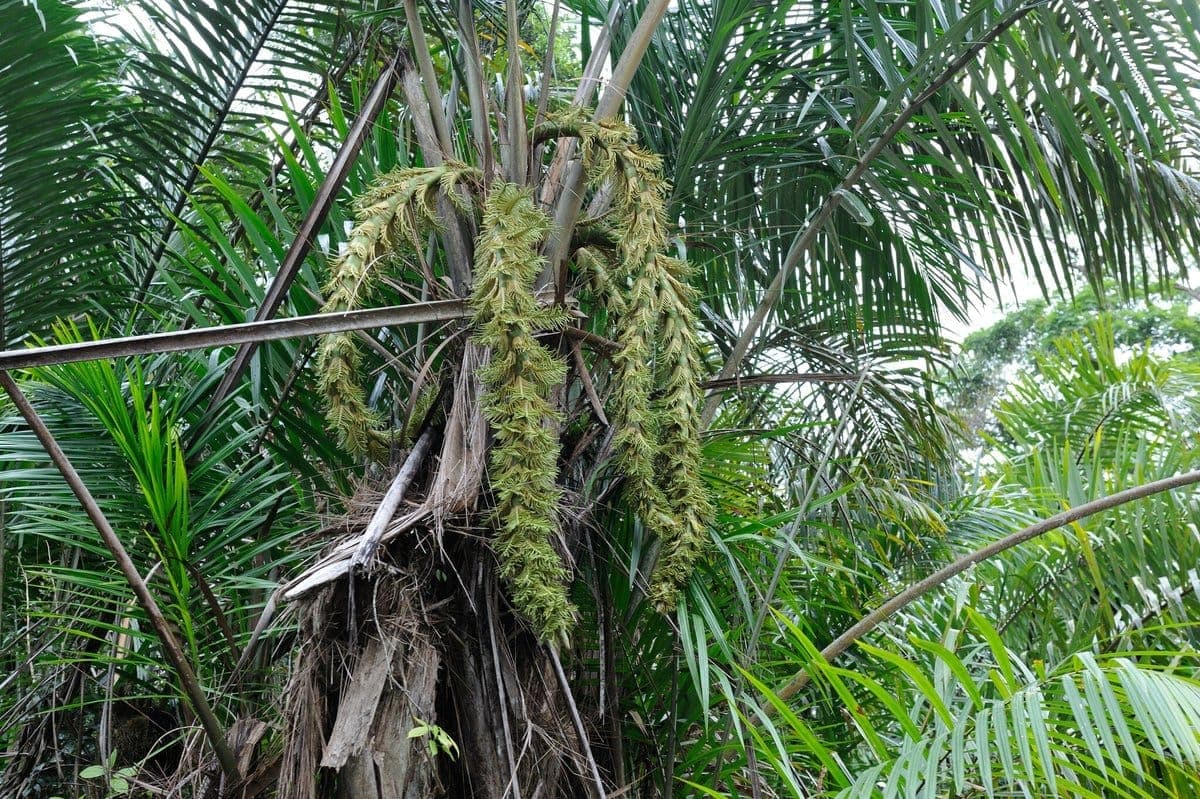
Inflorescences emerge from among the leaf bases, branching into one or more spikes covered with small, pinkish to reddish flowers embedded in pits along the axis. The flowers are unisexual but both sexes occur on the same inflorescence (monoecious). Flowers bloom throughout much of the year, with peak flowering during the early rainy season.
Fruit and Seeds
The fruits are small (8-12 mm), round to ovoid, turning from green through red to black or dark purple when ripe. Each contains a single seed. The thin flesh is consumed by small birds and mammals, which disperse the seeds. Fruiting peaks from June through November.
Geographic Distribution
Range in Costa Rica
The Palma Suita is widespread in Costa Rica's wet forests:
- Caribbean lowlands: Abundant in the Tortuguero-Sarapiquí corridor
- Osa Peninsula: Common in Corcovado and surrounding primary forests
- Central Valley slopes: Premontane wet forests up to ~1,400 m
- Monteverde area: Premontane forests on both slopes
- Turrialba-CATIE region: Well-studied populations in research forests
- Braulio Carrillo National Park: Common along upper trail sections
Broader Distribution
Geonoma congesta ranges from Honduras south through Nicaragua, Costa Rica, and into Panama. It is one of the most widespread and abundant Geonoma species in Central America. Related species extend the genus throughout tropical America from Mexico to Bolivia and Brazil.
Habitat and Ecology
Ecological Role
The Suita Palm is one of the most important structural components of the tropical forest understory:
- Understory architecture: Creates the low palm layer (2-6 m) that characterizes Central American wet forests. This palm layer provides critical three-dimensional complexity to forest structure, creating distinct microhabitats for countless organisms. Without understory palms like Geonoma, tropical forests would lack a defining architectural element.
- Seed dispersal: Fruits feed small tanagers, manakins, thrushes, and small mammals. The timing of fruit production (June-November) fills a critical gap in fruit availability for resident birds. Small fruits are perfectly sized for the mouths of small-bodied frugivores that cannot handle larger fruits from canopy trees.
- Nutrient cycling: Fallen fronds decompose rapidly, contributing to the forest floor nutrient cycle. Unlike some palms with persistent dead leaves, Geonoma sheds leaves cleanly, and the thin leaflets break down quickly, releasing nutrients back into the soil. The constant rain of small leaflets creates a steady nutrient flow throughout the year.
- Shade indicator: Presence indicates mature, closed-canopy forest with well-developed understory. Because G. congesta requires deep shade and cannot establish in open areas or young secondary growth, finding substantial populations is a reliable indicator of old-growth or near-mature forest conditions.
- Pollination ecology: Flowers attract specialized beetle and fly pollinators adapted to low-light conditions. These pollinators are critical components of understory food webs and contribute to the pollination of many other shade-dwelling plants.
- Microhabitat provider: The leaf axils, crownshaft crevices, and fallen leaves create microhabitats for frogs, insects, and small invertebrates. Studies have documented numerous species using Geonoma palms as refuge, breeding sites, and foraging grounds.
- Seedling bank: Dense aggregations of G. congesta seedlings form "seedling banks" in the understory — populations of juveniles waiting for increased light from canopy gaps. This strategy ensures rapid response to disturbance events.
Field Identification
Geonoma congesta can be identified by the combination of:
- Slender ringed trunk: 2-5 cm diameter, smooth, green aging to gray, with neat ring-like leaf scars
- Variable leaf form: The key feature — simple, bifid, or irregularly pinnate leaves, sometimes all forms on one plant
- Crownshaft: Many individuals have a short green crownshaft (tightly wrapped leaf bases)
- Small stature: Typically 2-6 m tall, occasionally reaching 8 m
- Deep shade habitat: Always found in forest understory, never in open areas
- Small dark fruits: Round, 8-12 mm, ripening from green to dark purple-black
Common Confusion Species:
- Geonoma cuneata: Another common understory Geonoma; smaller leaves, typically bifid rather than pinnate
- Chamaedorea species: Similar size and habitat, but leaves always regularly pinnate with symmetrically arranged leaflets
- Bactris species: Understory palms but with spiny trunks and regular pinnate leaves
The extreme leaf variability is diagnostic for Geonoma — no other Central American palm genus shows this character.
Wildlife Associations
Uses and Applications
Thatching (Suita Leaves)
The principal traditional use of the Suita Palm is leaf harvesting for thatching — a practice that has sustained rural communities throughout tropical Central America for centuries. The leaves' natural waterproofing, flexibility, and durability make them ideal roofing material for traditional structures:
Harvesting Process:
- Mature leaves are selectively cut at the base of the petiole using machetes
- Best harvest timing is during the dry season when leaves are fully developed and less brittle
- Sustainable harvest takes only 2-3 leaves per palm per year, allowing continued palm health
- Freshly cut leaves are transported to the construction site immediately (they become brittle if allowed to dry)
Thatching Technique:
- Fronds are woven or layered onto roof frameworks made of poles and horizontal battens
- Leaves are overlapped in a shingle-like pattern, with the bases facing upward
- Each layer is tied to the framework using strips of bark, vine fiber, or wire
- The overlapping creates a water-shedding surface that prevents leaks
- A typical rural ranch (rancho) or small house roof requires 500-1,000 suita fronds
Performance and Longevity:
- A well-made suita roof lasts 5-8 years before needing replacement — comparable to or better than many manufactured roofing materials
- The overlapping leaf layers shed tropical rain effectively, even during heavy downpours
- Natural insulation properties keep interiors cooler than metal roofs — a significant comfort advantage in hot, humid climates
- Suita roofs are quieter during rain than metal roofs
- When properly maintained (removing debris, replacing damaged sections), lifespan can extend to 10 years
Cultural and Practical Value:
- Suita thatching represents centuries of accumulated traditional ecological knowledge
- The technique is carbon-negative (stores carbon without industrial processing)
- Provides livelihood opportunities in rural areas
- Creates beautiful, culturally appropriate architecture that harmonizes with forest landscapes
- Remains the preferred roofing for ranches, shelters, and tourist eco-lodges seeking authentic tropical aesthetics
- Suita roofs remain cooler than metal roofs in tropical heat
Ornamental Use
The Suita Palm is increasingly valued for tropical landscaping and has become popular in both residential and commercial settings:
- Shade tolerance: One of the very few palms that thrives in deep shade (1-5% full sunlight) where most other palms fail — ideal for heavily shaded courtyards, north-facing walls, and understory plantings beneath large trees
- Compact form: Elegant, architectural form with slender trunk and arching leaves creates visual interest without overwhelming small garden spaces
- Leaf variability: The remarkable variation in leaf forms (simple, bifid, pinnate) on a single plant or within a planting group adds unique botanical interest — a "living laboratory" demonstrating palm morphological plasticity
- Non-invasive roots: The slender root system does not buckle pavement, damage foundations, or compete aggressively with neighboring plants — safe for tight urban spaces
- Safety: No spines, thorns, or structural hazards; safe around children and pets; minimal maintenance requirements
- Wildlife value: Attracts shade-loving birds and provides naturalistic tropical ambiance
- Authenticity: Using native understory palms like Geonoma in landscaping creates ecologically appropriate plantings that reflect Costa Rica's natural forest structure
Other Uses
- Temporary shelters: Leaves used for quick lean-to shelters on forest trails
- Palm heart: Tiny but edible — historically a survival food
- Walking sticks: The slender, flexible trunks used as walking poles
Cultural and Historical Significance
The word "suita" is deeply embedded in rural Costa Rican culture for any small palm used in thatching. For hundreds of years, before metal roofing became widely available in the mid-20th century, suita-thatched roofs were the standard in humid rural areas of Costa Rica. The skill of harvesting, preparing, and laying suita thatch was a fundamental part of rural life.
The cultural memory of suita thatching persists. Traditional "ranchos" (open-sided shelters with thatched roofs) remain common at farms, roadside stops, and tourist lodges, keeping the suita tradition alive. Some eco-lodges and biological stations deliberately use suita roofing to preserve the traditional aesthetic and demonstrate sustainable building practices.
Indigenous Bribri, Cabécar, and Ngäbe communities continue to use suita thatch in traditional architecture. The woven leaf patterns and layering techniques represent sophisticated indigenous engineering knowledge adapted to the wet tropical environment.
Conservation Status
Geonoma congesta is classified as Least Concern (LC) by the IUCN. It is one of the most abundant understory palms in Central American wet forests, with large populations in protected areas. However, deforestation of primary wet forest — the palm's required habitat — continues to reduce populations in unprotected areas.
Threats
- Deforestation: Loss of primary and mature secondary wet forest
- Overharvesting: Excessive leaf collection can weaken individual palms (sustainable harvest = no more than 30% of leaves per year)
- Forest fragmentation: Small forest fragments may not support viable populations long-term
- Selective logging: Canopy opening from logging increases light levels beyond the palm's tolerance
Conservation Actions
- Well-represented within Costa Rica's national park system
- Sustainable harvesting guidelines developed by CATIE (Centro Agronómico Tropical de Investigación y Enseñanza)
- Included in community forest management plans in the Talamanca region
- Research at La Selva, CATIE, and other biological stations informs conservation management
Growing the Palma Suita
Site Selection
The Suita Palm is an ideal choice for deeply shaded tropical gardens and naturalistic forest-style plantings:
- Deep shade required — 1-5% full sunlight is ideal (equivalent to the light level beneath closed rainforest canopy); tolerates dappled light but not direct sun, which will burn and bleach the leaves
- High humidity — requires very humid conditions typical of wet lowland and premontane forests; struggles in dry air or windy exposed sites
- Moist, well-drained soil — rich in organic matter with consistent moisture but never waterlogged; the palm naturally grows on well-drained forest slopes, not swamps
- Warm temperatures — optimal range 18-32°C with no frost tolerance; suitable for lowland to premontane elevations
- Wind protection — sensitive to desiccating winds which tear the delicate leaves and reduce ambient humidity
Perfect for: north-facing garden walls, beneath dense canopy trees, enclosed tropical courtyards, indoor atriums with high ceilings, tropical conservatories.
Propagation
From Seed: Collect ripe black/purple fruits. Remove flesh by soaking overnight and rubbing. Sow seeds immediately in warm, moist seed-starting mix. Keep at 25-30°C in deep shade. Germination is slow: 2-6 months. Seedling growth is very slow — expect 1-2 leaves per year initially. Do not rush transplanting; allow roots to develop fully.
Planting and Care
- Plant in the shadiest spot in the garden
- Amend soil with generous compost and leaf mold
- Maintain moisture — never let soil dry out completely
- Mist leaves frequently in dry weather
- Apply thin layer of organic mulch (leaf litter is ideal)
- Fertilize sparingly with dilute liquid fertilizer during the growing season
- Remove dead fronds by gently pulling — they typically release easily
- Protect from wind, sun exposure, and low humidity
Where to See the Palma Suita
In Costa Rica
- La Selva Biological Station (Sarapiquí): One of the most abundant understory palms — impossible to miss on any forest trail
- Braulio Carrillo National Park: Common throughout the wet forest understory
- Corcovado National Park: Abundant in primary forest areas
- Monteverde Cloud Forest Reserve: Upper elevation populations in premontane forest
- CATIE (Turrialba): Research plots with identified specimens
- Cahuita National Park: Accessible Caribbean lowland populations
Best Viewing Tips
The Suita Palm is one of the easiest understory palms to spot on any rainforest trail. Look for the slender, ringed trunks and the distinctive leaves — the simple, undivided leaves are particularly eye-catching. The palm is most abundant in mature, closed-canopy forest off the main trail. In the dim understory light, the waxy, dark green leaves have a subtle sheen that catches the filtered light.
Summary: Growing Success with Palma Suita
Ideal For: Deeply shaded tropical gardens, forest understory plantings, naturalistic landscapes, enclosed courtyards
Key Success Factors:
- Shade: Must have deep shade (1-5% sunlight) — the #1 requirement
- Humidity: High humidity essential; mist regularly in dry periods
- Moisture: Consistent but not waterlogged; never allow dry-down
- Patience: Very slow growth — wait years for visible trunk development
- Leaf care: Maintain all green leaves for photosynthesis
Common Mistakes to Avoid:
- Planting in too much sun (causes immediate leaf burn)
- Allowing soil to dry out (palm cannot recover from severe drought)
- Over-fertilizing (causes nutrient imbalances)
- Attempting to transplant wild palms (very low survival rate)
Ecological Benefits: Adds authentic rainforest character, supports shade-adapted wildlife, and demonstrates appropriate native plant use
External Resources
References
- Henderson, A., Galeano, G., & Bernal, R. (1995). Field Guide to the Palms of the Americas. Princeton University Press.
- Dransfield, J., et al. (2008). Genera Palmarum: The Evolution and Classification of Palms. Kew Publishing.
- Chazdon, R. L. (1991). Plant size and form in the understory palm genus Geonoma: Are species variations on a theme? American Journal of Botany, 78, 680–694.
- Hammel, B. E., Grayum, M. H., Herrera, C., & Zamora, N. (2003). Manual de Plantas de Costa Rica, Vol. II. Missouri Botanical Garden.
- Sylvester, O., & Avalos, G. (2013). Influence of light conditions on the allometry and growth of the understory palm Geonoma in Costa Rica. Journal of Tropical Ecology, 29, 1–10.
- Svenning, J.-C. (2002). Crown illumination limits the population growth rate of a neotropical understorey palm (Geonoma macrostachys). Plant Ecology, 159, 185–199.
Safety Information Disclaimer
Safety information is provided for educational purposes only. Individual reactions may vary significantly based on age, health status, amount of exposure, and individual sensitivity. Always supervise children around plants. Consult a medical professional or certified arborist for specific concerns. The Costa Rica Tree Atlas is not liable for injuries or damages resulting from interaction with trees described in this guide.
• Always supervise children around plants
• Consult medical professional if unsure
• Seek immediate medical attention if poisoning occurs
Information compiled from authoritative toxicology sources, scientific literature, and medical case reports.
Help improve this page
Know something about this tree? Share local knowledge, suggest a correction, or submit a photo to improve this guide for everyone.