Costa Rican Copal
Protium costaricense
Quick facts
Native Region
Costa Rica to Panama; Central American endemic
Max Height
20-35 meters
Family
Burseraceae
Conservation
LC — Least Concern
Uses
Safety Information
Toxicity Details
Protium costaricense is not considered toxic. The resin, bark, and leaves contain terpenes (alpha- and beta-amyrin, elemicin, and other monoterpenes) that are generally safe. The resin has been burned as incense and used medicinally without reported adverse effects. The fruit arils are consumed by wildlife without toxicity.
Skin Contact Risks
Low risk. The fresh resin is mildly sticky and can cause minor skin irritation in sensitive individuals due to the terpene content. Wear gloves when collecting large quantities of resin. No phototoxic effects have been reported, unlike some other Burseraceae (e.g., Bursera).
Allergenic Properties
Low allergen risk. Burning the resin produces aromatic smoke that may irritate the respiratory tract in sensitive individuals, especially in enclosed spaces. Pollen is insect-dispersed and not a significant airborne allergen.
Structural Hazards
Generally well-structured trees. Older specimens may have heavy branches with epiphyte loads. Standard precautions apply for any mature canopy tree during storms.
Wildlife & Pet Risks
Non-toxic to wildlife. Fruit arils are an important food source for toucans, cotingas, and other frugivorous birds. Resin exudates attract insects. The tree supports epiphyte communities.
Season
Flowering
Mar-May
Fruiting
Jul-Oct
How to identify
Costa Rican Copal
Copal (Protium costaricense), the Costa Rican Copal, is an aromatic rainforest tree whose golden resin has been burned as ceremonial incense since pre-Columbian times. A member of the torchwood family (Burseraceae), this elegant evergreen produces a fragrant oleoresin that fills the forest air with its distinctive balsamic scent. In Costa Rica's lowland and premontane wet forests, the Copal serves as both a cultural treasure and an ecological keystone, with its lipid-rich fruit arils feeding toucans, bellbirds, and a host of other forest birds.
Quick Reference
iNaturalist Observations
Community-powered species data
📸 Photo Gallery
Whole tree
📷 (c) Leonardo Álvarez-Alcázar, some rights reserved (CC BY-NC)(CC BY-NC)
View source ↗Leaves
📷 (c) Leonardo Álvarez-Alcázar, some rights reserved (CC BY-NC)(CC BY-NC)
View source ↗Leaves
📷 (c) Leonardo Álvarez-Alcázar, some rights reserved (CC BY-NC)(CC BY-NC)
View source ↗Leaves
📷 (c) Leonardo Álvarez-Alcázar, some rights reserved (CC BY-NC)(CC BY-NC)
View source ↗Leaves
📷 (c) Leonardo Álvarez-Alcázar, some rights reserved (CC BY-NC)(CC BY-NC)
View source ↗Taxonomy & Classification
Common Names by Region
Taxonomic Notes
Protium costaricense belongs to the genus Protium, one of the largest genera in the Burseraceae with over 150 species, predominantly Neotropical. The Burseraceae (torchwood family) is chemically defined by its production of aromatic resins and includes frankincense (Boswellia), myrrh (Commiphora), and the Mesoamerican copals (Bursera, Protium). The term "copal" derives from the Nahuatl word copalli meaning "incense" and has been applied across multiple Burseraceae genera.
In Costa Rica, several Protium species coexist, including P. panamense, P. ravenii, and P. pittieri. P. costaricense is distinguished by its leaflet number, fruit morphology, and resin chemistry. The specific epithet costaricense reflects its first description from Costa Rican specimens.
Physical Description
Tree Form
Copal is a medium to large canopy tree reaching 20–35 m in height, with a trunk diameter of 40–80 cm. The trunk is straight and cylindrical, with a moderately dense, rounded to spreading crown. The branching pattern is sympodial, creating a layered appearance. The overall impression is of an elegant forest tree with clean lines and a well-proportioned crown.
Bark
The bark is the most diagnostic field character. The outer bark is smooth to shallowly fissured, gray to grayish-brown, with irregular scales. When cut or damaged, the bark exudes a translucent, yellowish to golden oleoresin that is strongly aromatic, with a characteristic balsamic, slightly citrus-like fragrance. The resin hardens upon exposure to air, forming glossy, amber-colored droplets or sheets on the trunk surface. The resin flow is most abundant during the wet season when the tree is physiologically active.
Leaves
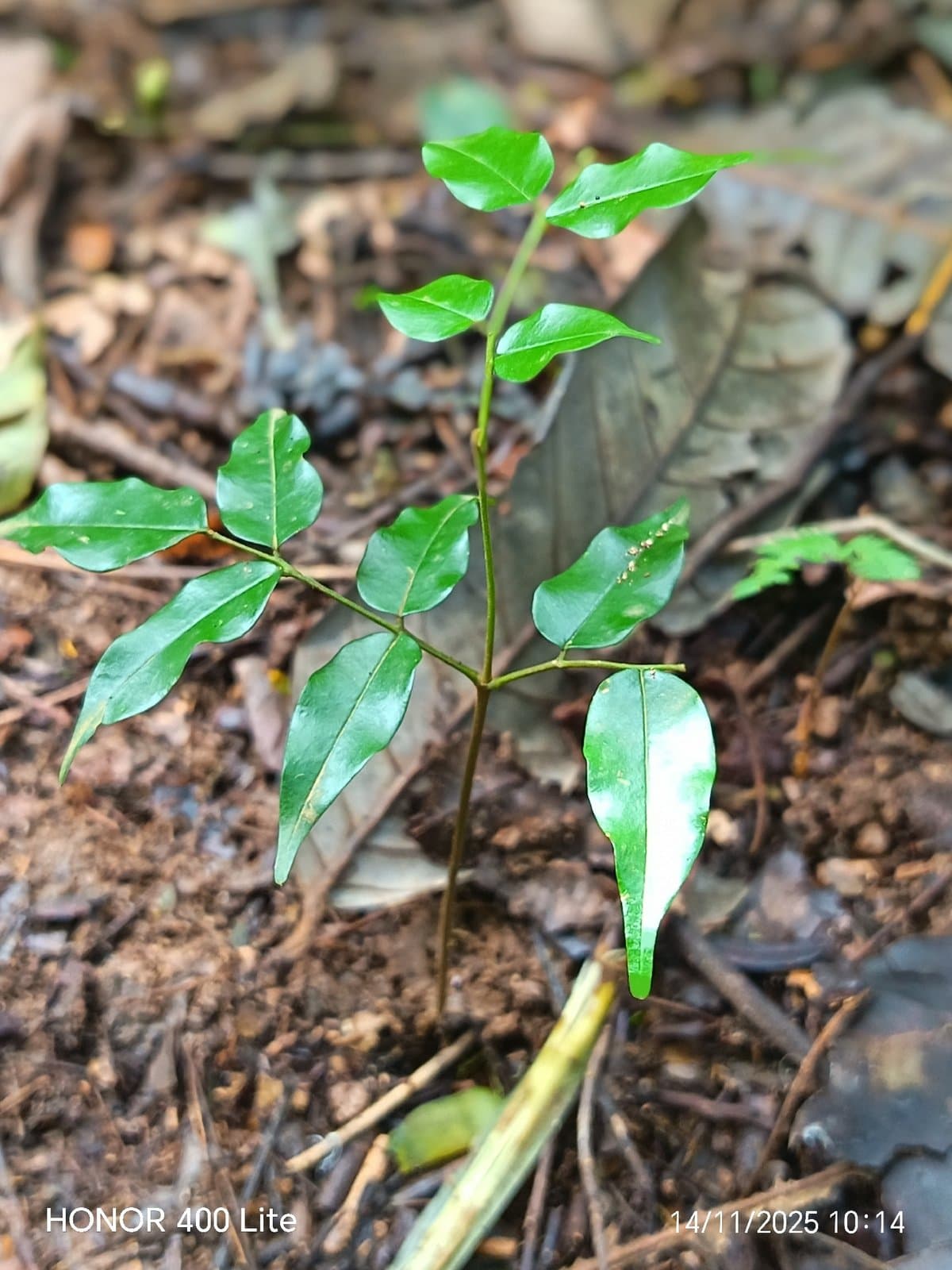
Leaves are alternate, imparipinnately compound, 15–35 cm long, with 5–9 leaflets. Leaflets are oblong to elliptic, 6–15 cm long and 3–6 cm wide, glossy dark green above and paler below, with entire margins and a distinctive drip tip (acuminate apex). The leaflets are coriaceous (leathery) and emit a subtle resinous scent when crushed. The leaf rachis is slightly winged between leaflets in some specimens.
Flowers
Flowers are small (3–5 mm), greenish-white to cream, arranged in axillary racemes or panicles 5–15 cm long. The flowers have 4–5 petals, 8–10 stamens, and a superior ovary. Flowering occurs during the dry-to-wet season transition (March–May). Flowers are pollinated primarily by small bees, wasps, and flies attracted by the mild resinous fragrance.
Fruit and Seeds
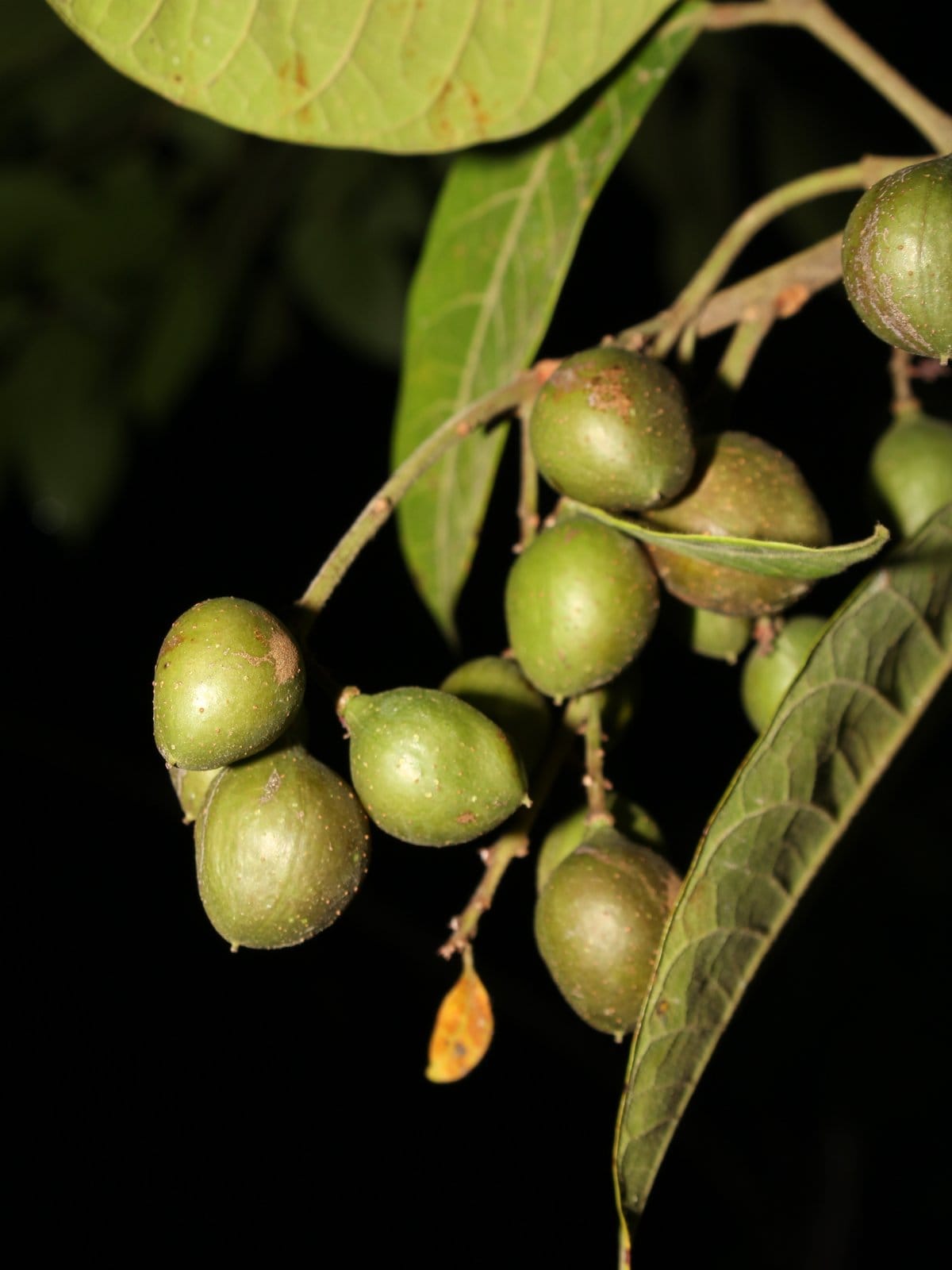
The fruit is a drupe, ovoid to globose, 1.5–2.5 cm long, with a thin green pericarp that splits open when ripe to reveal 1–4 seeds, each covered by a bright red to orange aril. The colorful arils are lipid-rich and are the primary attractant for frugivorous bird dispersers. Fruit maturation occurs from July to October. Each fruit contains 1–4 seeds, each about 8–15 mm long, enclosed in the fleshy, oily aril.
Root System
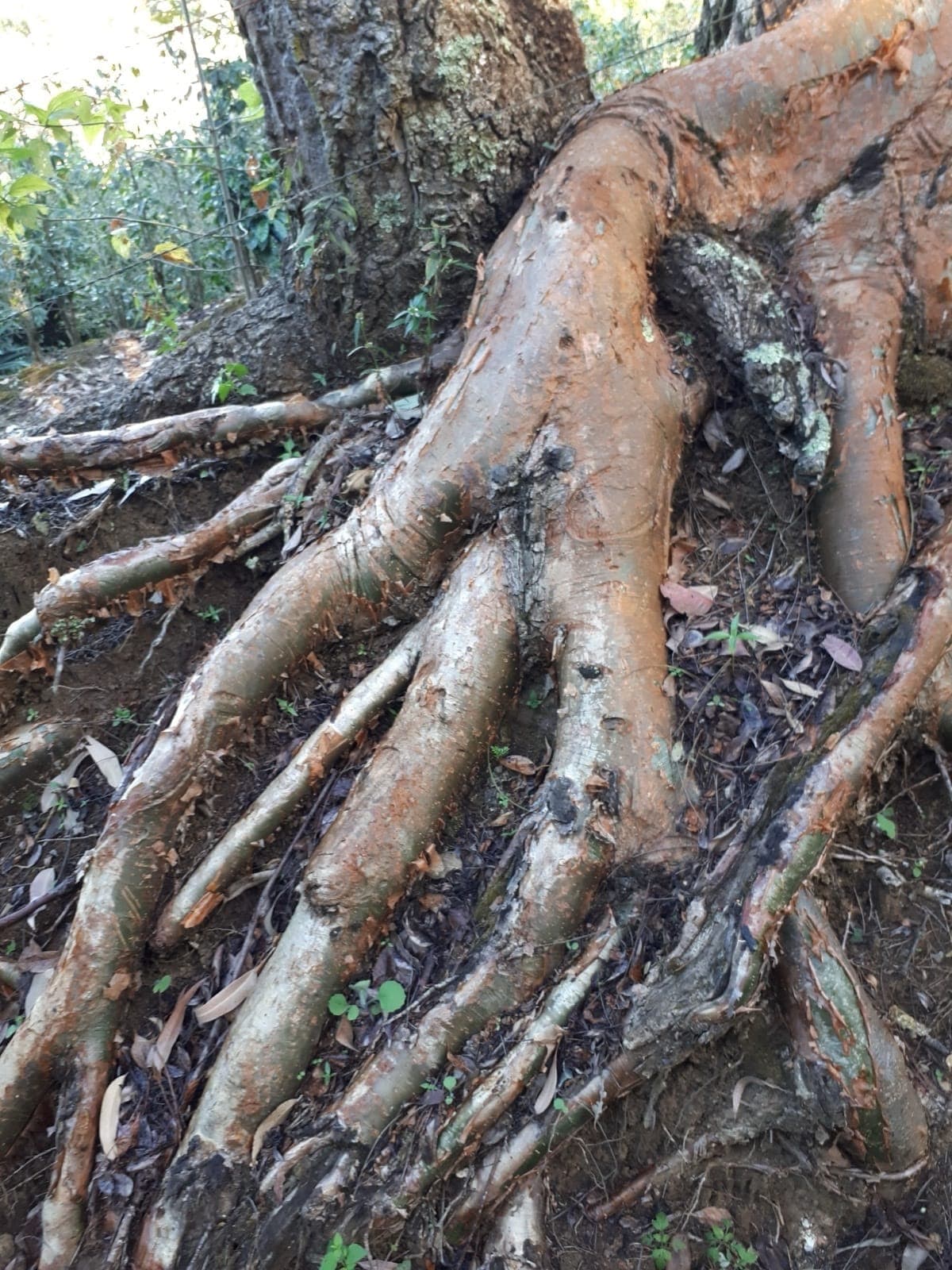
The root system is moderately deep with a strong taproot and spreading lateral roots. Small buttresses may develop at the base of older trees. The roots form ectomycorrhizal and arbuscular mycorrhizal associations that enhance nutrient uptake in forest soils.
Geographic Distribution
Protium costaricense is found in lowland and premontane wet forests from Costa Rica to Panama. It is most common on the Caribbean slope and southern Pacific lowlands of Costa Rica, at elevations from sea level to approximately 1,200 m.
Costa Rican Distribution
Habitat & Ecology
Ecological Role
Copal plays a significant ecological role in Costa Rica's wet forests. The aromatic resin has anti-fungal and anti-microbial properties that protect the tree from bark-boring insects and fungal pathogens — a chemical defense system shared with other Burseraceae. The resin exudates attract specialized insects, some of which feed on the resin while others prey on bark-boring species. The tree's lipid-rich fruit arils are a crucial food resource for many frugivorous birds during the wet season, when other fruit sources may be scarce.
Wildlife Interactions
The fruit arils of Copal are consumed by a wide variety of birds, including Toucans (Ramphastos spp.), Bellbirds (Procnias tricarunculatus), Cotingas (Cotinga spp.), Trogons, and Manakins. These birds swallow the arils and regurgitate or defecate the seeds, serving as primary dispersers. Spider monkeys and capuchins may also feed on the arils. The flowers attract diverse pollinator communities. The aromatic bark and resin support specialized beetle communities.
Uses & Applications
Ceremonial and Aromatic
The golden copal resin is the tree's most culturally significant product. When burned, it produces a fragrant, white smoke with a warm, balsamic, slightly sweet aroma that has been used in Mesoamerican ceremonies for millennia. Pre-Columbian peoples burned copal as an offering to deities, for purification rituals, and to consecrate ceremonial spaces. Today, copal incense continues to be used in indigenous ceremonies, Catholic church rituals (where it substitutes for imported frankincense), and in artisanal aromatherapy products.
Medicinal
Traditional medicine employs copal resin for respiratory ailments (inhaling the burning resin smoke), wound healing (applying dissolved resin as a poultice), and as a general tonic. The terpene-rich resin contains compounds with documented anti-inflammatory, antimicrobial, and analgesic properties. In rural Costa Rica, the resin is dissolved in alcohol to create a liniment for muscle pain and applied to cuts and abrasions to promote healing.
Timber
Copal wood is moderately hard, with a fine to medium grain and a warm, pale brown color. It is used locally for general construction, fence posts, and light carpentry. The wood is not heavily exploited commercially, as the tree's greater value lies in its resin and ecological functions.
Sources: GBIF species profile↗, Tropicos↗, iNaturalist observations↗, IUCN Red List search↗
Cultural Significance
Pre-Columbian Heritage
Copal resin is one of the most ancient aromatics of the Americas. Archaeological evidence from across Mesoamerica documents the burning of copal resins (from Protium, Bursera, and related genera) in ceremonial contexts spanning at least 3,000 years. The Maya, Aztec, and related civilizations considered copal smoke to be sacred — the "blood of the trees" offered to the gods. In Costa Rica, pre-Columbian peoples on both the Caribbean and Pacific coasts used copal in funerary rites, healing ceremonies, and as a trade commodity.
Indigenous Living Traditions
The Bribri and Cabécar peoples of the Talamanca region continue to use copal resin in spiritual practices. The Bribri awá (traditional healers) burn copal during healing ceremonies to purify the ceremonial space and to facilitate communication with the spirit world. The resin is also used practically as a torch fuel, wound sealant, and waterproofing material for canoes and baskets.
Modern Revival
Interest in copal as a natural incense and aromatherapy product has grown in recent years. Small-scale entrepreneurs in Costa Rica harvest copal resin sustainably for sale in farmers' markets, craft shops, and online platforms. This revival provides economic incentive for forest conservation while keeping ancestral aromatic traditions alive.
Sources: Langenheim (2003)↗, Tropicos↗, GBIF species profile↗, iNaturalist observations↗
Conservation Status
Protium costaricense is assessed as Least Concern (LC) due to its relatively wide distribution and stable populations within protected areas. However, the species faces threats from habitat loss through deforestation for agriculture and cattle ranching, particularly in unprotected lowland forests. Over-tapping of resin without sustainable practices can stress individual trees. The species benefits from its inclusion in protected areas throughout its range.
Cultivation & Care
Planting
Plant at the onset of the wet season (May–June) in partial shade. Copal establishes best under the canopy of existing trees or in enrichment plantings within secondary forest. Space 10–15 m apart. Select sites with well-drained, moderate to fertile soils. Dig planting holes 30 × 30 × 30 cm and mix with compost.
Watering
Moderate watering needs. Keep soil consistently moist but not waterlogged during the establishment phase (first 2 years). Once established, the tree is relatively drought-tolerant for short periods but performs best with regular rainfall of 2,000–4,000 mm/year.
Fertilization
Apply organic fertilizer at planting. Annual top-dressing with compost during the first 3–5 years helps establishment. Mature trees in forest settings require no supplemental nutrition.
Pruning
Minimal pruning needed. Remove dead or damaged branches only. Allow natural crown development. Do not excessively tap resin from young trees — wait until trees are at least 20 cm DBH before beginning resin collection, and limit the number and size of tapping wounds.
Year-Round Care Calendar
Propagation
Seeds must be sown fresh (within 2 weeks of harvest) as viability declines rapidly. Remove the fleshy aril before planting by soaking in water for 24 hours. Sow 1–2 cm deep in well-drained nursery mix at 25–28°C. Germination occurs in 20–40 days. Seedlings are slow-growing initially and require shade (60–70% shade cloth) for the first year. Transplant to the field at 30–50 cm height (typically after 8–12 months in the nursery).
Where to See This Tree
External Resources
References
- Zamora, N. et al. (2004). Árboles de Costa Rica, Vol. III. INBio/OET.
- Daly, D. C. (1992). "New taxa and combinations in Protium Burm. f." Studies in Neotropical Burseraceae VI. Brittonia, 44: 280–299.
- Langenheim, J. H. (2003). Plant Resins: Chemistry, Evolution, Ecology, and Ethnobotany. Timber Press.
- Stout, S. A. (1999). "Copal and other aromatic resins: their use, history, and importance." The Botanical Review, 65: 178–198.
- Hammel, B. E. et al. (2014). Manual de Plantas de Costa Rica, Vol. VII. Missouri Botanical Garden.
Safety Information Disclaimer
Safety information is provided for educational purposes only. Individual reactions may vary significantly based on age, health status, amount of exposure, and individual sensitivity. Always supervise children around plants. Consult a medical professional or certified arborist for specific concerns. The Costa Rica Tree Atlas is not liable for injuries or damages resulting from interaction with trees described in this guide.
• Always supervise children around plants
• Consult medical professional if unsure
• Seek immediate medical attention if poisoning occurs
Information compiled from authoritative toxicology sources, scientific literature, and medical case reports.
Help improve this page
Know something about this tree? Share local knowledge, suggest a correction, or submit a photo to improve this guide for everyone.