Targuá
Croton draco
Quick facts
Native Region
Mexico to South America
Max Height
15-25 meters (50-82 feet)
Family
Euphorbiaceae
Conservation
LC — Least Concern
Uses
Safety Information
Toxicity Details
The tree itself is safe for normal contact. The red latex sap (sangre de drago/dragon's blood) is a well-studied medicinal substance with a strong safety profile. Topical use is generally safe. Oral use in moderate amounts shows low toxicity in clinical studies. Side effects are rare and mild (mainly GI upset: abdominal pain, flatulence). The sap contains bioactive alkaloids and proanthocyanidins. Not for consumption without knowledge, but medicinal use is considered safe when used appropriately.
Skin Contact Risks
LOW risk. The red latex sap is generally safe for topical application (traditional use as 'liquid bandage'). Rare allergic reactions or skin sensitivities possible, as with any plant latex. Most people tolerate it well. Normal contact with bark or leaves is safe.
Allergenic Properties
LOW allergen risk. Latex sensitivities are possible but uncommon. The sap has been used extensively in traditional medicine with minimal allergic reactions reported. Wood dust: standard precautions.
Season
Flowering
Apr-Jul
Fruiting
Jul-Oct
How to identify
Targuá
The Targuá (Croton draco) is famous for its brilliant red sap that flows like blood when the bark is cut. This dramatic "dragon's blood" (sangre de drago) has been used in traditional medicine throughout Mesoamerica for centuries, valued for wound healing, gastrointestinal relief, and antimicrobial protection. Modern pharmacology has validated these traditional uses — a compound derived from a closely related species became an FDA-approved drug. As one of Costa Rica's most important pioneer species, the Targuá plays a vital role in forest regeneration while serving as a living pharmacy.
Quick Reference
iNaturalist Observations
Community-powered species data
📸 Photo Gallery
Whole tree
📷 (c) olafo, some rights reserved (CC BY-NC)(CC BY-NC)
View source ↗Leaves
📷 (c) joaquin_arrascaeta, some rights reserved (CC BY-NC)(CC BY-NC)
View source ↗Whole tree
📷 (c) Alejandro Juarez, some rights reserved (CC BY-NC)(CC BY-NC)
View source ↗Leaves
📷 (c) olafo, some rights reserved (CC BY-NC)(CC BY-NC)
View source ↗Whole tree
📷 (c) joaquin_arrascaeta, some rights reserved (CC BY-NC)(CC BY-NC)
View source ↗Photos sourced from iNaturalist community science database. View all observations →↗
Taxonomy and Classification
Common Names
The Euphorbiaceae Family
Etymology
- Croton: From Greek kroton (tick) — the smooth, rounded seeds resemble the body of a tick
- draco: Latin for "dragon" — referring to the dramatic blood-red sap, evoking the legendary dragon's blood
- Targuá: Indigenous name used in Costa Rica, of uncertain linguistic origin; possibly from the Huetar language
- Sangre de Drago: Spanish for "dragon's blood" — the most widely used common name throughout Latin America
Multiple "Dragon's Blood" Species
The term "dragon's blood" has been applied to red-sapped plants from several unrelated families worldwide. The Canary Island dragon tree (Dracaena draco, Asparagaceae) produces a similar red resin. In Southeast Asia, rattans of the genus Daemonorops (Arecaceae) yield "dragon's blood" resin historically traded along the Silk Road. The African padauk (Pterocarpus, Fabaceae) produces another "dragon's blood." Despite sharing the name, these species are not closely related — they represent a striking case of convergent evolution in defensive latex chemistry.
Physical Description and Botany
Overall Form
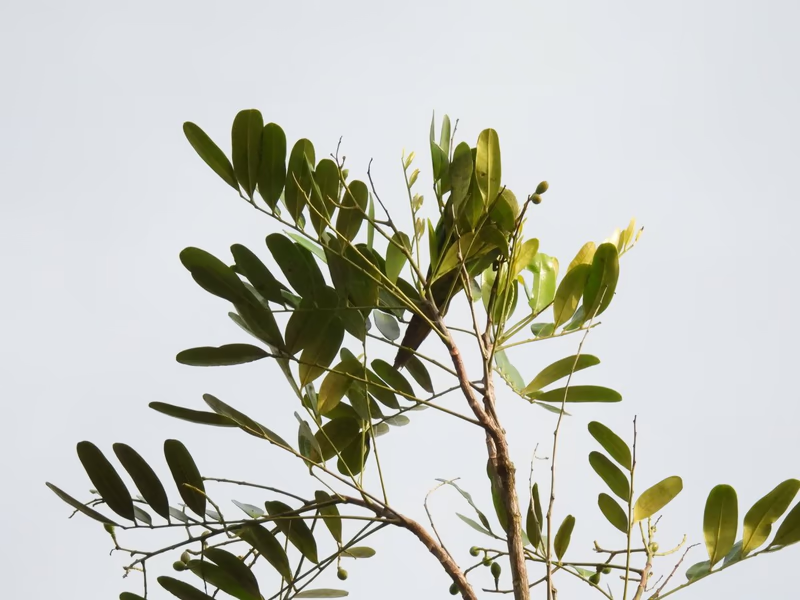
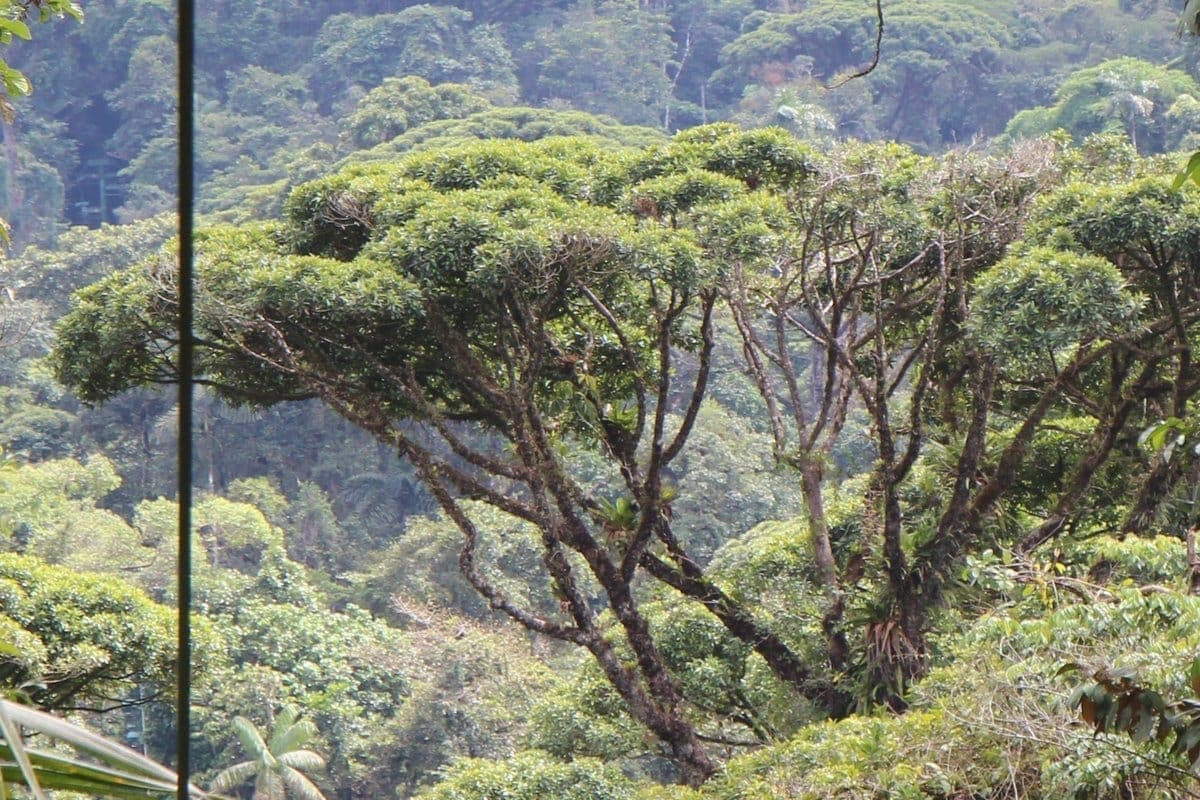
The Targuá is a fast-growing, medium-sized tree reaching 15-25 meters in height with a trunk diameter of up to 50 cm. The trunk is typically straight and columnar, supporting an open, spreading crown with relatively sparse branching. The overall silhouette is characteristic of pioneer trees — tall, skinny, and light-seeking rather than broad and sheltering. In dense secondary forest stands, Targuá trees often grow close together, forming a uniform canopy layer.
Bark and the Famous Red Sap
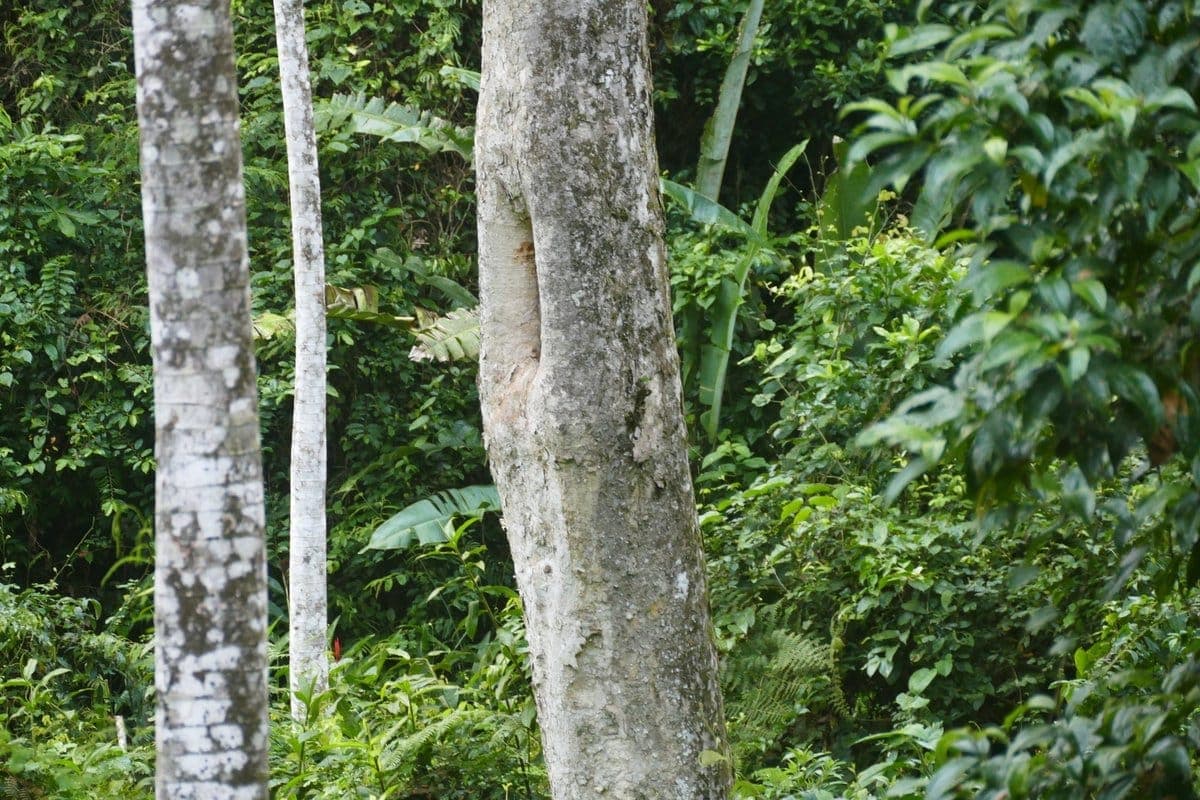
Bark: Smooth and gray-brown when young, becoming slightly rougher with age but never deeply fissured. The bark is thin — typically only 5-8 mm — which is why the red sap flows so freely with even shallow cuts.
Red Latex: The tree's most remarkable feature is its bright crimson latex that flows immediately when the bark is scored. The sap (technically a latex) is produced by specialized laticifer cells throughout the bark and inner wood. It is remarkably blood-like in appearance — viscous, bright red, and it coagulates on exposure to air, forming a dark reddish-brown protective film. This coagulation mimics blood clotting and is one reason the sap functions as a natural "liquid bandage." The latex contains a complex cocktail of bioactive compounds including the alkaloid taspine, oligomeric proanthocyanidins (OPCs), lignans, and diterpenes.
Leaves
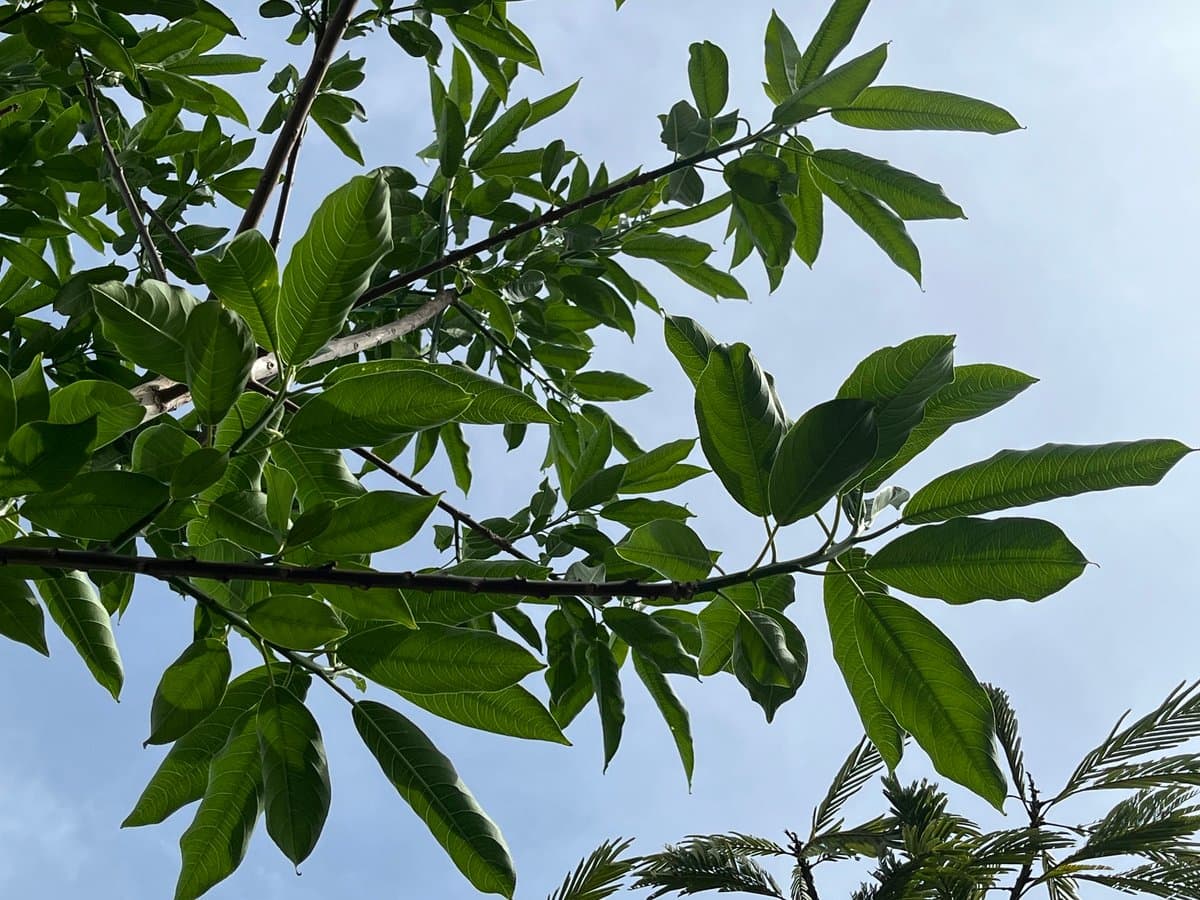
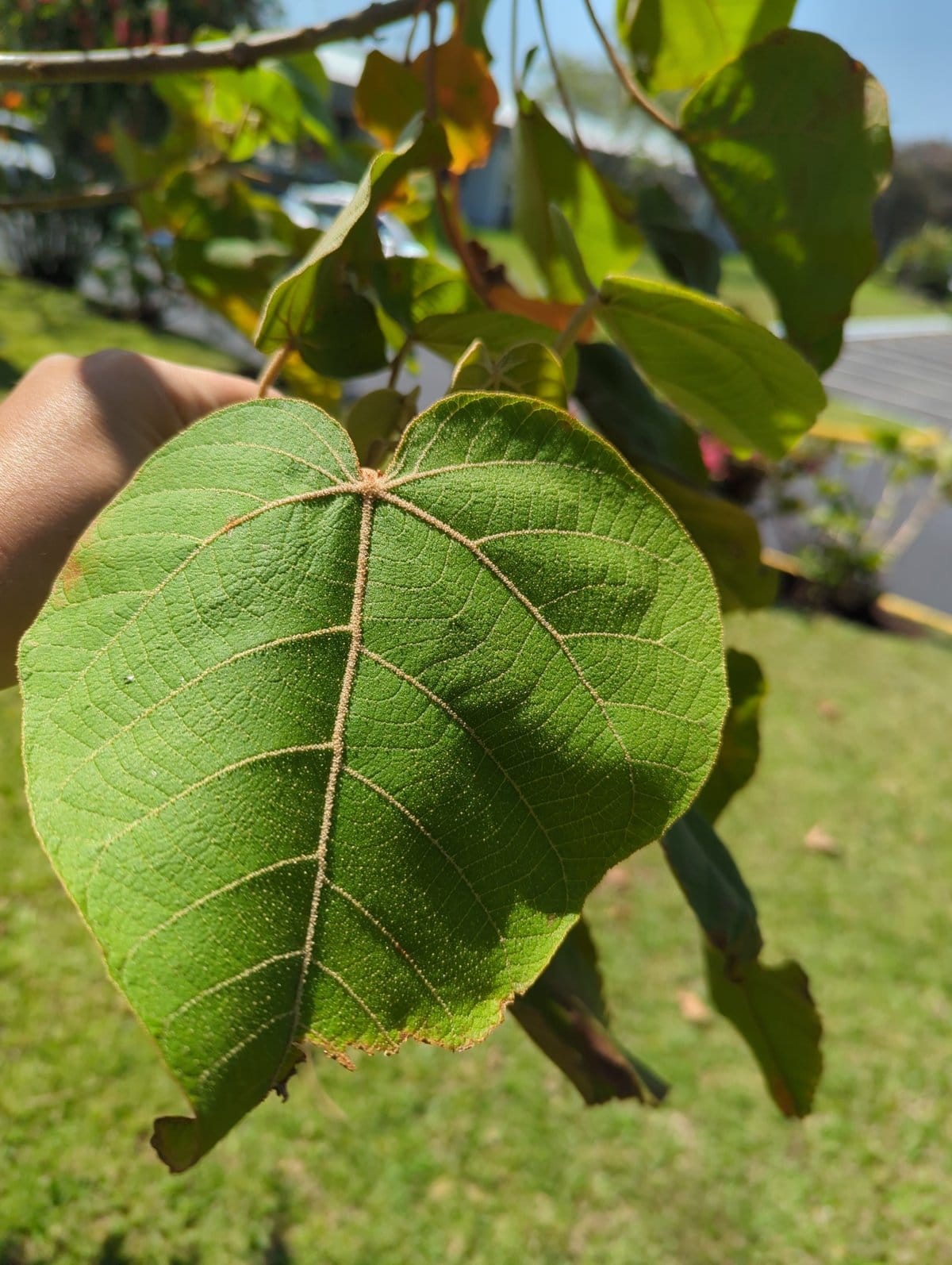
The leaves are large, heart-shaped (cordate), and covered with a distinctive soft, velvety pubescence created by dense stellate (star-shaped) trichomes — a hallmark of the genus Croton. The leaves are dark green above and paler below, with finely serrated margins. In the right light, the stellate hairs give the leaf surface a silvery-green sheen. Unlike many tropical dry forest trees, Targuá is semi-evergreen to evergreen, retaining most of its foliage year-round in areas with adequate rainfall.
Flowers
Flowers are arranged in long terminal racemes (15-30 cm). The tree is monoecious — bearing separate male and female flowers on the same inflorescence. Male flowers are small, numerous, and positioned at the tip of the raceme, while fewer, larger female flowers cluster at the base. Flowers are pollinated primarily by small bees, flies, and wind. The greenish-white flowers are inconspicuous individually but collectively attract significant insect activity.
Fruit and Seeds
Capsules: Small three-lobed capsules, 6-8 mm in diameter, initially green, turning brown at maturity. Each capsule contains three seeds, one per lobe.
Explosive dispersal: When dry, the capsules undergo explosive dehiscence — they split open suddenly and forcefully, launching seeds up to several meters from the parent tree. This ballistic dispersal is a classic Euphorbiaceae trait, supplemented by secondary dispersal through granivorous birds that consume scattered seeds.
Seeds: Small (3-4 mm), smooth, and rounded — resembling a tick body (hence the genus name Croton). Seeds are photoblastic, requiring light for germination, which ensures they only germinate in open, disturbed conditions where the pioneer tree can thrive.
Geographic Distribution
Geographic Distribution
A Pioneer of Disturbed Landscapes
Targuá thrives precisely where humans have disrupted the forest. Road cuts, landslides, abandoned farms, logged areas, and forest edges — wherever sunlight suddenly reaches the ground, Targuá seeds germinate within weeks. This tree is one of the first to appear in Costa Rica's recovering landscapes, and its ubiquity along highways and in secondary forest makes it one of the most commonly encountered trees in the country. Its abundance is directly proportional to human disturbance — a living indicator of landscape change.
Distribution in Costa Rica
The species ranges from southern Mexico through all Central American countries to Colombia, Venezuela, and Ecuador. In Costa Rica, it is found on both Caribbean and Pacific slopes, though it is more abundant on the wetter Caribbean side. It reaches its altitudinal limit around 1,800 m in premontane forests.
Where to See Targuá
- Highway 32 (San José to Limón) — Extremely common along road cuts through Braulio Carrillo; look for the large heart-shaped leaves
- La Selva Biological Station — Abundant in secondary forest and trail edges
- Tapantí National Park — Forest gaps and stream edges in premontane forest
- Rural roads throughout the Central Valley — Agricultural margins and fence lines
- Osa Peninsula — Regenerating areas following logging or farming
The Famous Red Sap
The red sap of Targuá and its close relatives represents one of the greatest success stories in ethnobotanical drug discovery. In 2012, the FDA approved crofelemer (tradename Mytesi®), a purified proanthocyanidin extract from the related Croton lechleri, for treating HIV/AIDS-associated diarrhea. This approval validated centuries of traditional Amazonian and Mesoamerican medicinal use and demonstrated the pharmaceutical potential of dragon's blood.
Bioactive Compounds
How the Sap Works as a Wound Healer
The wound-healing properties of dragon's blood sap are remarkably multifaceted. Taspine, the key alkaloid, promotes migration of fibroblast cells (the cells responsible for building new tissue) into wound sites, accelerating closure. Simultaneously, the proanthocyanidins form a physical barrier when the sap coagulates on air exposure, creating a protective "liquid bandage" that seals the wound from pathogens. The diterpenes provide broad-spectrum antimicrobial activity against bacteria that commonly infect wounds. And the high antioxidant content of catechins and flavonoids reduces oxidative stress and inflammation at the wound site. This combination — mechanical sealing + antimicrobial + anti-inflammatory + tissue regeneration — explains why traditional healers considered dragon's blood sap a near-universal wound treatment.
How to Collect Sap Sustainably
Traditional Medicine
A Living Pharmacy
Indigenous peoples throughout Mesoamerica and South America have used dragon's blood trees as living pharmacies for millennia. During the colonial era, the sap was traded internationally and incorporated into European medicine. Costa Rican traditional healers (curanderos) continue to recommend Targuá sap for a wide range of ailments — from wound healing to stomach ulcers to oral infections — uses that modern pharmacology has increasingly validated.
Applications
While traditional uses are well-documented and many have been scientifically validated, consult healthcare professionals before medicinal use. The sap can cause mild allergic reactions in some individuals. Oral dosing should be conservative. Do not substitute traditional remedies for professional medical treatment of serious conditions.
Habitat and Ecology
Pioneer Ecology
Forest Associations
In secondary forest, Targuá grows alongside other pioneer species:
- Guarumo (Cecropia spp.) — Hollow-stemmed pioneer; similar ecological niche but different family
- Balsa (Ochroma pyramidale) — Extremely fast-growing; world's lightest commercial wood
- Peine de mico (Apeiba membranacea) — Pioneer with distinctive spiny fruits
- Laurel (Cordia alliodora) — Valuable timber pioneer; longer-lived
- Gavilán (Pentaclethra macroloba) — Dominant canopy species in mature Caribbean lowland forest; eventually replaces pioneers
Conservation Status
Croton draco is assessed as Least Concern by the IUCN Red List. The species is abundant throughout its range, benefits from human disturbance, and has no significant threats. Its pioneer ecology means it actually increases with deforestation, making it one of the few native tropical trees with stable to increasing populations.
Conservation Role
While the Targuá itself needs no conservation intervention, it is critically important for conserving other species. As the primary pioneer in Costa Rica's forest regeneration, Targuá enables the recovery of biodiverse forest ecosystems on degraded land. Its value in reforestation projects is immense — it is arguably the most important "starter tree" for ecological restoration in wet and moist tropical forests. Protecting regenerating secondary forest (where Targuá dominates) is essential for long-term biodiversity conservation, as these forests will eventually mature into species-rich primary-like forest if given sufficient time and connectivity.
Sources: IUCN Red List↗, GBIF species profile↗, Missouri Botanical Garden Tropicos - Croton draco↗
Cultural Significance
The Curandero's Essential
In Costa Rican and Mesoamerican traditional medicine (curanderismo), the Targuá occupies a central place. The curandero (healer) regards the tree as a first-aid kit growing in the forest — a source of readily available wound treatment, infection fighter, and digestive remedy. The widespread knowledge of Targuá sap's medicinal properties cuts across cultures, from indigenous Bribri communities in the Talamanca mountains to mestizo farmers in the Central Valley. This cross-cultural consensus on the tree's value is one reason pharmacologists investigated the sap so intensively, ultimately leading to the crofelemer drug discovery.
The Red Stain
Anyone who has handled Targuá sap knows its most memorable property after medicinal value: it stains everything it touches a deep reddish-brown that is nearly impossible to remove from clothing, skin, and tools. This intense, persistent pigment was historically used as a natural dye for textiles and, according to some accounts, for body paint by indigenous groups. The staining property also means that trees that have been recently tapped for sap are easily identified by their dark reddish-brown bark scars.
Sources: Jones (2003), Journal of Alternative and Complementary Medicine↗, Salatino et al. (2007), Journal of the Brazilian Chemical Society↗, Hammel et al., Manual de Plantas de Costa Rica↗
Growing Targuá
Targuá is one of the easiest native trees to grow in Costa Rica. Its pioneer nature means it establishes rapidly on degraded land with minimal care. If you have a disturbed site in a wet or moist tropical zone, Targuá will likely appear on its own — but planting it accelerates the process dramatically.
Propagation
Cultivation Requirements
Landscaping and Restoration Uses
Excellent for: Forest restoration on degraded land, riparian buffer planting, erosion control on slopes, gap-filling in secondary forest, educational and medicinal gardens, attracting wildlife to recovering landscapes.
Considerations: Short-lived (30-50 years) — plan for eventual replacement. Not suitable for dry forest conditions (requires >2,000 mm annual rainfall). The red sap stains surfaces and clothing. Large leaves create abundant leaf litter. Self-pruning can leave dead branches in crown.
Similar Species
External Resources
Community observations and photos from Costa Rica and Mesoamerica
Global distribution records and specimen data
Nomenclatural records and synonymy
Accepted name, synonyms, and distribution data
Peer-reviewed research on dragon's blood pharmacology
Conservation status assessment
References
-
Ubillas, R., Jolad, S.D., Bruening, R.C., et al. (1994). SP-303, an antiviral oligomeric proanthocyanidin from the latex of Croton lechleri (Sangre de Drago). Phytomedicine 1(2): 77-106.
-
Jones, K. (2003). Review of Sangre de Drago (Croton lechleri) — A South American tree sap in the treatment of diarrhea, inflammation, insect bites, viral infections, and wounds. Journal of Alternative and Complementary Medicine 9(6): 877-896.
-
Pieters, L., De Bruyne, T., Claeys, M., et al. (1993). Isolation of a dihydrobenzofuran lignan from South American dragon's blood (Croton spp.) as an inhibitor of cell proliferation. Journal of Natural Products 56(6): 899-906.
-
Salatino, A., Salatino, M.L.F., & Negri, G. (2007). Traditional uses, chemistry and pharmacology of Croton species (Euphorbiaceae). Journal of the Brazilian Chemical Society 18(1): 11-33.
-
Webster, G.L. (1993). A provisional synopsis of the sections of the genus Croton (Euphorbiaceae). Taxon 42(4): 793-823.
-
Hammel, B.E., Grayum, M.H., Herrera, C., & Zamora, N. (eds.) (2003-2015). Manual de Plantas de Costa Rica (Volumes I-VIII). Missouri Botanical Garden Press.
-
Jiménez, Q. (1999). Árboles maderables de Costa Rica: ecología y silvicultura. Instituto Nacional de Biodiversidad (INBio), Santo Domingo de Heredia, Costa Rica.
-
Berry, P.E., Hipp, A.L., Wurdack, K.J., et al. (2005). Molecular phylogenetics of the giant genus Croton and tribe Crotoneae (Euphorbiaceae sensu stricto). American Journal of Botany 92(9): 1520-1534.
Safety Information Disclaimer
Safety information is provided for educational purposes only. Individual reactions may vary significantly based on age, health status, amount of exposure, and individual sensitivity. Always supervise children around plants. Consult a medical professional or certified arborist for specific concerns. The Costa Rica Tree Atlas is not liable for injuries or damages resulting from interaction with trees described in this guide.
• Always supervise children around plants
• Consult medical professional if unsure
• Seek immediate medical attention if poisoning occurs
Information compiled from authoritative toxicology sources, scientific literature, and medical case reports.
Help improve this page
Know something about this tree? Share local knowledge, suggest a correction, or submit a photo to improve this guide for everyone.