Quebracho
Lysiloma divaricatum
Quick facts
Native Region
Mexico to Costa Rica
Max Height
15-20 meters
Family
Fabaceae
Conservation
LC — Least Concern
Uses
Safety Information
Toxicity Details
Quebracho is non-toxic and safe for humans and animals. The tree has been used traditionally in food preparation, with seeds roasted and ground for beverages. No toxicity concerns have been documented.
Skin Contact Risks
Safe to handle. No skin irritation from leaves, bark, or wood. The wood is commonly worked without protective equipment beyond standard woodworking safety.
Wildlife & Pet Risks
Safe for all wildlife, pets, and livestock. Many species including parrots, bees, and butterflies benefit from this tree. Provides important food and habitat in dry forests.
Season
Flowering
Mar-May
Fruiting
Jun-Sep
How to identify
Quebracho
The Quebracho (Lysiloma divaricatum) is a cornerstone species of Costa Rica's critically endangered tropical dry forests — a hardy nitrogen-fixing legume that enriches degraded soils, withstands months of drought, and produces wood so hard it earned the name "axe-breaker" (quiebra hacha). As both an ecological restorer and a provider of durable timber, the Quebracho is indispensable for conservation and rural livelihoods in Guanacaste.
Quick Reference
iNaturalist Observations
Community-powered species data
📸 Photo Gallery
Whole tree
📷 (c) Cricket Raspet, some rights reserved (CC BY)(CC BY)
View source ↗Leaves
📷 (c) Eric Knight, some rights reserved (CC BY)(CC BY)
View source ↗Whole tree
📷 (c) Eric Knight, some rights reserved (CC BY)(CC BY)
View source ↗Leaves
📷 (c) Eric Knight, some rights reserved (CC BY)(CC BY)
View source ↗Whole tree
📷 (c) leithallb, some rights reserved (CC BY-NC)(CC BY-NC)
View source ↗Taxonomy & Classification
Common Names by Region
Taxonomic Notes
Lysiloma divaricatum was originally described by Nikolaus Joseph von Jacquin based on material from the Caribbean and later transferred to Lysiloma by J. Francis Macbride. The genus Lysiloma is a small Neotropical group of approximately 8 species, all restricted to Mesoamerica and the Caribbean basin. Recent molecular phylogenetic work by the Legume Phylogeny Working Group (LPWG, 2017) placed Lysiloma within the mimosoid clade of subfamily Caesalpinioideae, reclassifying it from the former subfamily Mimosoideae.
The name "Quebracho" is shared with the unrelated South American trees Schinopsis balansae and S. lorentzii (family Anacardiaceae), which are famous for their tannin-rich wood. The Costa Rican Quebracho (Lysiloma divaricatum) belongs to a completely different family (Fabaceae) and should not be confused with these South American species.
The Fabaceae Family
Etymology
- Lysiloma: From Greek lysis (loosening) + loma (border/fringe), referring to the separating margins of the seed pod
- divaricatum: Latin for "spreading widely" or "diverging at wide angles," describing the open branching pattern
- Quebracho: Spanish contraction of quiebra hacha (breaks the axe) — a testament to the legendary hardness and durability of the wood
Physical & Botanical Description
Tree Form
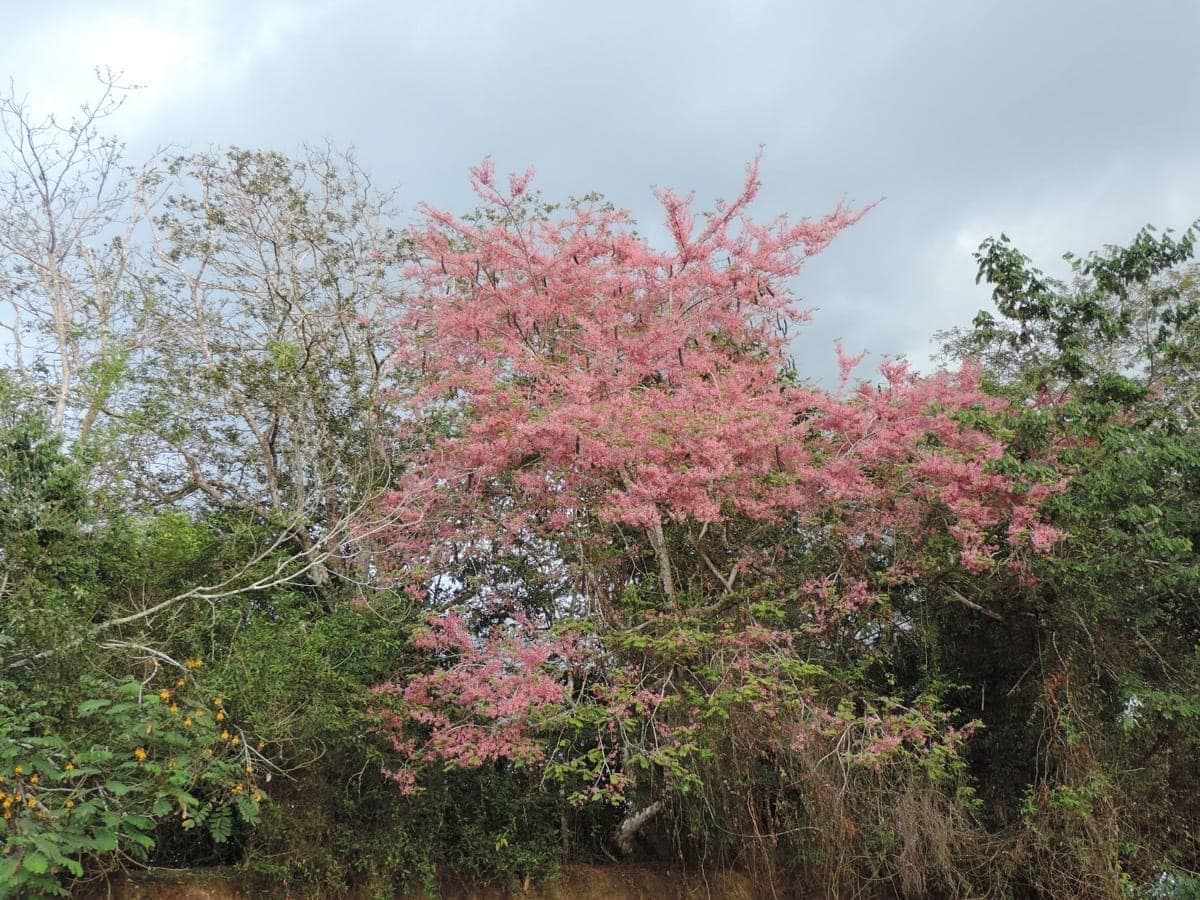
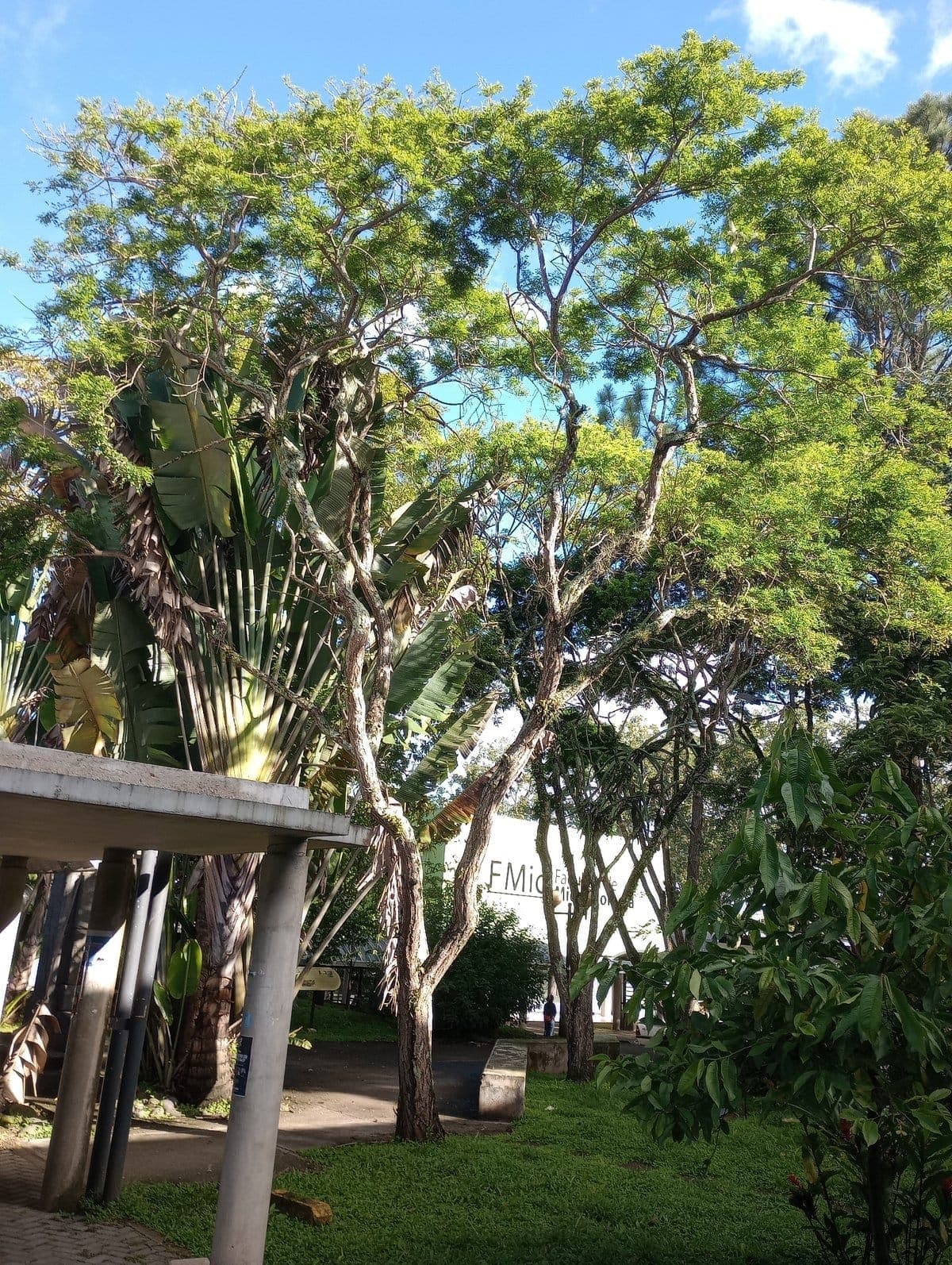
The Quebracho is a small to medium-sized deciduous tree reaching 15-20 meters in height with a trunk diameter of 40-60 cm at breast height. The tree develops a characteristic open, spreading, irregular crown that provides filtered shade — a highly valued trait in agroforestry systems. The branching pattern is widely divergent (matching the specific epithet divaricatum), with main branches spreading at wide angles from the trunk.
Bark & Wood
Bark: Gray to dark brown, becoming deeply furrowed and rough with age, forming irregular rectangular plates on mature trees. The bark is rich in condensed tannins (6-12% dry weight), making it valuable for leather processing and giving it a distinctive bitter-astringent taste that deters many herbivores.
Wood: The heartwood is pale yellow to light brown, fine-grained, and remarkably dimensionally stable and decay-resistant. With a density of 550-650 kg/m³, it is moderately heavy. Natural extractives — primarily flavonoids and terpenoids — protect the wood against rot and insect attack, with fence posts lasting 20-30 years in direct ground contact.
Leaves
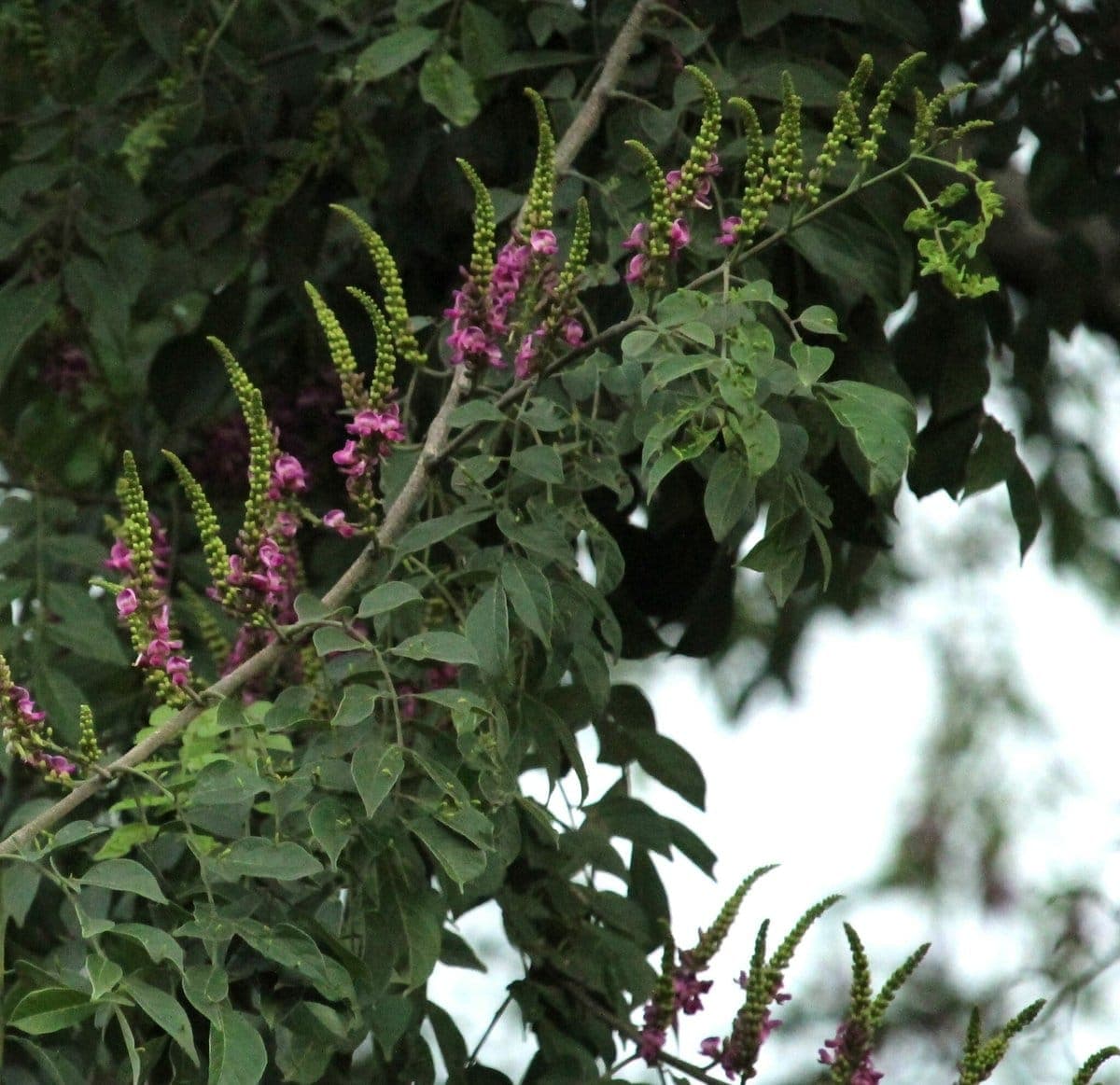
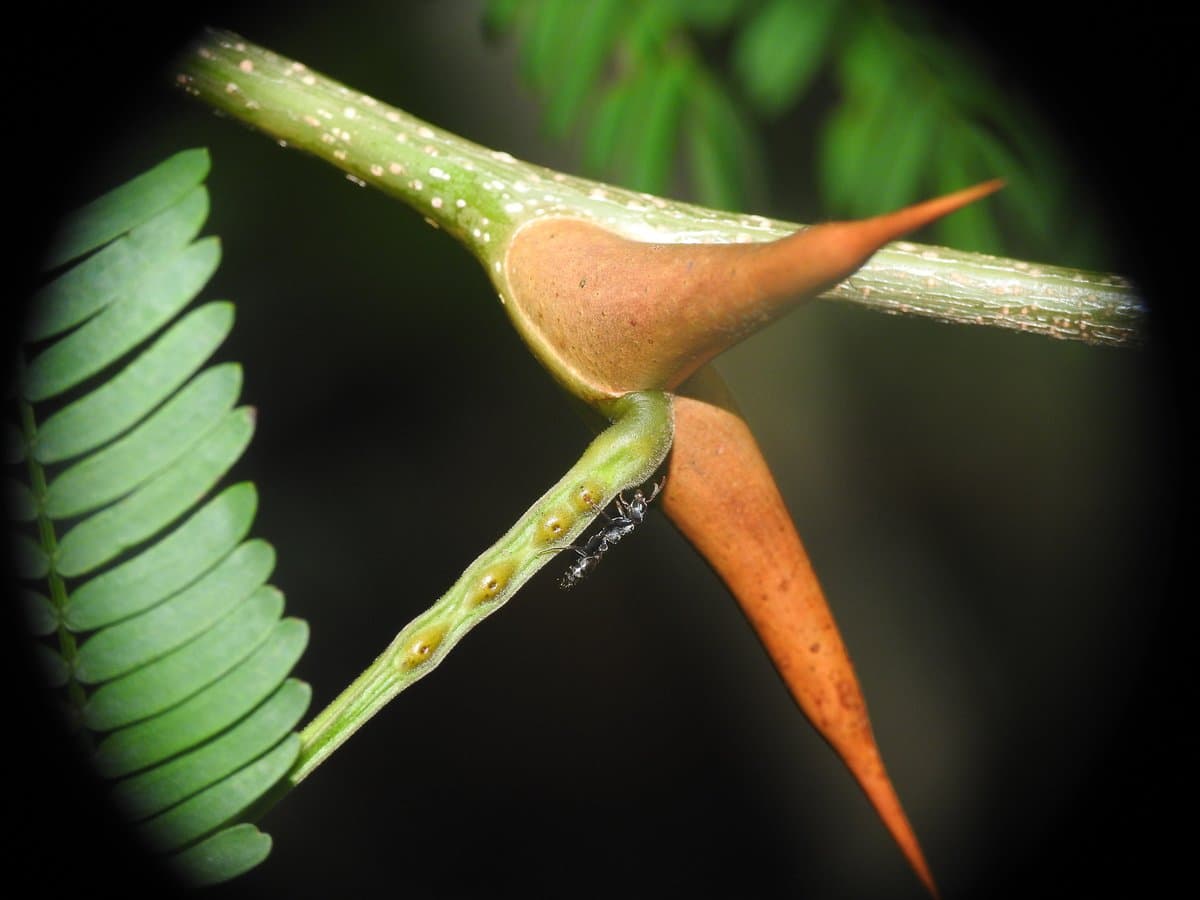
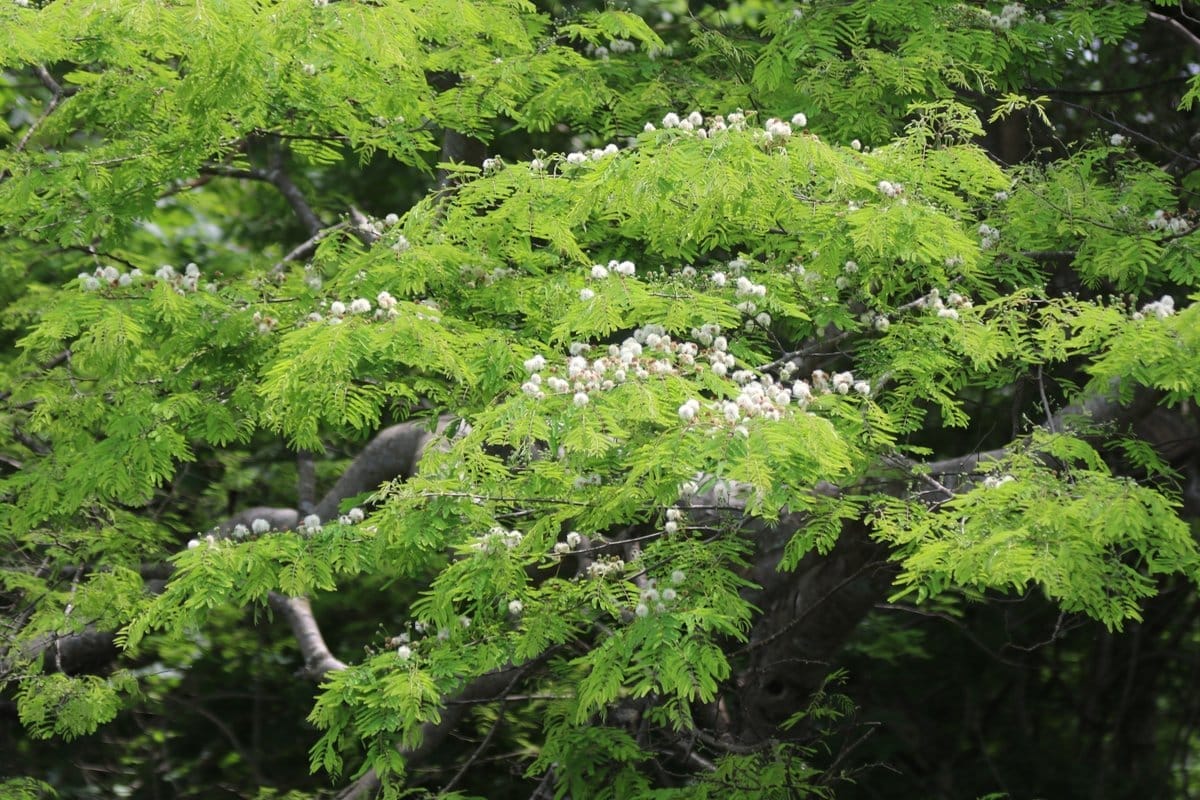
The leaves are fern-like and feathery, with delicate oblong leaflets 8-15 mm long arranged in bipinnate (twice-divided) compound leaves. Despite the tree's extreme hardiness, the foliage creates an unexpectedly delicate, airy appearance. Leaves are deciduous, dropping during the peak dry season (December-April) as a water-conservation strategy. New foliage flushes with the first rains, often appearing before or simultaneously with flowers.
Flowers
The flowers are small individually (5-8 mm) but are aggregated into dense, fragrant cylindrical spikes or globular heads typical of the mimosoid clade. The numerous protruding stamens give the inflorescences a soft, brush-like appearance. The sweet, pleasant fragrance attracts diverse pollinators including honeybees, native stingless bees (Trigona, Tetragonisca), butterflies, and beetles. Flowering occurs in the late dry season (March-May), often on leafless branches, producing a striking display of white flower clusters.
Fruit & Seeds
Pods: Flat, linear legume pods 12-20 cm long and 1.5-2 cm wide, papery when mature, straw-colored to light brown. The pods dehisce (split open) along both sutures when ripe, releasing seeds.
Seeds: 8-15 seeds per pod, flat, hard, and dark brown. Seeds are orthodox — unlike the recalcitrant seeds of cloud forest Lauraceae, Quebracho seeds can be stored dry for months without losing viability, an important trait for nursery operations and reforestation programs.
Dispersal: The lightweight, papery pods are dispersed by wind; gravity and small mammals contribute secondary dispersal. Seeds can persist in the soil seed bank for extended periods, contributing to rapid colonization after disturbance.
Geographic Distribution
Geographic Distribution
Costa Rica's Endangered Dry Forests
The tropical dry forests that Quebracho calls home are among the most endangered ecosystems on Earth. Originally covering over 500,000 km² across Mesoamerica, less than 2% of the original dry forest remains intact. In Costa Rica's Guanacaste province, centuries of cattle ranching and agriculture reduced dry forest to scattered fragments. Daniel Janzen's pioneering restoration work at the Área de Conservación Guanacaste (ACG) has helped rebuild dry forest using species like Quebracho, demonstrating that these ecosystems can recover with the right approach.
Distribution in Costa Rica
The species is native to Mesoamerica, ranging from southern Mexico (Guerrero, Oaxaca, Chiapas) through Guatemala, El Salvador, Honduras, Nicaragua, and into Costa Rica. It reaches the southern limit of its distribution in Costa Rica's Pacific lowlands.
Where to See Quebracho
- Santa Rosa National Park — One of the best-preserved dry forest remnants; Quebracho common along trails and in secondary forest
- Palo Verde National Park — Mixed dry forest and wetland edges; excellent for observing dry forest ecology
- Barra Honda National Park — Dry forest on limestone karst; Quebracho on exposed slopes
- Guanacaste National Park — Part of the ACG restoration area; both remnant and restored populations
- Carara National Park — Dry-wet forest transition zone; marks the ecological boundary
Habitat & Ecology
Ecological Roles
Forest Associations
Quebracho grows in association with characteristic Mesoamerican dry forest species:
- Guanacaste tree (Enterolobium cyclocarpum) — The national tree; co-dominant canopy species
- Pochote (Pachira quinata) — Deciduous timber tree sharing similar habitat
- Ron-ron (Astronium graveolens) — Valuable hardwood of dry forests
- Indio desnudo (Bursera simaruba) — Pioneer with distinctive peeling red bark
- Cacti and dry-adapted shrubs — Understory guild in the driest sites
Dry Season Adaptations
Uses & Applications
Traditional Uses
Modern Applications
Ecological Restoration: Quebracho is a flagship species for dry forest restoration in Costa Rica and across Mesoamerica. Its combination of rapid establishment on degraded sites, nitrogen fixation that improves soil for successor species, tolerance of harsh conditions (drought, poor soils, wind exposure), and provision of wildlife habitat and food make it a first-choice species for reforestation projects. It is widely used in the Área de Conservación Guanacaste (ACG) restoration programs.
Agroforestry: Quebracho is exceptionally well-suited to silvopastoral systems — the integration of trees with livestock pastures. The open crown allows sufficient light for grass growth while providing livestock shade, wind protection, and nitrogen enrichment of pasture soils. Large branch cuttings (50-100 cm) can be planted directly as living fence posts that root and grow, combining structural function with biological benefits.
Carbon Sequestration: With its moderate growth rate, long lifespan (50-80 years), and ability to establish on degraded lands, Quebracho contributes meaningfully to carbon storage in reforestation projects. Its root system also stores significant belowground carbon in deep soil horizons.
Sources: FAO Ecocrop - Lysiloma divaricatum↗, Useful Tropical Plants - Lysiloma divaricatum↗, Área de Conservación Guanacaste↗
Cultural & Historical Significance
The Fence Post of Guanacaste
In rural Guanacaste, the Quebracho is intimately known to every farmer and rancher. Its unmatched durability as a fence post has made it the material of choice for generations — a single post can outlast several rounds of barbed wire. The saying "fuerte como poste de quebracho" (strong as a quebracho post) is used colloquially to describe something enduring and reliably tough. For the sabanero (cowboy) culture of Guanacaste, the Quebracho fence post is as iconic as the cattle and horses it encloses.
Traditional Ecological Knowledge
Indigenous and rural communities across Mesoamerica have long recognized the Quebracho's role as a "soil healer." Traditional land managers observed that degraded pastures planted with Quebracho became more productive over time — an empirical understanding of nitrogen fixation centuries before the scientific mechanism was described. The tree's seasonal flowering was also used as a phenological calendar: the appearance of white flower clusters signaled the approaching rainy season and the time to prepare fields for planting.
Conservation Symbol
The Quebracho has become an ambassador for dry forest conservation — a charismatic species that demonstrates non-scientists can appreciate the value of tropical dry forests. Its dual identity as both ecologically essential and economically useful helps bridge the gap between conservation goals and the practical needs of rural communities, making it a powerful tool for environmental education.
Conservation Status
Lysiloma divaricatum is assessed as Least Concern by the IUCN Red List. The species has a wide Mesoamerican distribution and stable populations. However, its tropical dry forest habitat is among the most endangered ecosystems on Earth, with less than 2% of the original Central American dry forest remaining intact.
Habitat Threats
Conservation Priorities
The Guanacaste Restoration Model
The Área de Conservación Guanacaste (ACG), founded largely through the vision of ecologist Daniel Janzen and Costa Rican scientist Winnie Hallwachs, demonstrates that tropical dry forests can recover. Using pioneer species like Quebracho alongside natural regeneration, the ACG has restored thousands of hectares of degraded pastureland to functioning dry forest. This "rewilding" approach relies on the Quebracho's ability to colonize degraded ground, fix nitrogen, and create conditions for later-successional species — a living validation of the tree's ecological importance.
Growing Quebracho
Quebracho requires a tropical dry climate with a pronounced dry season. It is not suitable for wet Caribbean or high-elevation cloud forest conditions. Best results in Costa Rica are in Guanacaste and the northwestern Pacific lowlands below 1,000 m elevation.
Propagation
Cultivation Requirements
Landscape Uses
Excellent for: native dry forest restoration, xeriscaping (water-wise landscaping), shade trees for pastures, living fences and property boundaries, erosion-prone slopes, pollinator and wildlife gardens, and educational demonstration sites.
Design considerations: Deciduous habit means filtered shade year-round but bare branches during dry season (December-April). The open crown allows undergrowth. Delicate, fern-like foliage provides attractive textural contrast. Sweet-scented flowers in late dry season attract pollinators.
Similar Species
Quebracho can be confused with other mimosoid legumes in Costa Rica's dry forests. Key differences include pod shape, leaflet size, and bark characteristics.
External Resources
Community observations and photos from Costa Rica and Mesoamerica
Accepted name, synonyms, and distribution data
Uses, cultivation, and detailed species profile
Dry forest restoration programs using native species
Conservation status assessment
Specimen records and nomenclatural data
Global biodiversity occurrence data and distribution maps
References
-
Janzen, D.H. (1988). Tropical dry forests: the most endangered major tropical ecosystem. In E.O. Wilson (ed.), Biodiversity, pp. 130-137. National Academy Press, Washington, DC.
-
Jiménez, Q. (1999). Árboles maderables de Costa Rica: ecología y silvicultura. Instituto Nacional de Biodiversidad (INBio), Santo Domingo de Heredia, Costa Rica.
-
LPWG (Legume Phylogeny Working Group). (2017). A new subfamily classification of the Leguminosae based on a taxonomically comprehensive phylogeny. Taxon 66(1): 44-77.
-
Miles, L., Newton, A.C., DeFries, R.S., et al. (2006). A global overview of the conservation status of tropical dry forests. Journal of Biogeography 33: 491-505.
-
Pennington, R.T., Lewis, G.P., & Ratter, J.A. (2006). Neotropical Savannas and Seasonally Dry Forests: Plant Diversity, Biogeography, and Conservation. CRC Press, Boca Raton.
-
Sprent, J.I. (2009). Legume Nodulation: A Global Perspective. Wiley-Blackwell, Oxford.
-
Standley, P.C. & Steyermark, J.A. (1946). Flora of Guatemala. Fieldiana: Botany 24(4).
-
Hammel, B.E., Grayum, M.H., Herrera, C., & Zamora, N. (eds.) (2003-2015). Manual de Plantas de Costa Rica (Vols. I-VIII). Missouri Botanical Garden Press.
-
Janzen, D.H. & Hallwachs, W. (2016). DNA barcoding the Lepidoptera inventory of a large complex tropical conserved wildland, Área de Conservación Guanacaste, northwestern Costa Rica. Genome 59: 641-660.
Safety Information Disclaimer
Safety information is provided for educational purposes only. Individual reactions may vary significantly based on age, health status, amount of exposure, and individual sensitivity. Always supervise children around plants. Consult a medical professional or certified arborist for specific concerns. The Costa Rica Tree Atlas is not liable for injuries or damages resulting from interaction with trees described in this guide.
• Always supervise children around plants
• Consult medical professional if unsure
• Seek immediate medical attention if poisoning occurs
Information compiled from authoritative toxicology sources, scientific literature, and medical case reports.
Help improve this page
Know something about this tree? Share local knowledge, suggest a correction, or submit a photo to improve this guide for everyone.