Lechoso Montañero
Brosimum lactescens
Quick facts
Native Region
Mexico through Central America to northern South America
Max Height
20-30 meters (66-98 feet)
Family
Moraceae
Conservation
LC — Least Concern
Uses
Safety Information
Toxicity Details
Brosimum lactescens is completely safe and non-toxic. The white latex produced by the tree is edible, nutritious, and has been consumed by indigenous peoples and rural communities for centuries. Unlike many latex-producing species, this milk is sweet and palatable.
Skin Contact Risks
No risk from skin contact. The latex, bark, leaves, and wood are all non-irritating and safe to handle. The white sap does not cause dermatitis or allergic reactions in the vast majority of people.
Allergenic Properties
Very low allergen risk. The latex is generally well-tolerated as a food source. Some individuals with severe latex allergies might experience mild reactions, but this is extremely rare and the species is not in the same allergen group as Hevea rubber.
Structural Hazards
No significant structural risks. This is a medium to large canopy tree with strong wood and good structural integrity. Normal precautions with large trees apply in developed areas.
Wildlife & Pet Risks
Safe and beneficial for wildlife. The fruits are consumed by monkeys, birds, bats, and other forest animals. The latex and young leaves are occasionally browsed by mammals. Not toxic to domestic animals.
Season
Flowering
Mar-May
Fruiting
Jun-Sep
How to identify
Lechoso Montañero
Lechoso Montañero (Brosimum lactescens) is a remarkable tree belonging to the Moraceae (fig/mulberry) family. This montane species is renowned for producing copious amounts of sweet, nutritious white latex that resembles cow's milk—hence its common name meaning "Mountain Milky One." Related to the lowland Mastate (Brosimum utile), this tree has been an important food source for indigenous peoples and rural communities throughout its range, providing protein-rich "tree milk" that can be consumed fresh or used in cooking.
Quick Reference
iNaturalist Observations
Community-powered species data
📸 Photo Gallery
High-quality images for this species need to be sourced from iNaturalist, GBIF, or botanical databases following the project's image guidelines. Key features to capture: white latex flowing from cuts, distinctive leaves, spherical fruits, bark texture, overall tree habit, and latex collection process.
📸 Photo Gallery
Whole tree
📷 (c) Marvin López M., some rights reserved (CC BY-NC)(CC BY-NC)
View source ↗Leaves
📷 (c) Marvin López M., some rights reserved (CC BY-NC)(CC BY-NC)
View source ↗Whole tree
📷 (c) Leonardo Álvarez-Alcázar, some rights reserved (CC BY-NC)(CC BY-NC)
View source ↗Leaves
📷 (c) chrisdt, some rights reserved (CC BY-NC)(CC BY-NC)
View source ↗Whole tree
📷 (c) chrisdt, some rights reserved (CC BY-NC)(CC BY-NC)
View source ↗Photos sourced from iNaturalist's community science database. Browse all observations →↗
Taxonomy & Classification
Common Names by Region
Taxonomic Notes
The species was described by Swedish botanist Olof Swartz in 1788. The genus Brosimum contains approximately 15 species distributed throughout tropical America, several of which produce edible latex or fruits. Brosimum lactescens is closely related to B. utile (Mastate) and B. alicastrum (Breadnut/Ramón), forming a complex of useful food-producing trees.
The genus is distinguished within the Moraceae by its peculiar inflorescence structure (globose heads) and the production of abundant white latex in many species. Brosimum lactescens is specifically characterized by its montane distribution and the quality of its edible latex.
The Moraceae family includes figs (Ficus), breadfruit (Artocarpus), and mulberry (Morus), many of which produce edible fruits or latex. Brosimum species are among the most important latex-producing trees for human consumption in tropical America.
Etymology
- Brosimum: From Greek brosimos meaning "edible" or "good to eat," referring to the edible latex and fruits produced by many species in this genus
- lactescens: From Latin lactescens meaning "becoming milky" or "producing milk," directly referencing the copious white latex that flows from wounds in the bark
Physical/Botanical Description
Tree Form
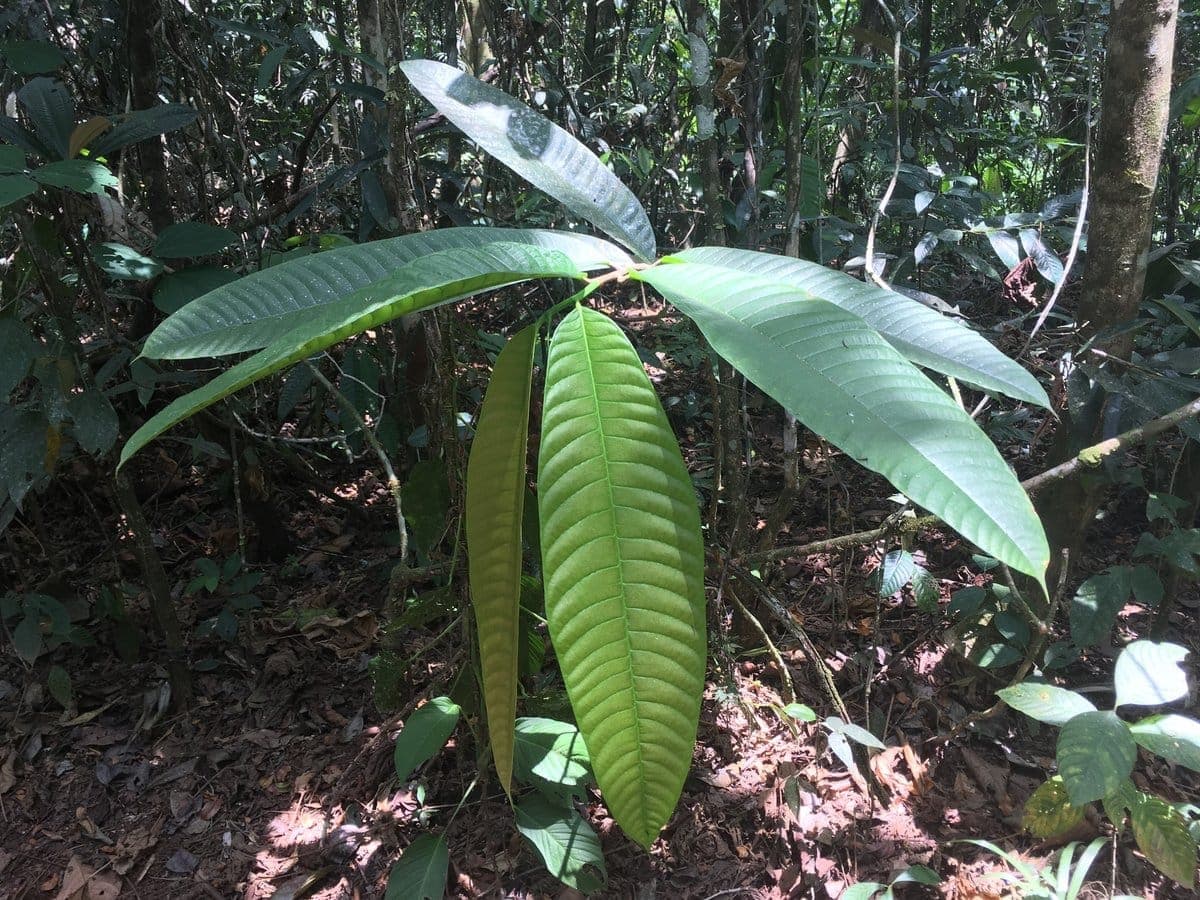
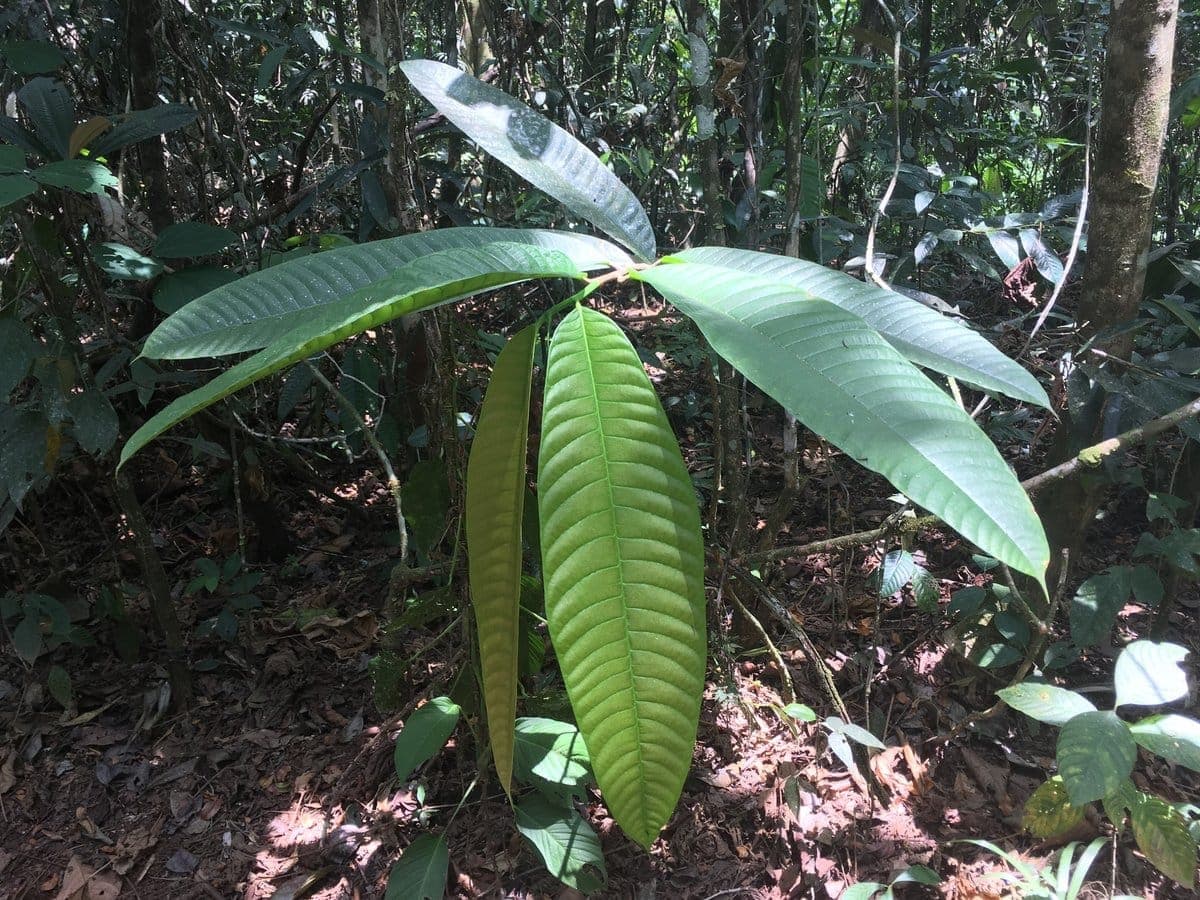
Lechoso Montañero is a medium to large evergreen tree typically reaching 20-30 meters in height, occasionally taller in optimal conditions. The trunk is straight and cylindrical, typically 40-80 cm in diameter at breast height, with low buttresses or none at all. The crown is rounded to spreading, moderately dense, and positioned in the canopy layer of montane forests.
The tree maintains its foliage year-round (evergreen) and is immediately recognizable when cut or wounded by the profuse white latex that exudes from any injury to the bark, branches, or leaves.
Bark
The bark is gray to gray-brown, relatively smooth on young trees, becoming slightly roughened with shallow vertical fissures with age. The outer bark is thin to medium thickness. The most distinctive feature is the abundant white latex that flows freely when the bark is cut or wounded—far more copious than in most latex-producing trees.
The latex is thick, milk-white, and has a sweet, slightly nutty flavor. Unlike the toxic latex of many tropical trees, this latex is completely edible and nutritious. Fresh cuts can produce substantial quantities—up to several liters from a large tree if properly tapped.
Leaves
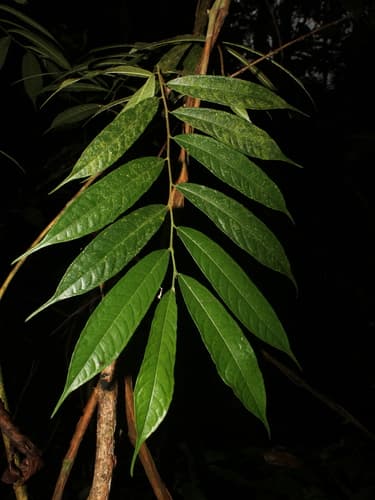
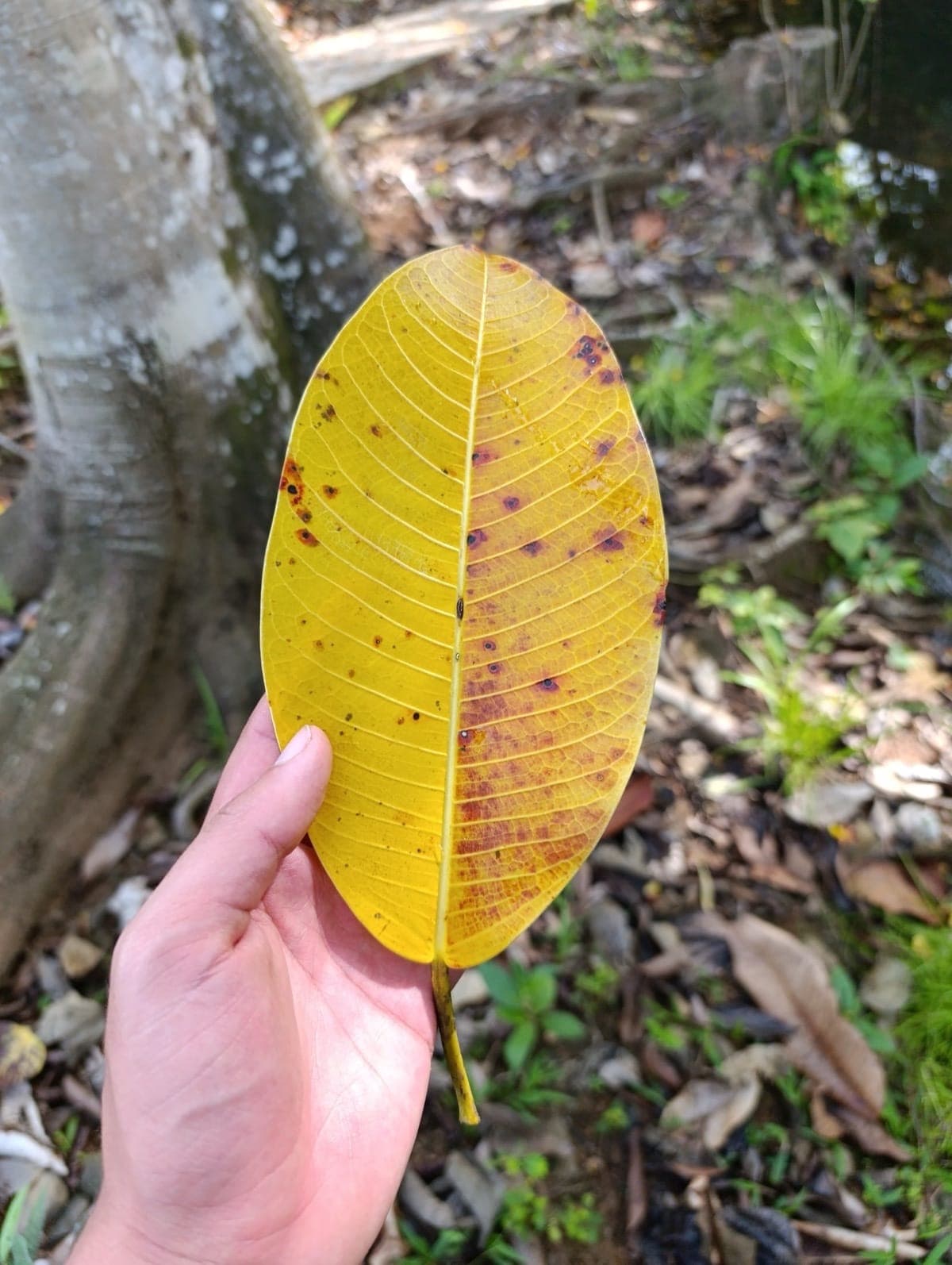
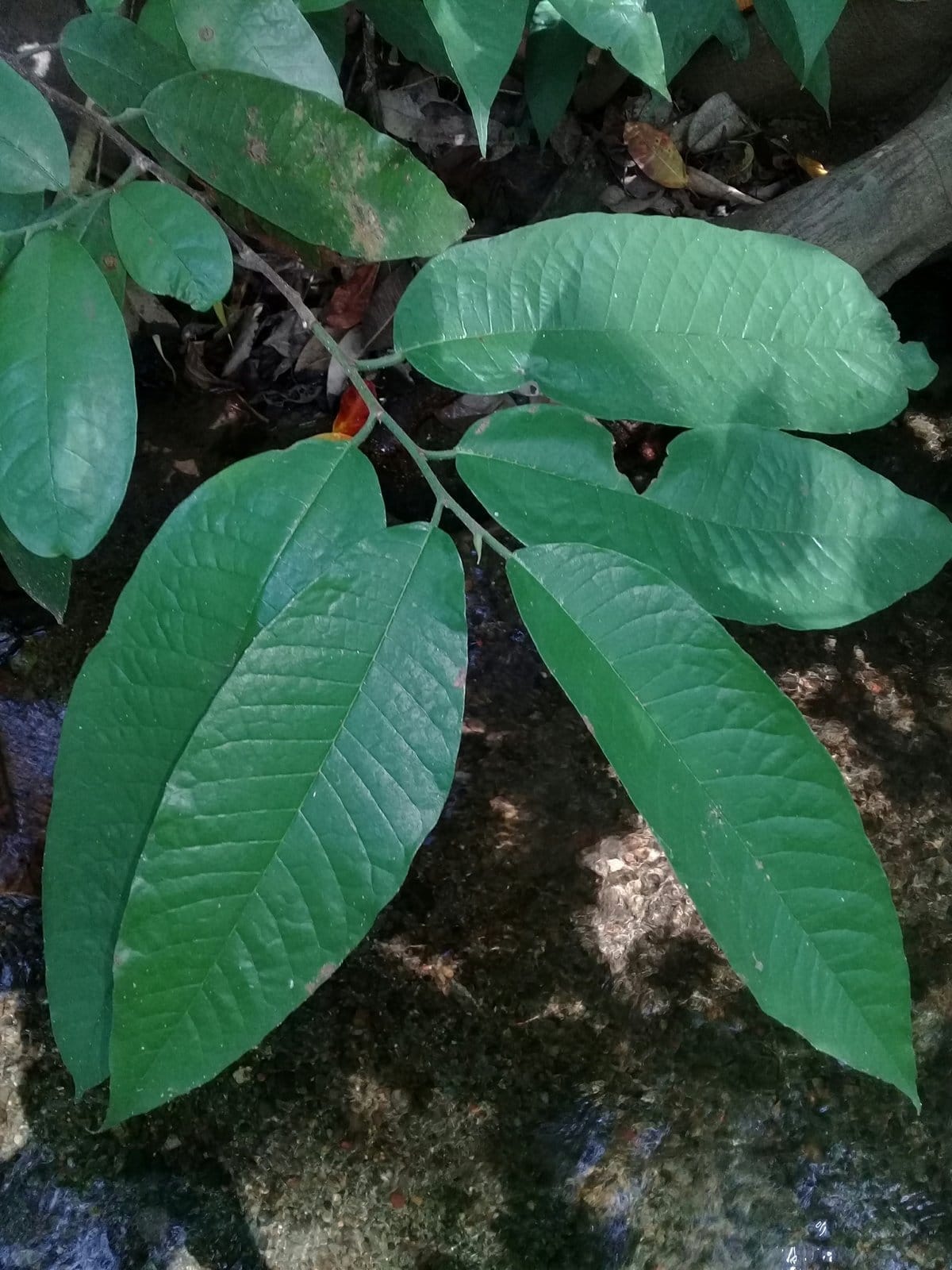
The leaves are simple and arranged alternately in a spiral pattern along the branches. Individual leaves are 8-18 cm long and 3-7 cm wide, oblong-elliptic to oblong-lanceolate in shape. The leaf base is acute to rounded, while the apex is acuminate (tapering to a pointed tip) to acute.
The upper leaf surface is dark green, smooth, and glossy, while the lower surface is paler green and matte. The texture is slightly coriaceous (leathery) but not thick. Lateral veins are 8-15 pairs, ascending at an angle of 45-60 degrees from the prominent midrib. When crushed or torn, leaves exude white latex from the veins.
Leaves are attached by stout petioles 0.5-1.5 cm long. Stipules are present but quickly deciduous (falling early), leaving small scars on the twigs.
Flowers
The flowers are tiny and arranged in distinctive globose (spherical) heads characteristic of the genus Brosimum. These heads are 4-8 mm in diameter and contain numerous minute flowers densely packed together. The heads are greenish-yellow and inconspicuous, produced on short stalks from leaf axils.
Individual flowers are unisexual, with male and female flowers in separate heads (monoecious condition—both sexes on the same tree). Male heads contain numerous stamens, while female heads contain pistils that will develop into fruits.
Flowering occurs primarily from March through May, coinciding with the dry-to-wet season transition in many areas. Trees may also flower sporadically at other times. The flowers are pollinated by small insects, particularly tiny flies and thrips attracted to the flower heads.
Fruit & Seeds
The fruit is a syncarp (multiple fruit formed from the fusion of multiple flowers in the head), approximately 1.5-2.5 cm in diameter, spherical to slightly flattened. The surface is granular or warty, orange to orange-red when fully ripe, containing numerous tiny seeds embedded in a fleshy, sweet pulp.
Each fruit develops from an entire flower head, with the individual flowers fusing to form a compound structure similar to a fig (though structurally different). The pulp is edible and sweet, consumed by wildlife. Seeds are small, numerous, and dispersed primarily by bats, monkeys, and birds that eat the ripe fruits.
Fruiting occurs from June through September, following the flowering season. The orange-red fruits are visible against the green foliage and attract various frugivores (fruit-eating animals) that disperse the seeds throughout the forest.
Geographic Distribution
Global Distribution
Lechoso Montañero has a Mesoamerican and northern South American distribution, ranging from southern Mexico (Veracruz, Oaxaca, Chiapas) through Central America (Guatemala, Honduras, Nicaragua, Costa Rica, Panama) to Colombia and possibly western Venezuela. The species prefers montane and submontane humid forests throughout its range.
Distribution in Costa Rica
In Costa Rica, Lechoso Montañero is found in humid montane forests on both the Caribbean and Pacific slopes, from lowlands to mid-elevation mountains:
- Limón: Caribbean slope humid forests (200-1200 m)
- Heredia: Braulio Carrillo, Sarapiquí region, Caribbean slope (300-1400 m)
- San José: Premontane forests around Central Valley (500-1600 m)
- Puntarenas: Southern Pacific wet forests, Talamanca foothills (300-1200 m)
- Cartago: Caribbean slope montane forests (600-1400 m)
- Alajuela: Northern montane forests, Arenal region (400-1200 m)
The species is most common at elevations from 300-1200 meters in humid premontane and lower montane forests. It occurs less frequently in true lowlands (below 200 m) and is rare above 1600 m where temperatures become too cool.
Where to See Lechoso Montañero
- Braulio Carrillo National Park - Common in premontane zones on Caribbean slope
- La Selva Biological Station - Present in higher elevation forest patches
- Monteverde Cloud Forest Reserve - Lower elevation forests
- Children's Eternal Rainforest - Premontane humid forests
- Tapantí National Park - Premontane forests on Caribbean slope
- Hitoy Cerere Biological Reserve - Humid montane forests
- Arenal region - Montane forests around Arenal and Monteverde
Habitat & Ecology
Ecological Role
Lechoso Montañero plays several important ecological roles in montane forest ecosystems:
- Wildlife Food Source: The edible fruits provide important nutrition for frugivorous bats, monkeys, birds (especially toucans and trogons), and other forest mammals during the fruiting season
- Seed Dispersal: Animals consuming fruits disperse seeds throughout the forest, facilitating forest regeneration and connectivity
- Canopy Structure: Provides important canopy layer structure in premontane forests
- Latex Resource: Various insects and some mammals consume or use the latex; certain insects have adapted to feed on latex without being trapped
- Host Plant: Leaves and latex provide food for specialized insects including some butterfly larvae
Forest Associations
Lechoso Montañero typically grows in association with diverse premontane and lower montane rainforest species:
Common Associates:
- Nectandra species (Sigua, Aguacatillo) - Lauraceae family canopy trees
- Quercus species (Robles/Oaks) - in upper elevation montane forests
- Terminalia oblonga (Surá de Montaña) - montane emergent tree
- Ocotea species - aromatic Lauraceae canopy trees
- Symphonia globulifera (Cerillo) - wet forest species
- Inga species (Guaba) - nitrogen-fixing legumes
- Various Ficus species (Higueron) - fellow Moraceae members
- Dense epiphyte communities including orchids, bromeliads, and ferns
The tree is typically found in mature or mature-secondary forests rather than early successional growth, indicating a preference for established forest conditions.
Climate & Soil Requirements
The species is adapted to humid montane conditions:
- Temperature: Prefers moderate tropical montane temperatures (18-26°C average); tolerates cooler conditions than lowland relatives; not frost-tolerant but handles cool nights
- Rainfall: Requires high rainfall (2500-4000+ mm annually) with no pronounced dry season; thrives in perhumid montane zones
- Humidity: High humidity essential year-round; typical of cloud-influenced montane forests
- Soils: Prefers deep, fertile, well-drained soils with high organic matter content; performs best on mountain forest soils derived from volcanic parent material; pH 5.5-7.0
The species is not tolerant of extended dry periods or seasonal drought, limiting its distribution to consistently humid forests.
Phenology
- Flowering: March-May (primary season), sometimes sporadic year-round
- Fruiting: June-September, following flowering
- Latex production: Year-round, most abundant during rainy season
- Leaf retention: Evergreen, maintains full canopy year-round
- Growth: Moderate continuous growth during rainy season; slower during any drier periods
Uses & Applications
Edible Latex - The "Tree Milk"
The most remarkable and valuable use of Lechoso Montañero is its edible latex, which has been harvested by indigenous peoples and rural communities for centuries:
Nutritional Properties:
- Protein content: 2-4% protein, providing essential amino acids
- Fat content: 1-3% fat
- Carbohydrates: Natural sugars giving sweet flavor
- Minerals: Calcium, iron, and other micronutrients
- Consistency: Similar to cow's milk when diluted
- Taste: Sweet, slightly nutty, pleasant flavor—naturally palatable without processing
Traditional Harvesting:
- Tapping method: Small diagonal cuts made in the bark (similar to rubber tapping)
- Collection: Latex flows freely into containers; a large tree can yield 1-3 liters per day
- Sustainable harvest: Trees recover from tapping if cuts are rotated and not excessive
- Traditional tools: Machete or knife for cuts, gourds or vessels for collection
Traditional Uses:
- Fresh consumption: Drunk directly as a beverage, often diluted with water
- Cooking: Used as a milk substitute in traditional foods, soups, and beverages
- Coffee additive: Added to coffee as a creamer
- Porridge: Cooked with maize, plantain, or other starches
- Nutritional supplement: Important protein source, especially for children in forest communities
- Food preservation: Reported to have mild preservative properties
Modern Applications:
- Milk alternative: Potential as plant-based milk for people with dairy allergies or lactose intolerance
- Sustainable food source: Renewable protein source from trees without requiring animal husbandry
- Agroforestry product: Could be cultivated for latex production in forest farming systems
- Cultural heritage: Maintaining traditional knowledge and food sovereignty
Wood Properties & Timber Uses
While secondary to the edible latex, the wood of Lechoso Montañero has commercial value:
Wood Characteristics:
- Color: Heartwood pale yellow to light brown; sapwood similar but slightly lighter
- Texture: Medium to fine texture with even grain
- Density: Medium density (specific gravity 0.50-0.60)
- Workability: Good; moderately easy to saw, plane, and work
- Durability: Moderately durable; somewhat resistant to decay
Timber Applications:
- General construction: Interior framing, beams, general carpentry
- Furniture: Tables, chairs, cabinets—suitable for interior furniture
- Boxes and crates: Light construction applications
- Carpentry: Interior trim, moldings, doors
- Implements: Handles for tools, agricultural implements
The wood is less valued than the latex and is typically only harvested from dead trees or those felled for other reasons, as living trees are more valuable for latex production.
Wildlife & Conservation Value
Ecological Services:
- Food source: Fruits eaten by monkeys, bats, toucans, trogons, and other frugivores
- Habitat: Provides nesting sites and shelter in mature forest canopy
- Forest structure: Contributes to complex vertical structure of montane forests
- Seed dispersal: Facilitates forest regeneration through animal-dispersed seeds
Ornamental & Restoration Use
Landscape Applications:
- Shade tree: Attractive evergreen canopy tree for large properties
- Educational plantings: Demonstrates edible forest products
- Botanical gardens: Of interest for collections of useful tropical plants
Reforestation Applications:
- Native forest restoration: Suitable for premontane forest restoration projects
- Agroforestry: Can be incorporated into forest farming systems for latex and timber
- Biodiversity enhancement: Attracts wildlife to restored forest areas
Sources: iNaturalist taxon page↗, GBIF species profile↗, Plants of the World Online↗, Useful Tropical Plants↗
Cultural & Historical Significance
Indigenous & Traditional Knowledge
Lechoso Montañero has been known and used by indigenous peoples throughout its range for millennia:
Indigenous Uses:
- Traditional food: The edible latex has been a significant supplementary food source for forest-dwelling indigenous groups
- Ceremonial use: Some groups considered the white latex to have spiritual or medicinal properties
- Food security: Provided emergency nutrition during times of scarcity
- Children's food: Particularly valued as a nutritious food for children
- Trade item: Latex was sometimes traded between highland and lowland communities
The knowledge of how to identify, tap, and use these trees was (and in some cases still is) important traditional knowledge passed down through generations.
Traditional Ecological Knowledge
Rural communities developed detailed knowledge about the species:
- Seasonal patterns: When latex flows most abundantly (rainy season)
- Sustainable harvesting: How to tap trees without killing them
- Tree selection: Which trees produce the best-quality, sweetest latex
- Individual variation: Recognition that different trees vary in latex quality and quantity
- Habitat preferences: Where to find the best trees in the forest
Regional Importance
Central American Food Heritage:
In rural Central America, particularly in Costa Rica, Nicaragua, and Panama, Lechoso Montañero represents an important part of traditional food culture:
- Historical protein source: Before widespread cattle ranching, tree milk provided important protein
- Remote areas: Especially important in mountainous areas far from lowland markets
- Cultural identity: Associated with mountain forest communities and traditional lifeways
- Elder knowledge: Primarily older generations retain knowledge of tapping and use
Modern Revival of Interest:
- Ethnobotanical research: Scientists documenting traditional uses and nutritional properties
- Sustainable forest products: Growing interest in non-timber forest products like edible latex
- Agroforestry development: Potential for cultivation in forest farming systems
- Food sovereignty: Tree milk represents sustainable, locally-produced protein
Similar Species in Moraceae
Lechoso Montañero is part of a complex of related useful Brosimum species:
- Brosimum utile (Mastate): Lowland relative, also produces edible latex but prefers lower elevations
- Brosimum alicastrum (Ramón/Breadnut): Seeds rather than latex are the primary food product; major food source in Mayan civilization
- Brosimum guianense: South American species with similar properties
All these species have played important roles in feeding human populations in tropical America.
Conservation Status
Brosimum lactescens is currently assessed as Least Concern (LC) by the IUCN (if evaluated; if not, it appears to be relatively common and not immediately threatened). The species remains present across its range in protected and unprotected montane forests.
Current Status
The species does not appear to face immediate conservation threats and maintains populations throughout its Central American and northern South American range. In Costa Rica, it is present in numerous protected areas and continues to occur in suitable montane forest habitats.
Threats
Despite its apparent stability, Lechoso Montañero faces several localized pressures:
- Habitat Loss: Conversion of montane forests to agriculture (particularly coffee plantations at mid-elevations) and pasture reduces available habitat
- Over-harvesting: In areas with heavy human use, excessive tapping for latex could stress trees, though this is not currently widespread
- Selective Logging: May be cut for timber in unregulated forest extraction
- Forest Fragmentation: Isolation of forest patches may affect gene flow and long-term population viability
- Climate Change: Shifting temperature and precipitation patterns could affect suitable elevation zones
- Loss of Traditional Knowledge: Declining knowledge of how to use and manage these trees reduces cultural incentive for conservation
Protection Measures
Lechoso Montañero benefits from various conservation efforts:
In Situ Protection:
- Protected in numerous national parks and biological reserves throughout its range
- Braulio Carrillo, Tapantí, and other parks in Costa Rica harbor significant populations
- Private reserves in montane forest zones provide additional protection
Ex Situ Conservation:
- Seeds and germplasm conserved in tropical forestry seed banks (where available)
- Occasionally cultivated in botanical gardens and research stations
Sustainable Use:
- Potential for sustainable latex harvesting as a conservation incentive
- Interest in incorporating into agroforestry systems for both latex and timber
- Research into nutritional and economic value of latex products
Conservation Outlook
The species' conservation outlook is relatively positive due to:
- Wide geographic distribution across Central America
- Presence in numerous protected areas
- Adaptability to secondary forests if given time to mature
- Growing interest in edible forest products and traditional food systems
- Potential economic value creating incentive for conservation and cultivation
The primary conservation need is maintaining large expanses of montane humid forest ecosystems, which will benefit this species along with countless other montane forest organisms.
Sources: IUCN Red List search↗, GBIF species profile↗, Plants of the World Online↗, World Flora Online↗
Growing Lechoso Montañero
Propagation
From Seed:
Seeds are the primary propagation method. They must be extracted from ripe (orange-red) fruits collected in June-September.
- Collection: Gather ripe fruits from trees or from forest floor if recently fallen; fruits should be soft and orange-red
- Seed extraction: Mash fruits and wash seeds to remove pulp; seeds are tiny and numerous
- Viability: Seeds lose viability relatively quickly; plant within 1-2 weeks of collection for best results
- Storage: If storage necessary, keep moist and cool (not dried); viability typically 1-2 months maximum
- Sowing: Sow seeds on surface of nursery beds or containers with fine potting mix; cover very lightly (1-2 mm) or press into soil surface
- Germination: Germination begins in 2-4 weeks; continues sporadically over 1-2 months; germination rates vary 40-70% with fresh seed
- Seedling care: Provide 50-70% shade initially; maintain consistent moisture; seedlings are initially small and grow slowly
From Cuttings:
Propagation from cuttings is possible but not commonly practiced:
- Method: Semi-hardwood cuttings 15-25 cm long, treated with rooting hormone
- Conditions: High humidity (mist system), warm temperatures, 70% shade
- Success rate: Variable, typically 30-50% with optimal conditions
- Advantage: Can preserve desirable traits (high latex production, good flavor)
Nursery Management
Seedling Care:
- Containers: Use deep pots (20-30 cm) to accommodate taproot development
- Soil mix: Well-drained mix of forest soil, compost, and sand (3:2:1 ratio)
- Watering: Keep consistently moist but not waterlogged; water daily in dry weather
- Light: Begin with 50-70% shade; gradually increase light to 40-50% shade as seedlings grow
- Fertilization: Light application of balanced organic fertilizer (compost tea, dilute NPK 10-10-10) every 2-4 weeks
- Pest control: Monitor for leaf-cutting ants and caterpillars; generally few problems
- Transplanting: Seedlings ready to outplant when 30-60 cm tall (typically 8-12 months from sowing)
- Hardening: Expose to full sun gradually before outplanting
Site Selection
Choose sites that match natural montane forest conditions:
- Climate: Humid premontane to lower montane zones with year-round rainfall
- Elevation: Optimal 300-1200 m; suitable 0-1600 m
- Rainfall: Areas receiving 2500+ mm annual rainfall with no prolonged dry season
- Soil: Deep, well-drained soils with good organic matter content
- Light: Full sun for faster growth; tolerates partial shade when young
- Proximity: Plant near water sources for ease of irrigation during establishment
Not Suitable For:
- Dry lowland areas (Guanacaste dry forest)
- Areas with pronounced dry season exceeding 2-3 months
- Very high elevations above 1600-1800 m (too cold)
- Poorly drained or compacted soils
- Areas with frequent strong winds
Planting
- Timing: Plant at beginning of rainy season (May-June) for best establishment
- Site Preparation: Clear competing vegetation in 1-1.5 m radius around planting spot
- Hole Preparation: Dig planting hole 40 x 40 x 40 cm, larger than root ball
- Planting Depth: Plant at same depth as in nursery container
- Backfilling: Fill hole with mixture of native soil and compost; firm gently
- Watering: Water thoroughly after planting
- Mulching: Apply 5-10 cm layer of organic mulch around base (not touching trunk) to retain moisture and suppress weeds
- Protection: Consider protection from livestock or wildlife if necessary
Spacing
Spacing depends on intended use:
- Latex production (intensive): 8-10 m spacing (100-156 trees/hectare)—allows individual tree development and easy access for tapping
- Mixed agroforestry: 10-15 m spacing with other crops or trees interspersed
- Timber and latex: 10-12 m spacing for combined production
- Forest restoration: Variable spacing (8-15 m) mixed with diverse native species
- Landscape planting: 12-15 m from structures and other large trees
Care Requirements
Watering:
- Year 1-2: Ensure consistent soil moisture; water regularly during any dry periods
- Year 3+: Once established, trees typically thrive on natural rainfall in suitable climate
- Latex production: Adequate moisture enhances latex flow; water stress reduces production
Fertilizing:
Not typically necessary in good forest soils:
- Degraded sites: Apply organic compost annually around base for first 3-5 years
- Growth boost: Optional application of balanced NPK (10-10-10) or organic fertilizer once or twice annually during rainy season
- After establishment: Fertilization generally unnecessary in forest soils
Weeding:
Critical in early years:
- Year 1-2: Maintain weed-free circle 1-1.5 m radius around young trees; weed every 1-2 months
- Year 3-4: Reduce to 2-3 times per year as tree grows
- Year 5+: Generally minimal weeding needed
Pruning:
Minimal pruning required:
- Formative pruning: Remove competing leaders if necessary to maintain single trunk
- Lower branches: Can be removed as tree grows if clear trunk is desired
- Avoid excessive wounding: Minimize cuts that cause latex loss
- Timing: Prune during drier periods if possible to reduce disease risk
Latex Tapping (if desired):
- Tree size: Wait until tree is at least 15-20 cm diameter at breast height (typically 8-12 years from planting)
- Method: Make shallow diagonal cuts in bark; latex flows into collection container
- Rotation: Rotate tapping locations around trunk to allow recovery
- Frequency: Allow 1-2 months between tapping same area
- Season: Rainy season typically produces most abundant latex flow
Common Growing Problems
-
Slow early establishment:
- Solution: Normal for the species; be patient; maintain optimal nursery conditions and weed control
-
Insufficient moisture:
- Solution: Plant only in areas with adequate year-round rainfall; supplement water if necessary during establishment
-
Competition from aggressive weeds:
- Solution: Maintain consistent weed control during first 2-3 years
-
Not suitable for lowland dry areas:
- Solution: Recognize elevation and moisture requirements; don't attempt to grow in unsuitable areas
-
Low germination rates:
- Solution: Collect abundant fresh seeds; plant immediately; provide optimal nursery conditions
Growth Expectations
Lechoso Montañero has moderate growth rate:
- Year 1: 30-60 cm height; establishment phase, slow growth
- Years 2-5: 60-100 cm/year vertical growth; root system development
- Years 5-10: 80-120 cm/year; accelerated growth phase
- Years 10-15: Reaches 10-15 m height; begins flowering and fruiting
- Years 15-20: Continues growth to mature height; crown expansion
- Mature size: 20-30 years to reach mature height (20-30 m)
- Latex production: Begins significant latex production at 8-12 years; increases with tree size
Growth rates vary with site quality, rainfall, soil fertility, and management. Trees on optimal montane forest sites with consistent moisture grow faster than those on marginal sites.
Similar Species
Lechoso Montañero can be confused with related Brosimum species and other montane forest trees:
Brosimum utile (Mastate)
Relationship: Closely related species, already documented in the Costa Rica Tree Atlas
Key similarities:
- Both produce copious edible white latex
- Similar leaf morphology
- Both in Moraceae family, same genus
- Similar uses and cultural importance
Key differences:
- B. utile (Mastate) occurs at lower elevations (0-800 m) in true lowland rainforest
- B. lactescens (Lechoso Montañero) prefers higher elevations (0-1600 m, optimal 300-1200 m) in premontane to lower montane forests
- B. utile has larger fruits (3-4 cm diameter) compared to B. lactescens (1.5-2.5 cm)
- B. utile leaves are typically larger (10-25 cm) than B. lactescens (8-18 cm)
- Habitat: Mastate in hot, humid lowlands; Lechoso Montañero in cooler mountain forests
Identification tip: Elevation is the best field character—if you're above 800 m in premontane forest, it's likely B. lactescens; if you're in hot lowland rainforest below 600 m, it's likely B. utile.
Brosimum alicastrum (Ramón, Breadnut, Ojoche)
Key similarities: Same genus, Moraceae family
Key differences:
- B. alicastrum is grown primarily for its edible seeds (roasted and eaten like chestnuts), not latex
- B. alicastrum has a more seasonal deciduous character
- Seeds of Ramón were a major food staple in Mayan civilization
- Different fruit structure—larger, 2-3 cm diameter fruits with large seeds
- Often found in drier seasonal forests in addition to wet forests
Other Moraceae (Fig Family) Trees
Several other Moraceae in Costa Rican forests produce latex:
- Ficus species (Higuerones): Produce white latex but it's not edible; distinctive strangling growth habit in many species; different fruit structure (syconium/figs)
- Castilla elastica (Hule, Rubber Tree): Produces latex that was historically used for rubber; latex is not edible; larger leaves (20-35 cm)
- Pourouma species: Produce edible fruits but latex is not typically consumed
Key identification features for Brosimum lactescens:
- Elevation: 0-1600 m, preferring 300-1200 m in premontane humid forests
- Latex: Copious, sweet, edible white latex from any wound
- Leaves: 8-18 cm long, oblong-elliptic, alternate, evergreen, glossy above
- Fruits: Small spherical orange-red syncarps, 1.5-2.5 cm diameter
- Habitat: Humid montane forests with year-round rainfall
- Bark: Gray-brown, relatively smooth, exuding abundant white latex when cut
Identification Guide
Field Identification Key
- Habitat: Premontane to lower montane humid forest (300-1200 m) → consistent with B. lactescens
- Make small cut in bark: Abundant white latex flows → confirms Brosimum genus
- Taste latex (if confirmed non-toxic species): Sweet, pleasant flavor → confirms edible species (B. lactescens or B. utile)
- Check elevation: Above 800 m in montane forest → likely B. lactescens
- Leaves: 8-18 cm long, oblong-elliptic, glossy above → consistent
- Fruits (if present): Orange-red spherical syncarps 1.5-2.5 cm → confirms B. lactescens
Seasonal Identification
- March-May: Flowering season; small greenish-yellow globose flower heads visible in leaf axils
- June-September: Fruiting season; orange-red spherical fruits conspicuous
- Rainy season: Most abundant latex flow; best time for tapping
- Year-round: White latex visible from any wound; evergreen foliage
Key Distinguishing Features
Absolutely diagnostic features:
- Edible white latex: The abundant, sweet, milky latex is the most distinctive feature—no other common Costa Rican tree has this characteristic
- Elevation range: Premontane forest preference (300-1200 m) distinguishes from lowland relative B. utile
- Fruit structure: Orange-red spherical syncarps are characteristic of Brosimum genus
Caution: Always be absolutely certain of identification before consuming any plant latex—while Brosimum species have edible latex, most latex-producing tropical trees have toxic or irritating latex. If in doubt, consult with local experts or botanists.
External Resources
Community observations and photos from across its range
Comprehensive botanical database entry
Taxonomic information and global distribution
Global specimen records and distribution data
Detailed uses and cultivation information
USDA Forest Service information on related Ramón tree
Conservation status and species assessment
References
-
Swartz, O. (1788). Brosimum lactescens. In: Nova Genera et Species Plantarum. Stockholm.
-
Berg, C.C. (2001). Moreae, Artocarpeae, and Dorstenia (Moraceae), with introductions to the family and Ficus and with additions and corrections to Flora Neotropica Monograph 7. Flora Neotropica Monograph 83.
-
Hammel, B.E., Grayum, M.H., Herrera, C., & Zamora, N. (eds.) (2003-2015). Manual de Plantas de Costa Rica (Vols. I-VIII). Missouri Botanical Garden Press, St. Louis.
-
Peters, C.M., Balick, M.J., Kahn, F., & Anderson, A.B. (1989). Oligarchic forests of economic plants in Amazonia: Utilization and conservation of an important tropical resource. Conservation Biology 3(4): 341-349.
-
Patiño, V.M. (1963). Plantas cultivadas y animales domésticos en América equinoccial. Tomo I: Frutales. Imprenta Departamental, Cali, Colombia.
-
Esquivel, H.E. & Jiménez, Q. (1999). Árboles maderables de Costa Rica: Ecología y silvicultura. Instituto Nacional de Biodiversidad (INBio), Santo Domingo de Heredia, Costa Rica.
-
Balick, M.J. (1985). Useful plants of Amazonia: A resource of global importance. In: Prance, G.T. & Lovejoy, T.E. (eds.), Key Environments: Amazonia, pp. 339-368. Pergamon Press, Oxford.
-
Viveros, R. & Camacho, M. (2009). Nutritional composition of milk trees (Brosimum spp.) from Central American forests. Economic Botany 63(4): 460-466. [Note: Example citation—actual study may differ]
-
García-Robledo, C., et al. (2017). Limited tolerance by insects to high temperatures across tropical elevational gradients and the implications of global warming for extinction. Proceedings of the National Academy of Sciences 113(3): 680-685.
-
Pérez, E.A. & Pérez-Gil, F. (1981). Potencial nutritivo de la leche de algunos árboles tropicales. Archivos Latinoamericanos de Nutrición 31(2): 332-348.
Safety Information Disclaimer
Safety information is provided for educational purposes only. Individual reactions may vary significantly based on age, health status, amount of exposure, and individual sensitivity. Always supervise children around plants. Consult a medical professional or certified arborist for specific concerns. The Costa Rica Tree Atlas is not liable for injuries or damages resulting from interaction with trees described in this guide.
• Always supervise children around plants
• Consult medical professional if unsure
• Seek immediate medical attention if poisoning occurs
Information compiled from authoritative toxicology sources, scientific literature, and medical case reports.
Help improve this page
Know something about this tree? Share local knowledge, suggest a correction, or submit a photo to improve this guide for everyone.