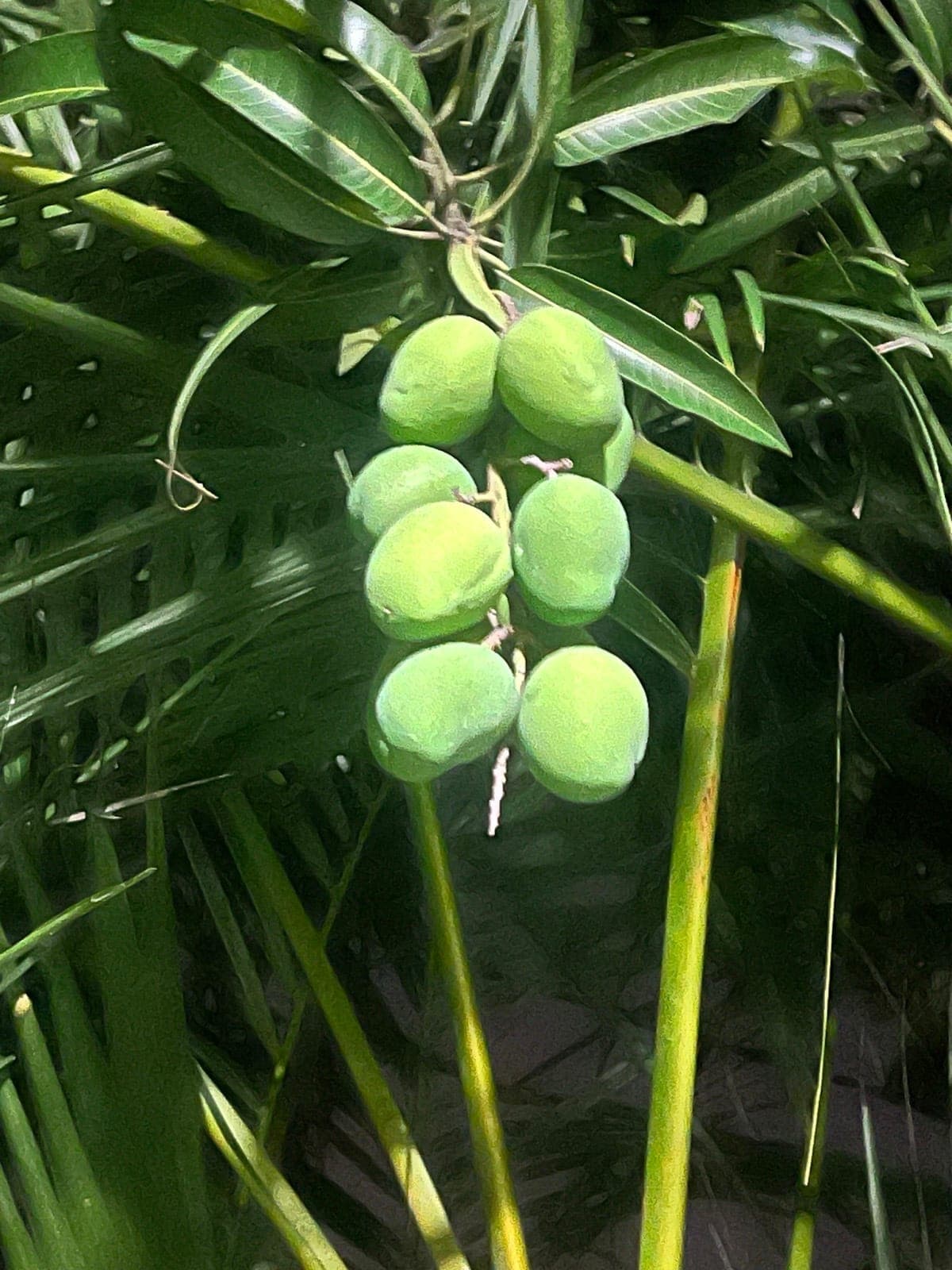
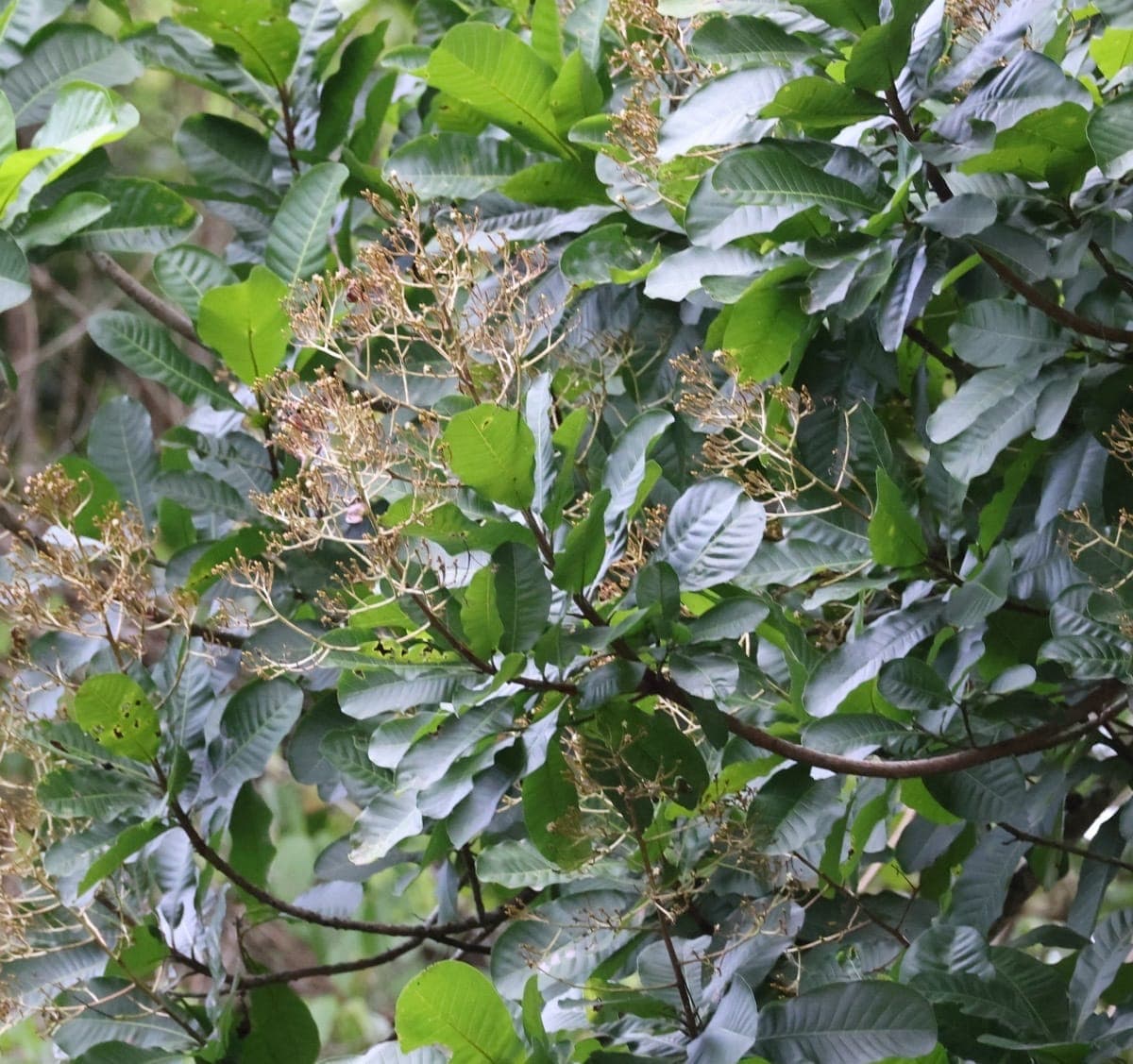
Mango
Mangifera indica
Espavel
Anacardium excelsum
Mango vs. Espavel: Cultivated vs. Wild Anacardiaceae Giants
Key Difference
Mango is a cultivated fruit tree with single large fruits and dense crown; Espavel is a towering rainforest giant with massive buttress roots and cashew-like fruits.
Mango vs. Espavel: Cultivated and Wild Anacardiaceae
While both mango and espavel belong to the Anacardiaceae (cashew) family, they occupy completely different ecological niches in Costa Rica. Mango is the familiar cultivated fruit tree found in gardens and farms, while espavel is a majestic native forest giant that towers over riverbanks. Despite their family relationship, these trees are easy to distinguish once you know what to look for.
Mango: Medium-sized cultivated tree (15-30m), dense rounded crown, found in gardens/farms, single large fleshy fruits. Espavel: Towering forest giant (40-50m), massive buttress roots extending several meters, grows along rivers, cashew-like fruits with nut attached to fleshy base.
Side-by-Side Comparison
Detailed Comparison Table
| Feature | Mango (Mangifera indica) | Espavel (Anacardium excelsum) | | ----------------------- | -------------------------------------- | --------------------------------------------- | | Tree Type | Cultivated fruit tree | Wild rainforest emergent | | Height | 15-30 m (occasionally 40 m) | 40-50 m (up to 60 m) | | Trunk Features | Straight trunk, no buttresses | Massive buttress roots 3-5 m high | | Trunk Diameter | 50-100 cm | Up to 200-300 cm | | Crown Shape | Dense, rounded, symmetrical | Spreading, emergent above canopy | | Typical Habitat | Gardens, farms, urban areas | Riverbanks, lowland rainforests | | Fruit Type | Single drupe (traditional mango) | Cashew-like: nut + fleshy "apple" | | Fruit Size | 10-25 cm long, single fruit | Nut 2-3 cm + cashew apple 5-8 cm | | Edible Part | Flesh around seed | Roasted nut (raw nuts toxic!) | | Leaf Size | 15-30 cm long, 2-8 cm wide | 15-30 cm long, 8-15 cm wide | | Leaf Shape | Lanceolate, pointed tip | Obovate to elliptic, broader | | Leaf Color | Dark green (reddish when new) | Bright to dark green | | Bark | Rough, dark gray-brown, fissured | Gray to brown, smooth to slightly fissured | | Flowering Season | December-March | November-January | | Fruiting Season | April-August | December-March | | Origin | Southeast Asia (introduced) | Native (Honduras to Ecuador) | | Common Setting | Plantations, gardens, urban streets | Wild riverbanks, protected forests | | Conservation Status | Least Concern (widely cultivated) | Least Concern (but habitat-dependent) | | Wildlife Value | Moderate (fruit bats, birds eat fruit) | Very high (critical food source for wildlife) | | Wood Quality | Not typically used for timber | Light, soft, limited timber use |
Key Identification Features
1. Tree Size & Structure (Most Diagnostic!)
Mango:
- Medium-sized tree: 15-30 m tall (occasionally to 40 m)
- NO buttress roots - straight single trunk
- Dense, rounded, symmetrical crown
- Trunk diameter: 50-100 cm
- Cultivated appearance - well-maintained, often pruned
- Typically found in open areas, gardens, farms
Espavel:
- Forest giant: 40-50 m tall (up to 60 m!)
- MASSIVE buttress roots extending 3-5 m up trunk and several meters outward
- Emergent crown towers above rainforest canopy
- Trunk diameter: Up to 200-300 cm
- Wild, natural appearance - unpruned, impressive stature
- Grows along rivers and streams in lowland forests
If you see massive triangular buttress roots extending like walls from the base of the tree, it's definitely an Espavel - mangoes never develop buttresses!
2. Habitat & Location
Mango:
- Cultivated settings: Gardens, yards, farms, plantations
- Urban areas: Streets, parks, landscaping
- Elevation: Sea level to 1,200 m (tolerates various conditions)
- Soil: Adaptable - grows in many soil types
- Location: Full sun, open areas
- Human association: Always near human habitation
Espavel:
- Wild forests: Primary and secondary rainforests
- Riparian zones: Along rivers, streams, floodplains
- Elevation: 0-800 m (lowland forests only)
- Soil: Alluvial soils, seasonally flooded areas
- Location: Deep forest, riverbanks
- Human association: Remote forests, protected areas
3. Fruit Structure
Mango:
- Single large drupe - the familiar mango fruit
- Oval to kidney-shaped, 10-25 cm long
- Hangs from stem on panicle
- Colors: Green, yellow, orange, red (various cultivars)
- Flesh surrounds large flat seed
- Seed NOT eaten
- Sweet, aromatic flesh eaten fresh
Espavel:
- Cashew-like double structure: Fleshy "apple" + hard nut
- Cashew apple: Yellow-orange, 5-8 cm, swollen receptacle
- Nut: Kidney-shaped, 2-3 cm, attached at BASE of apple
- Apple is edible but not commonly eaten
- Nut is edible ONLY when properly roasted
- Raw nuts contain anacardic acid and cardol (caustic, skin-irritating compounds related to urushiol)
- Important wildlife food source
4. Leaves
Mango:
- Lanceolate to oblong shape
- 15-30 cm long, 2-8 cm wide (narrow)
- Pointed tip (acuminate)
- Dark green above, lighter below
- Reddish or bronze when young, turning dark green
- Strong mango scent when crushed
- Alternate arrangement in clusters
Espavel:
- Obovate to elliptic shape
- 15-30 cm long, 8-15 cm wide (broader)
- Rounded to slightly pointed tip
- Bright to dark green
- Uniform green color (not reddish when new)
- Leathery texture, glossy above
- Simple, alternate, clustered at branch ends
- Briefly deciduous in dry season
5. Bark
Mango:
- Rough texture throughout
- Dark gray-brown color
- Deeply fissured on mature trees
- Resinous sap when damaged
- Consistent appearance
Espavel:
- Gray to brown, relatively smooth
- Becomes slightly fissured with age
- Lighter colored than mango
- Less deeply fissured
- Latex contains irritating compounds
Anacardiaceae Irritant Warning - Both Trees Have It!
Both trees are in the Anacardiaceae family and contain irritant phenolic compounds — structurally related to urushiol (the compound in poison ivy). Mango sap contains mangol and cardol; Espavel nuts and sap contain anacardic acid and cardol. These compounds cause contact dermatitis similar to poison ivy in sensitive individuals.
Mango Irritant Exposure
- Location: Highest in peel and sap
- Fruit flesh: Generally safe to eat
- Sap contact: Contains mangol and cardol; can cause skin rash in sensitive people
- "Mango mouth": Rash from eating unpeeled fruit
- Risk level: Moderate - most people tolerate mangoes
Espavel Irritant Exposure
- Raw nut shell: Contains anacardic acid and cardol (caustic, like raw cashew shell)
- Sap/bark: Contains irritating phenolic compounds
- Roasting required: Nuts must be roasted to destroy toxins
- Cashew apple: Generally safe
- Risk level: Moderate to high if handling raw nuts
Safety Guidelines
- Wear gloves when harvesting either species
- Peel mangoes carefully - avoid skin contact with peel
- NEVER eat raw Espavel nuts - roasting required
- Wash hands after handling either tree
- Sensitive individuals: Extra caution with both species
- Cross-reactivity: If allergic to cashews, avoid Espavel nuts
When Confusion Might Occur
Situations Where They Might Be Confused:
- Young cultivated Espavel: Occasionally planted as an ornamental (rare)
- Large old Mangoes: Can appear massive but still lack buttresses
- Anacardiaceae family knowledge: "Oh, they're related!" doesn't mean they look alike
Easy Ways to Tell Them Apart:
- Check for buttress roots - Only Espavel has them
- Look at habitat - Cultivated garden vs. wild riverbank
- Measure tree height - Espavel towers above mango
- Examine fruit structure - Single mango vs. cashew-like structure
- Consider location - Urban/farm vs. deep forest
Ecological & Cultural Roles
Mango
Ecological Role:
- Moderate wildlife value (fruit bats, birds eat fruit)
- Provides shade in agroforestry systems
- Widely cultivated for commercial fruit production
Cultural Importance:
- Beloved fruit tree throughout Costa Rica
- Important cash crop for small farmers
- Cultural significance in Asian and tropical regions
- Street tree in many towns and cities
Uses:
- Fresh fruit consumption (most important)
- Processed products (dried, juice, preserves)
- Wood occasionally used for crafts
- Shade and ornamental value
Espavel
Ecological Role:
- Keystone species in riparian forests
- Critical food source for wildlife (agoutis, squirrels, birds, monkeys)
- Massive trees provide habitat for epiphytes and wildlife
- Buttress roots prevent riverbank erosion
- Emergent canopy provides nesting sites
Cultural Importance:
- Traditional food source (roasted nuts)
- Sacred to some indigenous communities
- Important indicator of healthy riparian ecosystems
- Symbol of old-growth forest
Uses:
- Edible nuts (traditional food)
- Limited timber use (wood is soft)
- Watershed protection (erosion control)
- Wildlife habitat conservation
- Ecotourism value (impressive trees attract visitors)
Quick Visual ID Guide
🔍Quick ID
See Massive Buttress Roots?
- YES → Espavel (only Espavel has huge buttresses)
- NO → Continue checking
Where is the Tree Growing?
- Garden/Farm/Urban → Likely Mango
- Wild Riverbank/Forest → Likely Espavel
What's the Tree Height?
- 15-30 m with dense crown → Likely Mango
- 40-50 m towering above canopy → Definitely Espavel
What Type of Fruit?
- Single large mango fruit → Mango
- Cashew-like nut + apple → Espavel
Summary: Key Differences at a Glance
Related Comparisons
- Mango vs. Marañón - Compare mango with its closer relative, the cultivated cashew
- Espavel species page - Learn more about this rainforest giant
- Mango species page - Explore the cultivated mango in detail
Conclusion
While mango and espavel share membership in the Anacardiaceae family and both contain irritant phenolic compounds (structurally related to urushiol), they are remarkably different trees occupying completely different niches:
Choose Mango if you're looking at:
- A cultivated fruit tree in a garden or farm
- A medium-sized tree with a dense rounded crown
- A tree with NO buttress roots
- A tree producing familiar mango fruits
Choose Espavel if you're looking at:
- A towering forest giant along a riverbank
- One of the tallest trees around with emergent crown
- A tree with MASSIVE triangular buttress roots
- A tree producing cashew-like fruits (nut + apple)
The most reliable field test: Look for buttresses! If you see massive buttress roots extending several meters from the base, you're looking at an Espavel. Mango never develops buttresses.
Want to explore more?
Use our interactive tool to compare these species side by side.
Compare in interactive tool