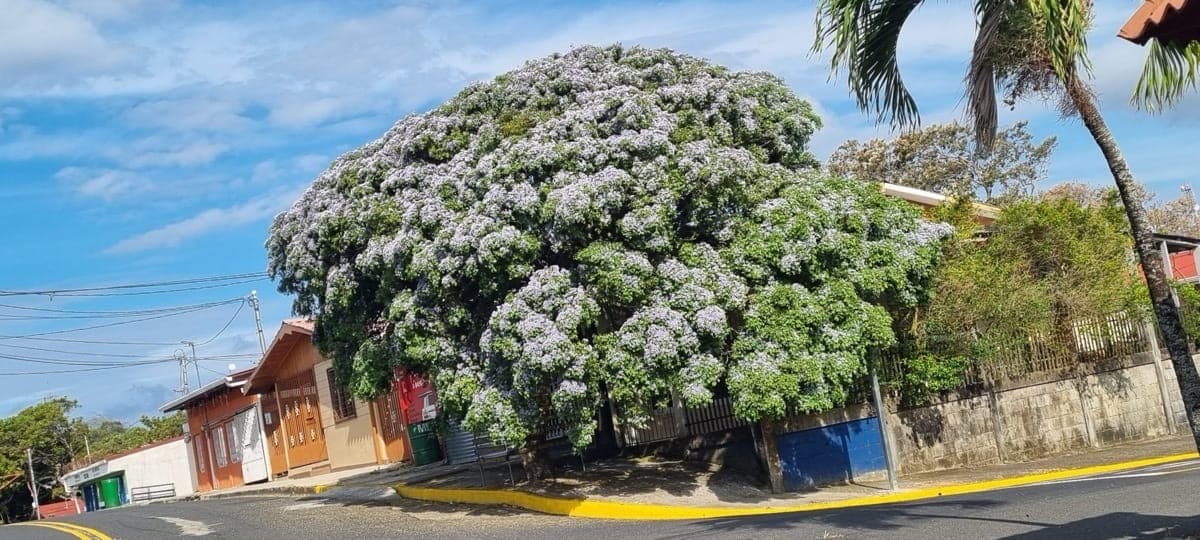
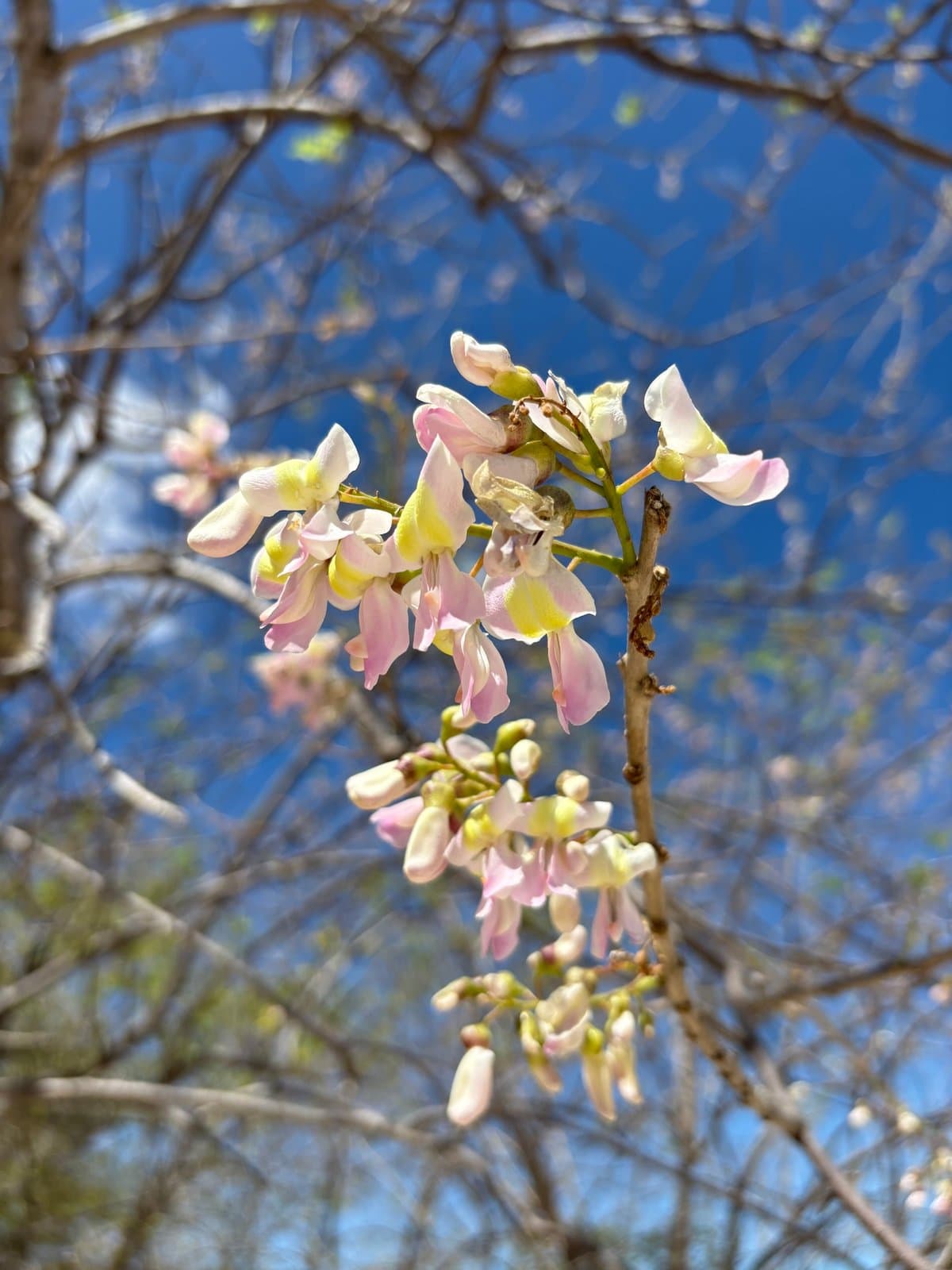
Guayacán Real
Guaiacum sanctum
Madero Negro
Gliricidia sepium
Guayacán Real vs. Madero Negro: Precious Wood vs. Practical Pioneer
Key Difference
Guayacán Real is an endangered slow-growing tree producing the world's densest wood, while Madero Negro is a fast-growing nitrogen-fixing legume used as living fences and coffee shade.
Guayacán Real vs. Madero Negro: The Hardwood Contrast
Two medium-sized trees both valued for their wood and practical uses, but representing opposite ends of the sustainability spectrum. One is critically endangered from overexploitation; the other is planted by the millions as a conservation solution.
Guayacán Real = ENDANGERED (CITES-protected, slow-growing, overexploited) Madero Negro = CONSERVATION TOOL (fast-growing, nitrogen-fixing, widely planted) Understanding this difference is crucial for sustainable forestry and reforestation.
The One-Minute ID Test
Look at the leaves:
- Small compound leaves with 6-10 tiny paired leaflets → Guayacán Real
- Large pinnate leaves with 7-17 large leaflets → Madero Negro
Check the flowers:
- Deep blue flowers (rare in trees) → Guayacán Real
- Bright pink/purple pea-like flowers → Madero Negro
Growth rate observation:
- Very slow growth, mature small tree → Guayacán Real
- Extremely fast growth, coppices vigorously → Madero Negro
🔍Quick Identification Guide
Side-by-Side Comparison
Detailed Comparison Table
| Feature | Guayacán Real (Guaiacum sanctum) | Madero Negro (Gliricidia sepium) | | --------------------------- | ----------------------------------------------------------- | -------------------------------------------------- | | Family | Zygophyllaceae (Caltrop) | Fabaceae (Legume/Pea) | | Common Names | Lignum Vitae, Holywood, Guayacán Santo | Madre de Cacao, Madreado, Piñón Cubano, Mata Ratón | | Maximum Height | 8-15 m (26-50 ft) - SMALL tree | 10-15 m (33-50 ft) - MEDIUM tree | | Trunk Diameter | Up to 60 cm (very dense) | 30-50 cm (moderate density) | | Growth Rate | VERY SLOW (inches/year) | VERY FAST (2-3 m/year) | | Time to Maturity | 50-100+ years | 3-5 years | | Leaf Type | Compound, paired leaflets (paripinnate) | Pinnate compound, alternating leaflets | | Leaflet Count | 6-10 leaflets (3-5 pairs), SMALL (1-2 cm) | 7-17 leaflets, LARGE (3-7 cm) | | Leaf Texture | Thick, leathery, evergreen | Thin, smooth, deciduous | | Leaf Color | Dark green, glossy | Bright green | | Deciduous/Evergreen | Evergreen (keeps leaves year-round) | Deciduous (drops leaves in dry season) | | Flower Type | 5-petaled, deep blue/purple (rare!) | Pea-like, bilateral symmetry (legume) | | Flower Color | DEEP BLUE to purple (unique) | PINK to purple-pink | | Flower Display | Modest, scattered blooms | SPECTACULAR mass blooming | | Flowering Season | March-April | December-March (dry season peak) | | Fruiting Season | June-July | May-June | | Fruit Type | Fleshy capsule (orange when ripe) | Legume pods (brown, 10-15 cm) | | Wood Density (SG) | 1.2-1.3 (DENSEST commercial wood) | 0.6-0.7 (moderate hardwood) | | Wood Sinks in Water? | YES (so dense it sinks!) | NO (normal buoyancy) | | Wood Color | Dark greenish-brown heartwood | Yellowish-brown to dark brown | | Wood Uses | Self-lubricating bearings, carvings, scientific instruments | Firewood, posts, living fences, charcoal | | Nitrogen Fixation | NO (not a legume) | YES (root nodules fix 100+ kg N/ha/year) | | Propagation | Seeds (slow), cuttings difficult | Cuttings (EASY - just stick in ground!) | | Ease of Cultivation | DIFFICULT (slow, finicky) | EXTREMELY EASY (fool-proof) | | Conservation Status | ENDANGERED (CITES Appendix II) | Least Concern (widely cultivated) | | Main Traditional Use | Premium timber, medicine | Living fences, coffee/cacao shade | | Main Modern Use | Ornamental, conservation | Agroforestry, reforestation, fodder | | Toxicity to Humans | LOW (medicinal resin safe in small amounts) | MODERATE (seeds toxic, bark poison) | | Pet Safety | Generally safe | Seeds toxic to rodents, horses, pigs, chickens | | Distribution in CR | Guanacaste, Puntarenas (Pacific dry forest ONLY) | ALL provinces, widely cultivated | | Elevation Range | 0-600 m (lowland coastal) | 0-1400 m (broad range) | | Soil Tolerance | Needs well-drained, struggles in poor soils | HIGHLY adaptable, thrives in poor soils | | Drought Tolerance | HIGH (native to dry forests) | HIGH (survives on 800mm rainfall) | | Planting Recommendation | Protected conservation only | Highly recommended for agroforestry |
Growth & Cultivation Contrast
Guayacán Real: The Precious Heirloom
Slow Growth - Generational Investment:
- Grows inches per year (not feet!)
- Takes 50-100+ years to reach harvestable size
- Small tree at maturity (8-15 m tall)
- Trunk diameter increases painfully slowly
- Wood so dense (SG 1.2-1.3) growth is agonizingly slow
- One generation plants, grandchildren see mature tree
Difficult Cultivation:
- Seeds germinate slowly and erratically
- Seedlings very slow to establish
- Cuttings difficult to root
- Requires well-drained soil, struggles in poor conditions
- Sensitive to frost and cold
- Not suitable for degraded land restoration
- Needs decades of care before any return
Historical Overexploitation:
- Centuries of harvesting for "wood of life"
- Ships' propeller shaft bearings (self-lubricating)
- Police batons and bowling balls (dense, hard)
- Scientific instruments requiring precision
- Result: Now endangered, CITES-protected
Modern Conservation Approach:
- Listed CITES Appendix II (monitored trade)
- Protected in remaining dry forests
- Ornamental planting encouraged
- Harvesting heavily restricted
- Focus on preservation, not production
Madero Negro: The Fast Multiplier
Explosive Growth - Instant Results:
- Grows 2-3 meters per year (6-10 feet!)
- Living fence established in 1-2 years
- Reaches mature height in 3-5 years
- Coppices vigorously when cut back
- Can be harvested for poles/firewood within 3 years
- Plant a fence post, have a tree within a year
Ridiculously Easy Propagation:
- Take a cutting, stick it in ground, done
- Hardwood stakes 1-2 m long root easily
- No rooting hormone needed
- 80-95% success rate
- Plant at start of rainy season (May-June)
- Water for 2-3 months, then forget it
- Can create 100 trees from one mature tree
Multipurpose Agroforestry Star:
- Living fences: Plant 1-2 m apart, forms dense hedge
- Coffee/cacao shade: 3-4 m spacing, provides ideal filtered light
- Nitrogen fixation: Root nodules add 100+ kg N/ha/year
- Livestock fodder: Leaves are 20-30% protein
- Firewood/charcoal: Coppicing provides renewable fuel
- Green manure: Prunings improve soil
- Erosion control: Fast root growth stabilizes slopes
Conservation & Reforestation Tool:
- Planted by the millions across Central America
- Restores degraded agricultural land
- Nurse crop for slower-growing natives
- Prevents soil erosion on slopes
- Provides income while natives grow
- Example of SUSTAINABLE forestry
Botanical Family Differences
Guayacán Real: Zygophyllaceae (Caltrop Family)
Unusual Family:
- Small tropical family (~300 species worldwide)
- NOT a legume - does NOT fix nitrogen
- Resinous wood with medicinal properties
- Often adapted to arid environments
- Famous members: Creosote bush, other Guaiacum species
Leaf Structure:
- Paripinnate (even-pinnate) - no terminal leaflet
- Leaflets in 3-5 PAIRS (6-10 total)
- Leaflets TINY (1-2 cm long)
- Opposite arrangement on rachis
- Thick, waxy, leathery texture
- Dark green, glossy
Flower Structure:
- 5 separate petals (not fused)
- Radial symmetry
- DEEP BLUE color (extremely rare in trees!)
- 10 stamens
- Superior ovary
- Not a legume flower
Madero Negro: Fabaceae (Legume Family)
Classic Legume:
- One of world's largest plant families (20,000+ species)
- Nitrogen-fixing root nodules (Rhizobium bacteria)
- Characteristic legume pods
- Protein-rich foliage
- Famous members: Guanacaste, Cenízaro, Poró, beans, peas
Leaf Structure:
- Imparipinnate (odd-pinnate) - terminal leaflet present
- 7-17 leaflets, alternating (not paired)
- Leaflets LARGE (3-7 cm long)
- Alternate arrangement on rachis
- Thin, smooth texture
- Bright green
Flower Structure:
- Papilionaceous (butterfly-like)
- Bilateral symmetry (not radial)
- Pink/purple color
- Typical legume structure: banner, wings, keel
- 10 stamens (9 fused, 1 free)
- CLEARLY a pea-family flower
Wood Properties: Extreme Contrast
Guayacán Real: The Densest Wood
Extraordinary Physical Properties:
- Specific Gravity: 1.2-1.3 (one of world's densest)
- Sinks in water like a stone
- Janka Hardness: 4,000+ lbf (incredibly hard)
- Self-lubricating: Natural resin content = 25-30%
- Extremely slow grain (tight annual rings)
- Dark greenish-brown heartwood
- Virtually no sapwood distinction
Historical Industrial Uses:
- Ship propeller shaft bearings (pre-metal bearings)
- Stern tube bearings for naval vessels
- Police truncheons/batons (indestructible)
- Bowling balls (before plastic)
- Mortar and pestles (incredibly hard)
- Precision scientific instruments (stable, no expansion)
- Rolling mill bearings (textile industry)
Why Self-Lubricating?
- Wood naturally contains 25-30% resin
- Under friction, resin melts and lubricates surfaces
- Bearings lasted 30-40 years underwater!
- Eliminated need for oil/grease
- Revolutionary technology pre-1900s
Modern Wood Uses (Limited):
- Premium wood carvings (takes incredible detail)
- Specialty tool handles (indestructible)
- Collectors' items (bowls, boxes)
- Restoration of historic ships
- Harvesting highly restricted due to endangerment
Madero Negro: The Practical Wood
Moderate Physical Properties:
- Specific Gravity: 0.6-0.7 (typical hardwood)
- Floats normally in water
- Janka Hardness: ~1,000 lbf (moderate)
- No special resin content
- Moderate grain
- Yellowish to dark brown
- Distinct sapwood/heartwood
Traditional Rural Uses:
- Living fence posts (most common use)
- Firewood (burns hot, good heat)
- Charcoal production
- Temporary construction poles
- Rustic furniture
- Tool handles (machetes, hoes)
- Fuel for brick/lime kilns
Why NOT Premium Timber:
- Moderately hard but nothing special
- No unique properties like Guayacán
- Abundant and fast-growing (no scarcity value)
- Better known for NON-timber uses
- Value is in living tree, not dead wood
Real Value in Living State:
- Living fences (eliminates need for wire/posts)
- Shade tree benefits (coffee/cacao yields)
- Nitrogen fixation (soil improvement)
- Livestock fodder (protein source)
- Carbon sequestration
- Keep it alive, it's worth more!
Flower Displays: Blue Rarity vs. Pink Abundance
Guayacán Real: The Blue Marvel
Deep Blue Flowers (Extremely Rare):
- One of very few trees with TRUE BLUE flowers
- 5-petaled, 2-3 cm diameter
- Deep blue to purple-blue
- Star-shaped (radial symmetry)
- Sweet fragrance
- Appear in clusters at branch tips
Why Blue is Rare in Trees:
- Blue pigments (anthocyanins) difficult to produce
- Most "blue" flowers are actually violet/purple
- True blue requires specific pH conditions in petals
- Evolutionarily uncommon in woody plants
- Makes Guayacán Real HIGHLY ORNAMENTAL
Flowering Pattern:
- March-April (peak dry season)
- Modest display (not mass flowering)
- Tree often has scattered blooms
- Flowers appear periodically year-round
- Seeds follow in June-July (orange capsules)
Madero Negro: The Pink Carpet
Spectacular Mass Blooming:
- Thousands of pink flowers simultaneously
- Covers entire tree canopy
- Tree looks like pink cloud from distance
- Flowers appear BEFORE leaves (deciduous)
- Carpets ground with fallen pink petals
- Visible for kilometers
Typical Legume Flowers:
- Papilionaceous (butterfly-shaped)
- Bilateral symmetry (like sweet pea)
- Banner petal (top), 2 wing petals (sides), keel (bottom)
- Pink to purple-pink to lilac
- 1-2 cm long
- In dense racemes (flower clusters)
Flowering Pattern:
- December-March (dry season peak)
- Synchronized mass flowering
- Trees lose leaves, then flower
- Weeks of pink display
- Signal for planting season (traditional knowledge)
- Seed pods follow in May-June
Cultural Importance:
- "When Madero Negro blooms, plant your corn"
- Flowering marks transition from dry to wet season
- Traditional phenological calendar
- Spectacular visual event in rural landscapes
Ecological Roles
Guayacán Real: Dry Forest Specialist
Habitat:
- Pacific dry forests (Guanacaste, Puntarenas)
- Lowland coastal (0-600m elevation)
- Rocky, well-drained soils
- Seasonally very dry (4-6 month drought)
- Often on limestone outcrops
Ecosystem Role:
- Indicator of intact dry tropical forest
- Slow-growing climax species
- Provides nectar for pollinators (rare blue flowers)
- Seeds eaten by some bird species
- Dense wood provides long-lasting deadwood habitat
- Survivor in harsh dry conditions
Conservation Importance:
- Dry forests most threatened ecosystem in Central America
- Guayacán presence indicates ecological quality
- Slow growth makes restoration very difficult
- Protecting existing trees is critical
- Cannot be "replanted" on human timescales
Madero Negro: The Ecosystem Engineer
Habitat:
- Naturally in moist to seasonally dry forests
- Cultivated in ALL climate zones 0-1400m
- Thrives in degraded/marginal soils
- Roadside, fence lines, agricultural land
- Essentially everywhere humans need a quick tree
Ecosystem Role (Positive):
- Nitrogen fixation: Adds 100+ kg N/ha/year to soil
- Improves soil fertility for adjacent crops
- Provides nectar for bees (honey production)
- Flowers feed hummingbirds
- Leaves feed livestock (protein source)
- Fast biomass production for mulch/compost
- Erosion control on slopes
- Pioneer species on degraded land
- Nurse tree for slower-growing natives
Agroforestry Superstar:
- Coffee/cacao shade: Provides ideal 30-50% shade
- Living fences: Eliminates barbed wire
- Alley cropping: Allows crops between rows
- Fodder banks: Continuous protein source
- Firewood lots: Sustainable fuel production
- Windbreaks: Protects crops from wind damage
Traditional & Modern Uses
Guayacán Real: The Medicinal & Industrial Marvel
Traditional Medicine (Historic):
- Resin used to treat arthritis, gout, syphilis
- "Guaiac" test for blood detection (forensic)
- Anti-inflammatory properties (validated by science)
- Treatment for respiratory ailments
- Laxative in low doses
- Spanish imported tons to Europe (1500s-1800s)
Industrial Revolution Uses:
- Maritime industry: Billions of bearings produced
- Every ship had Guayacán bearings pre-1900
- Police/military: Truncheons, riot batons
- Textile mills: Bearing blocks
- Early machinery: Gears, bearings, bushings
- Precision equipment: Rulers, parallel bars
Modern Limited Uses:
- Ornamental landscaping (spectacular flowers)
- Wood carving by permitted artisans
- Scientific/historical restoration projects
- Botanical gardens (conservation collections)
- Harvesting commercial wood is restricted
Conservation Efforts:
- CITES monitoring of international trade
- Protected in national parks/reserves
- Encouragement of ornamental planting
- Research into sustainable harvesting
- Focus on PRESERVING existing trees
Madero Negro: The Multipurpose Workhorse
Daily Rural Life:
- Living fences everywhere in Costa Rica
- Coffee/cacao farms all use Madero Negro shade
- Livestock farmers cut branches for fodder daily
- Rural homes use for firewood/charcoal
- Children recognize flowering as seasonal marker
- Most planted tree in Central American agriculture
Modern Agroforestry:
- Recommended by agricultural extension services
- Carbon sequestration projects
- Erosion control on degraded slopes
- Sustainable fuel wood production
- Protein supplement for cattle (reduces need for grain)
- Alley cropping systems (crops between tree rows)
- Reforestation of abandoned pastures
Industrial Uses:
- Charcoal for grilling
- Firewood for brick kilns
- Living fence posts (most common)
- Temporary construction poles
- Pulp for paper (experimental)
Rodenticide (Historic):
- Seeds/bark contain rotenone (rat poison)
- Ground seeds mixed with bait to kill rats/mice
- "Mata Ratón" = rat killer (common name)
- Modern rodenticides preferred now
- Seeds still toxic - keep away from pets
Conservation Status: Critical Difference
Guayacán Real: ENDANGERED
Why Endangered:
- Overexploitation: Centuries of unsustainable harvesting
- Slow growth: Cannot regenerate on human timescales
- Small range: Restricted to dry forests (already rare habitat)
- Habitat loss: 98% of Central American dry forests destroyed
- Climate change: Threatens remaining dry forest habitat
- Historical demand: Industrial uses depleted populations
CITES Protection:
- Listed Appendix II (monitored trade)
- Export permits required
- Importers must verify legal sourcing
- Commercial harvesting restricted
- Violations can result in heavy fines
What This Means:
- DO NOT harvest wild trees
- Protect existing trees on your property
- Plant for ornamental value only (not timber)
- Report illegal harvesting to authorities
- Will not see harvestable timber in your lifetime
- Grandchildren won't see it either (needs 100+ years)
Current Populations:
- Scattered individuals in protected areas
- Some in private properties (often don't know what they have)
- Dry forests being restored with Guayacán plantings
- Recovery will take centuries even with protection
Madero Negro: CONSERVATION TOOL
Why Least Concern:
- Planted by millions across Central America
- Fast growth allows sustainable use
- Easy propagation from cuttings
- Wide adaptability to many climates
- Multiple uses maintain farmer interest
- No threat of depletion
Positive Conservation Impact:
- Reduces pressure on natural forests (fuel wood)
- Enables sustainable agriculture (living fences)
- Improves soil fertility (nitrogen fixation)
- Restores degraded lands
- Provides habitat for wildlife in agricultural landscapes
- Example of SUSTAINABLE resource use
What This Means:
- Plant freely, use abundantly
- Cut for firewood without guilt (coppices back)
- Use as living fences everywhere
- Encourage neighbors to plant
- Can harvest within 3-5 years, over and over
- Model for sustainable forestry
Identification Keys
Leaves (Most Reliable)
Guayacán Real:
- Compound leaf: 6-10 TINY leaflets (1-2 cm long)
- Paripinnate: Leaflets in 3-5 PAIRS (no terminal leaflet)
- Opposite arrangement: Paired perfectly along rachis
- Thick & leathery: Feels waxy, glossy dark green
- Evergreen: Keeps leaves year-round
- Overall length: 4-8 cm total leaf length
Madero Negro:
- Compound leaf: 7-17 LARGE leaflets (3-7 cm long)
- Imparipinnate: Leaflets alternating PLUS terminal leaflet
- Alternate arrangement: Leaflets staggered along rachis
- Thin & smooth: Papery texture, bright green
- Deciduous: Drops all leaves in dry season (Dec-Feb)
- Overall length: 15-30 cm total leaf length
Bark
Guayacán Real:
- Gray-brown to gray
- Finely fissured (shallow cracks)
- Tight, hard, difficult to peel
- Aromatic when cut (resinous)
- Very hard to damage (densest wood)
Madero Negro:
- Light gray to gray-brown
- Smooth to slightly rough
- Easily damaged (softer wood)
- Not particularly aromatic
- Cuts easily, lenticels visible
Trunk & Size
Guayacán Real:
- Small tree (8-15 m tall at maturity)
- Trunk diameter up to 60 cm (rare to see large ones)
- Often multi-stemmed or branching low
- Crooked, irregular form
- Extremely dense wood (try lifting a branch!)
Madero Negro:
- Medium tree (10-15 m tall), often kept shorter
- Trunk diameter 30-50 cm
- Usually single straight trunk (living fences)
- Can be branching if allowed to grow naturally
- Moderate wood density (normal hardwood)
When to See Each Tree
Guayacán Real
Flowering (March-April):
- BLUE flowers (rare, unmistakable)
- Peak dry season flowering
- Modest scattered blooms
- Tree retains leaves while flowering
Fruiting (June-July):
- Orange fleshy capsules
- 1-2 cm diameter
- Splits to release seeds
- Seeds eaten by some birds
Madero Negro
Flowering (December-March):
- SPECTACULAR pink mass blooming
- Tree drops leaves first (leafless)
- Entire canopy covered in pink
- Peak January-February
- Carpets ground with fallen petals
Fruiting (May-June):
- Legume pods 10-15 cm long
- Turn brown when dry
- Hang on tree, then drop
- Seeds toxic (rodenticide)
Planting Recommendations
Guayacán Real: Ornamental Only ✓ (with patience)
Plant For:
- Ornamental value (spectacular blue flowers)
- Conservation (every tree planted helps species)
- Botanical interest (rare in cultivation)
- Generational legacy (grandchildren will see mature tree)
- Supporting endangered species
NOT For:
- Timber production (illegal + requires 100+ years)
- Quick results (painfully slow growth)
- Agroforestry (no nitrogen fixation, too slow)
- Marginal/degraded soils (needs good conditions)
Growing Tips:
- Buy nursery-grown seedlings (don't dig from wild!)
- Plant in full sun, well-drained soil
- Protect from frost in first years
- Water regularly until established
- Be patient - this is a multi-generational project
- Mainly for Pacific dry forest zones (Guanacaste)
Long-term Value:
- Increases property value (rare ornamental)
- Supports conservation of endangered species
- Educational value (show children the densest wood)
- Beautiful blue flowers once mature
- Living heirloom for future generations
Madero Negro: HIGHLY Recommended ✓✓✓
Plant For:
- Living fences (best use - replace barbed wire)
- Coffee/cacao shade (industry standard)
- Nitrogen fixation (soil improvement)
- Livestock fodder (20-30% protein)
- Firewood production (sustainable)
- Reforestation (fast pioneer species)
- Erosion control (slopes, stream banks)
- Quick results (fence in 1-2 years!)
How to Plant:
- Get cuttings: Take 1-2 m long hardwood branches
- Timing: Plant at START of rainy season (May-June)
- Method: Push cutting 30-50 cm into soil
- Spacing: 1-2 m apart for fence, 3-4 m for shade
- Water: First 2-3 months, then forget it
- Success rate: 80-95% will root and grow
Management:
- Prune annually to maintain fence height
- Coppice every 1-2 years for fodder/firewood
- Allow some to grow as shade trees
- Cut branches for livestock during dry season
- Essentially zero maintenance required
Economics:
- Living fence costs: ~$200-500/km (cuttings + labor)
- Barbed wire fence: ~$2,000-3,000/km (posts + wire)
- Save money + get nitrogen fixation + fodder + firewood!
- Pays for itself in 1-2 years
Summary: Slow Treasure vs. Fast Multiplier
Guayacán Real and Madero Negro represent fundamentally different approaches to tree cultivation and forestry:
| Aspect | Guayacán Real 🐌🔵 | Madero Negro 🚀🌸 | | ------------------------ | -------------------------------- | ------------------------------------ | | Growth Speed | VERY SLOW (generational) | VERY FAST (immediate) | | Time to Mature | 50-100+ years | 3-5 years | | Wood Density | Heaviest on Earth (sinks) | Moderate (normal) | | Wood Value | Priceless (if legal) | Low (firewood) | | Conservation Status | ENDANGERED (protect!) | Abundant (plant freely) | | Ease of Cultivation | DIFFICULT (needs patience) | RIDICULOUSLY EASY (just plant stake) | | Nitrogen Fixation | NO (not legume) | YES (100+ kg N/ha/year) | | Best Use | Ornamental, conservation | Agroforestry, living fences | | Harvesting Timeline | Never in your lifetime | Every 1-3 years (coppicing) | | Propagation | Hard (seeds slow) | Easy (cuttings root anywhere) | | Flower Color | Deep blue (rare!) | Pink (spectacular!) | | Practical Value | Generational legacy | Immediate utility | | Planting Advice | Only for ornamental/conservation | Plant everywhere! | | Return on Investment | Your great-grandchildren | 1-2 years |
Key Takeaway
Guayacán Real = Plant for your great-grandchildren's great-grandchildren. Protect every existing tree. Appreciate the miracle of the densest wood on Earth. Enjoy the blue flowers. NEVER harvest commercially. This is a living treasure, not a timber crop.
Madero Negro = Plant today, use next year. The ultimate sustainable agroforestry solution. Cut it, it grows back stronger. Use it for everything. This is how forestry SHOULD work - fast, renewable, beneficial to soil, and economically practical.
One teaches patience and conservation. The other provides immediate, tangible benefits while restoring ecosystems. Both have their place in Costa Rican landscapes—understand the difference and choose wisely.
Learn More
- Full Guayacán Real Profile - Endangered species care, CITES status
- Full Madero Negro Profile - Agroforestry uses, propagation guide
- Conservation Guide - Protecting endangered trees
- Tree Safety Information - Toxicity of Madero Negro seeds
- CITES Species Database↗ - Trade restrictions for Guayacán
Want to explore more?
Use our interactive tool to compare these species side by side.
Compare in interactive tool