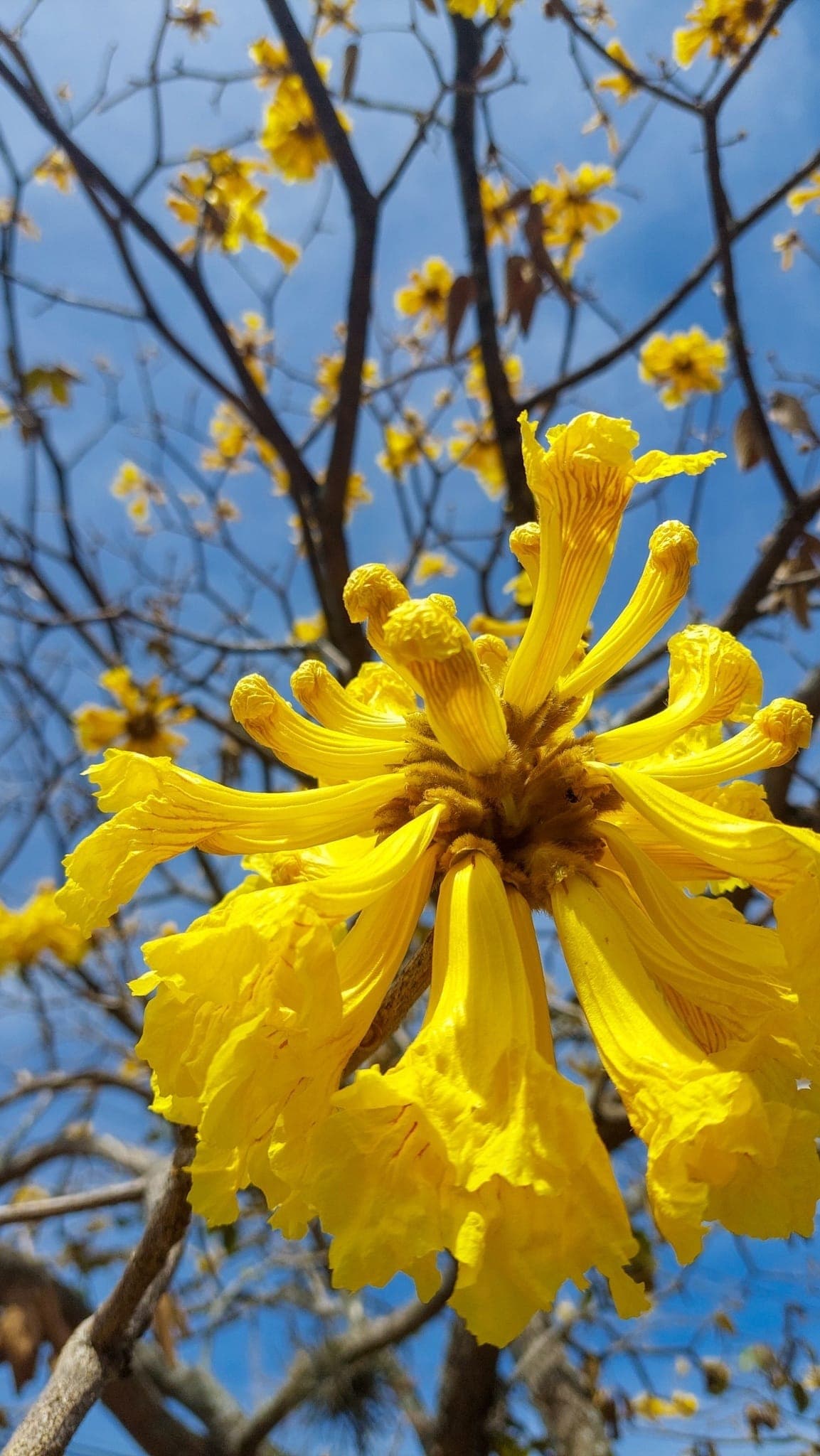
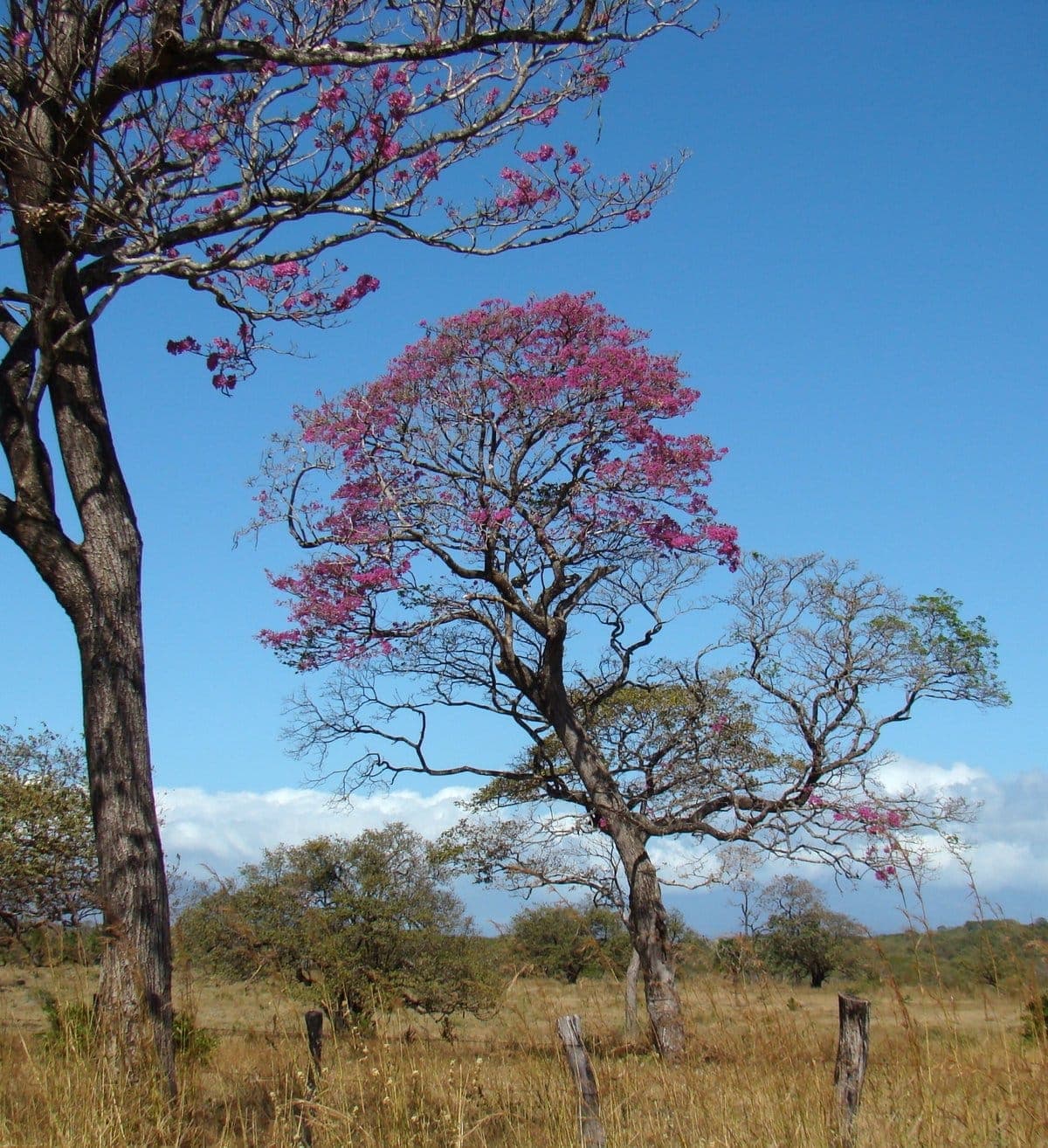
Corteza Amarilla
Handroanthus ochraceus
Cortez Negro
Tabebuia impetiginosa
Corteza Amarilla vs. Cortez Negro: Yellow vs. Pink Trumpet Trees
Key Difference
Corteza Amarilla has golden-yellow flowers (Mar-Apr); Cortez Negro has pink-purple flowers (Feb-Mar). Both bloom spectacularly when leafless, but flower color is unmistakable!
Corteza Amarilla vs. Cortez Negro: Costa Rica's Trumpet Tree Twins
These two iconic flowering trees share the "Cortez" name, belong to the same family (Bignoniaceae), and put on Costa Rica's most spectacular floral displays during the dry season. When blooming, they're unmistakable—one covers hillsides in golden yellow, the other in vivid pink-purple. But outside of flowering season, telling them apart requires closer observation. Both are prized ornamental and timber trees found throughout the country.
Corteza Amarilla: Bright golden-yellow trumpet flowers (March-April). Cortez Negro: Vivid pink to purple trumpet flowers (February-March). During flowering, identification is instant!
Side-by-Side Comparison
Detailed Comparison Table
| Feature | Corteza Amarilla (Handroanthus ochraceus) | Cortez Negro (Tabebuia impetiginosa) | | ----------------------- | ------------------------------------------- | -------------------------------------- | | Common Names | Yellow Cortez, Golden Trumpet Tree | Pink Trumpet Tree, Lapacho | | Flower Color | Bright golden-yellow | Pink to magenta-purple | | Tree Height | 15-25 m | 20-35 m (larger) | | Trunk Diameter | Up to 60 cm | Up to 100 cm (thicker) | | Bark Color | Yellowish-brown to tan | Gray to dark brown | | Bark Texture | Deeply fissured, rough | Less fissured, smoother | | Flowering Peak | March-April | February-March (slightly earlier) | | Flower Throat | Yellow with darker lines | Pink with yellow throat markings | | Flower Size | 5-8 cm long | 5-10 cm long (slightly larger) | | Leaves | 5 leaflets, palmately compound | 5 leaflets, palmately compound | | Leaflet Size | 5-12 cm long | 6-15 cm long (slightly larger) | | Leaflet Margin | Serrated (toothed) | Entire to slightly serrated | | Seed Pod | Linear, 15-35 cm long | Linear, 20-40 cm long | | Elevation Range | 0-800 m | 0-1200 m (wider range) | | Drought Tolerance | Good | Excellent | | Primary Habitat | Pacific dry forest | Both slopes, wider distribution | | Timber Quality | High-quality hardwood | Premium hardwood (Ipe/Lapacho) | | Conservation Status | Least Concern | Least Concern |
Key Identification Features
1. Flower Color (Definitive During Bloom!)
Corteza Amarilla:
- Flowers: Bright golden-yellow to orange-yellow
- Trumpet-shaped, 5-8 cm long
- Often with darker yellow/orange lines in throat
- Tree appears like a ball of yellow sunshine
- Blooms: March-April (peak dry season)
Cortez Negro:
- Flowers: Vivid pink to magenta-purple
- Trumpet-shaped, 5-10 cm long
- Yellow markings in throat
- Tree appears pink/purple from distance
- Blooms: February-March (earlier in dry season)
This is the easiest comparison in the entire tree atlas! Yellow flowers = Corteza Amarilla. Pink flowers = Cortez Negro. That's it!
2. Tree Size
Corteza Amarilla:
- Height: 15-25 m (medium-sized)
- Trunk: Up to 60 cm diameter
- Crown: Rounded, moderately spreading
- More compact overall
Cortez Negro:
- Height: 20-35 m (larger)
- Trunk: Up to 100 cm diameter
- Crown: Broader, more spreading
- More impressive stature
3. Bark Characteristics
Corteza Amarilla:
- Color: Yellowish-brown to tan (hence "amarilla"!)
- Texture: Deeply fissured, rough
- Pattern: Vertical ridges, corky
- Inner bark: Yellow-brown
Cortez Negro:
- Color: Gray to dark brown (hence "negro"!)
- Texture: Less deeply fissured, smoother
- Pattern: More subtle ridges
- Inner bark: Pinkish to brown
Amarilla = Yellow = Yellowish bark Negro = Black/Dark = Darker gray bark The names hint at the bark color as well as the darkness of the wood!
4. Leaves (When Present)
Both species have palmately compound leaves with 5 leaflets (like a hand), but:
Corteza Amarilla:
- Leaflets: 5-12 cm long
- Margin: Clearly serrated (toothed edges)
- Texture: Somewhat rough above
- Hairiness: Slightly pubescent below
Cortez Negro:
- Leaflets: 6-15 cm long (slightly larger)
- Margin: Entire to slightly serrated (smoother edges)
- Texture: Smoother, more leathery
- Hairiness: Nearly glabrous (smooth)
5. Habitat and Distribution
Corteza Amarilla:
- Pacific dry forest specialist
- Primarily Guanacaste, Puntarenas
- Elevation: 0-800 m (lower range)
- Prefers defined dry season
- Less common at higher elevations
Cortez Negro:
- Wider distribution - both slopes
- Found nationwide including Caribbean
- Elevation: 0-1200 m (wider range)
- More adaptable to different climates
- Common in urban plantings everywhere
Quick Decision Guide
🔍Corteza Amarilla vs. Cortez Negro
When They Look Most Similar
- Outside flowering season: Both are deciduous, leafless trees
- Young trees: Before bark character fully develops
- Distant viewing: Crown shapes can appear similar
- Mixed plantings: Sometimes planted together as "Cortez"
Both species produce valuable hardwood. Cortez Negro wood (marketed as "Lapacho" or "Ipe") is especially valuable for outdoor applications due to exceptional durability. Make sure you know which species you're buying or selling!
The "Cortez" Name Group
These two trees are part of a larger group of Bignoniaceae trumpet trees called "Cortez" in Costa Rica:
| Species | Common Name | Flower Color | Notes | | ------------------------ | ----------------- | --------------- | ---------------------------- | | Handroanthus ochraceus | Corteza Amarilla | Yellow | This comparison | | Tabebuia impetiginosa | Cortez Negro | Pink-purple | This comparison | | Tabebuia rosea | Roble de Sabana | Light pink | Lighter pink, different tree | | Handroanthus guayacan | Guayacán Amarillo | Yellow | Similar to Corteza Amarilla |
Ecological & Cultural Significance
Corteza Amarilla
- Dry forest indicator: Strong association with Pacific dry forests
- Pollinator magnet: Bees, butterflies flock to yellow blooms
- Photography subject: Iconic dry season landscapes
- Climate signal: Blooming indicates peak dry season
- Timber: High-quality wood for furniture and construction
Cortez Negro
- Urban champion: One of Costa Rica's favorite street trees
- Medicinal: Bark used traditionally (contains lapachol)
- Premium timber: "Lapacho/Ipe" wood extremely durable
- Wildlife: Important nectar source for hummingbirds, bees
- Cultural icon: Symbol of dry season beauty
Growing and Landscape Use
Both make excellent landscape trees, but:
Corteza Amarilla:
- Better for: Dry climate areas, smaller properties
- Space needed: 10-15 m radius
- Flowering: Peaks mid-dry season
- Character: More compact, garden-scale
Cortez Negro:
- Better for: Wider range of climates, larger properties
- Space needed: 12-18 m radius
- Flowering: Peaks early dry season
- Character: Grander, statement tree
Choose Corteza Amarilla if you see: Golden-yellow flowers, yellowish-brown bark, clearly serrated leaflets, smaller tree (15-25m), Pacific dry forest. Choose Cortez Negro if you see: Pink-purple flowers, gray to dark bark, smooth-edged leaflets, larger tree (20-35m), found nationwide.
Related Comparisons
- Corteza Amarilla vs. Roble de Sabana - Yellow vs. light pink Cortez
- Guayacán Real vs. Madero Negro - More timber tree comparisons
Want to explore more?
Use our interactive tool to compare these species side by side.
Compare in interactive tool