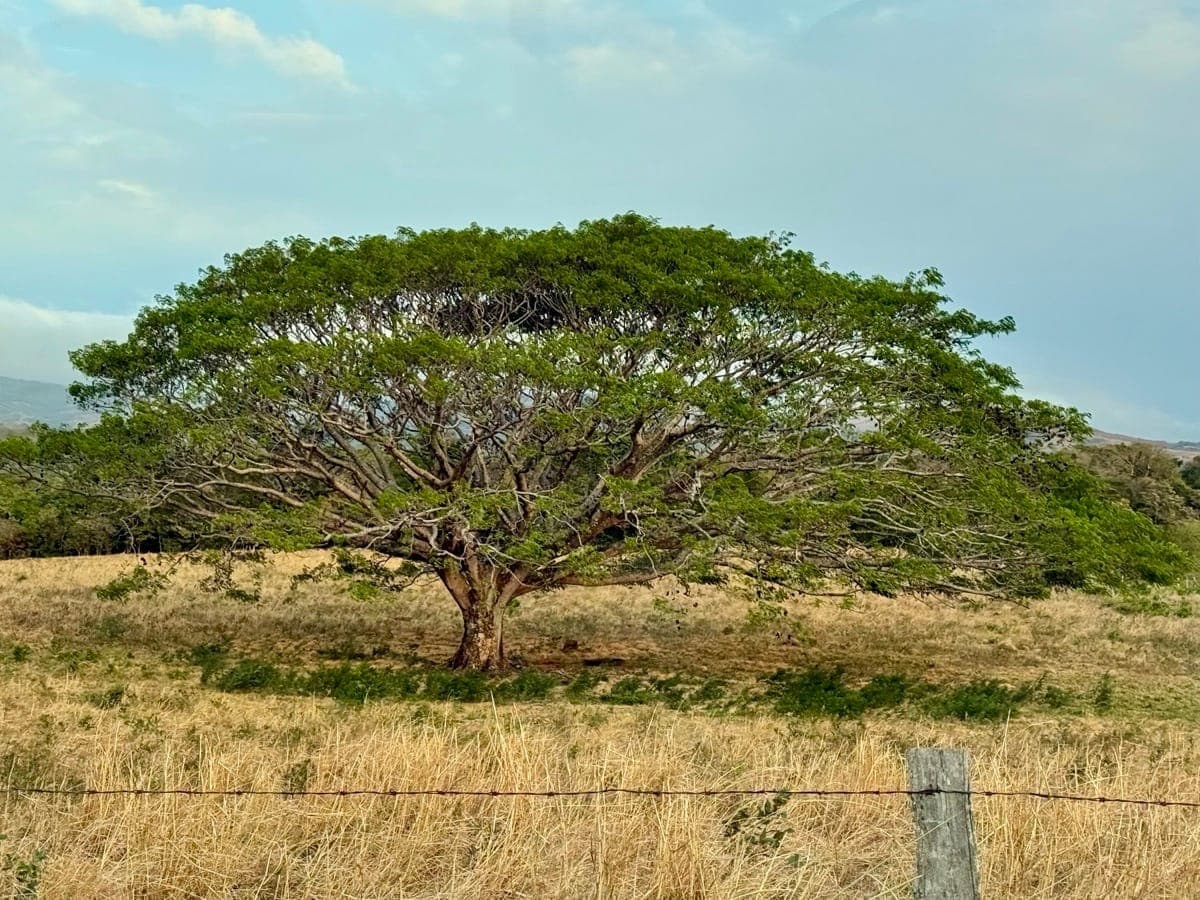
Guanacaste
Enterolobium cyclocarpum
Cenízaro
Samanea saman
Guanacaste vs. Cenízaro: Two Giants of the Dry Forest
Key Difference
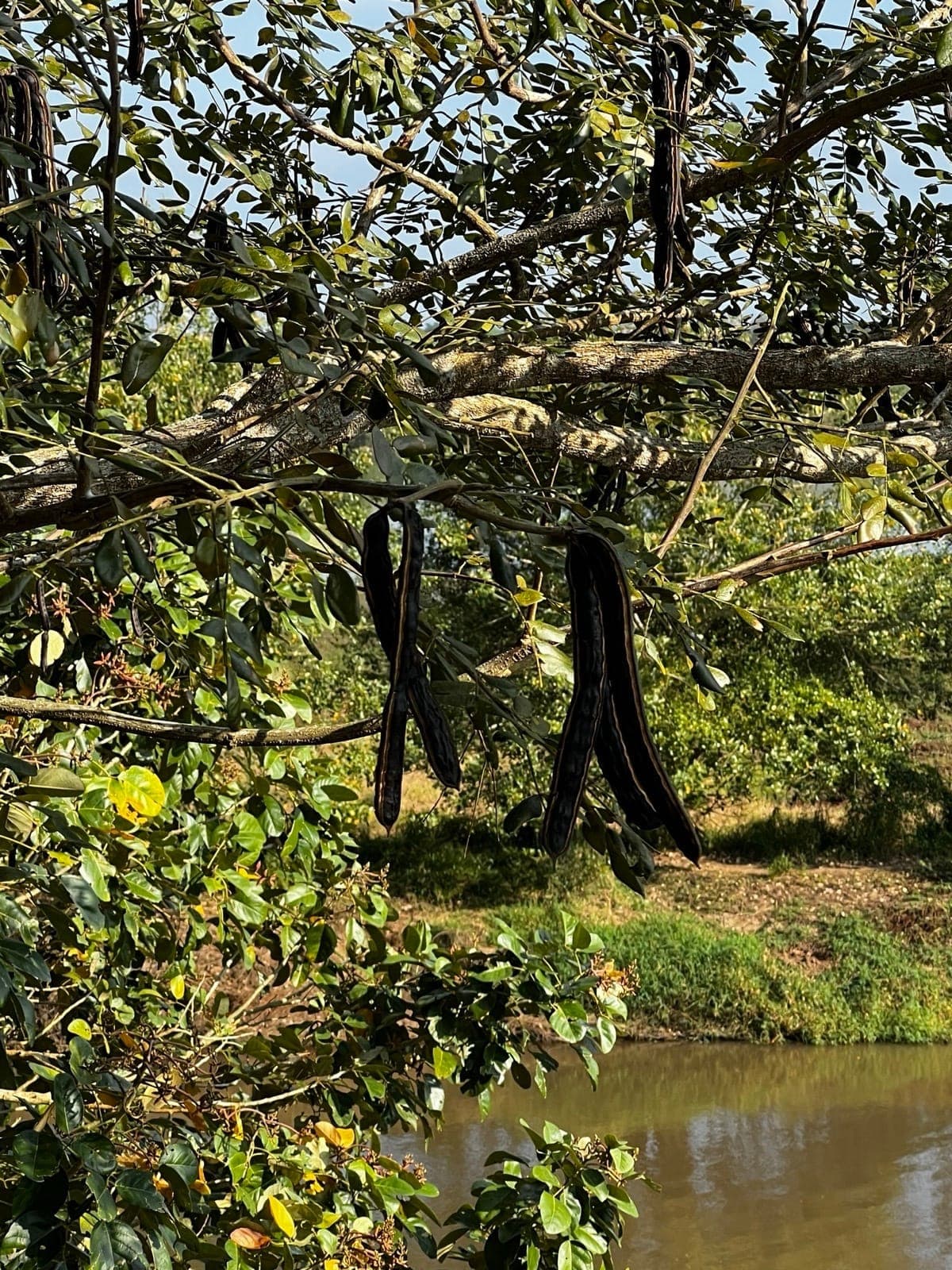
Guanacaste has distinctive ear-shaped seed pods, while Cenízaro has long, flat, straight pods typical of legumes.
Guanacaste vs. Cenízaro: Quick ID Guide
Both Guanacaste and Cenízaro are iconic giants of Costa Rica's dry forests, providing massive shade with their umbrella-like crowns. They're both legumes with similar growth forms, making them easy to confuse. Here's how to tell them apart.
Look at the seed pods. Guanacaste has distinctive curved, ear-shaped pods that twist into a spiral. Cenízaro has long, straight, flat pods like a typical bean. If no pods are visible, check the leaf size—Guanacaste has much finer, smaller leaflets.
Side-by-Side Comparison
Detailed Comparison Table
| Feature | Guanacaste (Enterolobium cyclocarpum) | Cenízaro (Samanea saman) | | --------------------- | ----------------------------------------------------- | ---------------------------------------------- | | Seed Pod Shape | Distinctive ear-shaped, circular, twisted into spiral | Long, flat, straight typical legume pod | | Pod Size | 7-12 cm diameter, circular | 10-20 cm long, 1.5-2 cm wide | | Pod Color | Dark brown to black when mature | Brown when mature | | Leaflet Size | Very small: 5-8 mm long | Medium: 2-4 cm long | | Leaflet Count | 40-60 pairs per pinna | 3-8 pairs per pinna | | Leaf Complexity | Twice-pinnate (bipinnate), highly divided | Twice-pinnate but less divided | | Maximum Height | 25-35 m (80-115 ft) | 15-25 m (50-80 ft) | | Crown Spread | 30-50 m (can be wider than tall) | 20-40 m (umbrella-shaped) | | Trunk Diameter | Up to 3 m | Up to 2 m | | Bark Texture | Deeply furrowed, rough, grayish | Relatively smooth, gray-brown | | Flower Color | Cream to white, small pom-poms | Pink to red, larger pom-poms | | Flowering Season | February-April (dry season) | February-May (dry season) | | Growth Rate | Moderate to fast | Fast | | Branching Pattern | Low, wide-spreading, often multi-trunked | Single trunk, umbrella crown | | Habitat | Dry forest, pastures, lowlands | Dry to moist forest, parks, roadsides | | Elevation Range | 0-1200 m | 0-1500 m | | Cultural Name | Named after Guanacaste Province | "Rain tree" (leaves fold at night/before rain) |
Key Identification Features
1. Seed Pods (Most Diagnostic!)
Guanacaste:
- Unmistakable ear shape (Spanish "oreja de mono" = monkey's ear)
- Circular/spiral twist, forms complete or partial ring
- Hard, woody, dark brown to black when mature
- Contains multiple seeds embedded in sweet pulp
- Pods persist on tree and ground, easy to find
- Named after this distinctive pod shape
Cenízaro:
- Typical straight legume pod
- Flat, elongated, straight or slightly curved
- Brown when mature
- Contains seeds in a row inside pod
- Pods split along seams when dry (dehiscent)
- Similar to other legume pods, less distinctive
Why This Matters: Even when trees are leafless (common in dry season), you can identify them by pods on the ground or remaining on the tree. Guanacaste pods are so distinctive they're used in crafts and decorations.
2. Leaf Structure
Guanacaste:
- Extremely fine, delicate appearance
- Leaflets very small (5-8mm long)
- 40-60 pairs of tiny leaflets per pinna
- Twice-pinnate (bipinnate) with many divisions
- Gives feathery, fern-like texture
- Leaves fold at night (nyctinastic)
Cenízaro:
- Coarser, less divided
- Leaflets medium-sized (2-4cm long)
- 3-8 pairs of larger leaflets per pinna
- Twice-pinnate but much less divided
- More substantial appearance than Guanacaste
- Leaves famously fold before rain and at night
3. Flowers
Guanacaste:
- Small cream to white pom-pom flowers
- Arranged in dense spherical clusters
- Each flower cluster 1-2cm diameter
- Less showy than Cenízaro
- Abundant nectar attracts bees
Cenízaro:
- Larger pink to red pom-pom flowers
- More spectacular flowering display
- Each flower cluster 3-5cm diameter
- Very attractive to hummingbirds, bees
- Creates dramatic pink cloud effect when fully flowering
4. Growth Form & Crown Shape
Guanacaste:
- Crown often wider than the tree is tall
- Low, wide-spreading branching
- Often multi-trunked from near the base
- Branching starts low on trunk
- Creates incredibly wide shade circles
- "Acacia-like" spreading form
Cenízaro:
- Classic umbrella shape
- Usually single straight trunk
- Crown branches high on trunk
- More vertically oriented than Guanacaste
- Symmetrical umbrella canopy
- "Parasol" shape
5. Bark
Guanacaste:
- Deeply furrowed and rough
- Grayish color
- Vertical ridges and cracks
- Thick, corky texture
- Becomes progressively more furrowed with age
Cenízaro:
- Relatively smooth, even on older trees
- Gray-brown color
- Shallow furrows or smooth
- Less dramatically textured than Guanacaste
When They Look Most Similar
Both trees can be confusing in these situations:
From a Distance in Leaf
- Both have large, umbrella-shaped crowns
- Both are deciduous, lose leaves in dry season
- Both have spreading forms
- Silhouettes can be similar
Solution: Look at the tree base—Guanacaste often has multiple trunks or very low branching; Cenízaro typically has a single tall trunk. If you can see leaves, Guanacaste's are much finer and more delicate.
Dry Season (Leafless)
- Both lose all leaves
- Both have large bare crowns
- Pod coloring can be similar from distance
Solution: Look for pods on the ground or hanging on tree. Guanacaste's distinctive ear-shaped pods are unmistakable. Cenízaro pods are straight and look like large bean pods.
Young Trees
- Both have compound leaves
- Both grow in similar habitats
- Crown form not yet fully developed
Solution: Look at leaflet size under a single leaf—Guanacaste leaflets are tiny (5-8mm), Cenízaro's are much larger (2-4cm). Even young trees show this difference.
Range & Habitat
Guanacaste
- Distribution: Pacific slope, especially Guanacaste province (the tree that named the province!)
- Habitat: Dry forest, cattle pastures, roadsides, lowlands
- Elevation: Sea level to 1200 m
- Tolerance: Very drought-tolerant, prefers dry regions
- Soil: Tolerates poor soils, compacted pasture soils
- Common locations: Fences, isolated pasture trees, dry forest remnants
Cenízaro
- Distribution: Both Pacific and Caribbean slopes, throughout Costa Rica
- Habitat: Dry to moist forest, parks, urban areas, coffee plantations
- Elevation: Sea level to 1500 m
- Tolerance: Moderately drought-tolerant but prefers some moisture
- Soil: Prefers better drained, richer soils than Guanacaste
- Common locations: Urban parks, shade trees, planted along roads
Quick Field Test
🔍Quick ID
Ask yourself these questions:
-
Can you see the seed pods?
- Ear-shaped/circular → Guanacaste
- Long and straight → Cenízaro
-
Are the leaflets tiny (smaller than your pinky fingernail)?
- YES → Guanacaste
- NO (bigger than fingernail) → Cenízaro
-
Does the crown spread wider than the tree is tall?
- YES → Probably Guanacaste
- NO (umbrella shape) → Probably Cenízaro
-
Are there multiple trunks or very low branching?
- YES → More likely Guanacaste
- NO (single trunk) → More likely Cenízaro
-
Are flowers bright pink/red and showy?
- YES → Cenízaro
- NO (cream/white) → Guanacaste
Cultural & Ecological Significance
Guanacaste
- National Symbol: Guanacaste Province named after this tree
- National Tree: Official tree of Costa Rica since 1959
- Historical: Gathering place for colonial-era meetings under massive shade
- Cattle Culture: Iconic pasture tree providing vital shade for livestock
- Wildlife: Seeds eaten by horses, cattle (aid dispersal), rodents
- Wood Uses: Construction, furniture, traditional ox-cart wheels
- Medicinal: Bark used traditionally for respiratory ailments
Cenízaro
- Common Name: "Rain tree" or "monkey pod tree"
- Weather Predictor: Leaves fold before rain and at night (nyctinastic movement)
- Urban Favorite: Widely planted in parks and cities for spectacular shade
- Coffee Shade: Traditional shade tree in coffee plantations
- Wildlife: Flowers attract hummingbirds, bees, butterflies
- Wood Uses: Furniture, decorative wood, "live-edge" slabs popular
- Cultural: Symbol of shade and rest, gathering tree
Interesting Facts
Guanacaste
- Crown spread can exceed 50 meters (160+ feet)—one of the widest crowns in the tropics
- Seeds viable for years, germinate after passing through cattle digestive system
- Ear-shaped pods have sweet edible pulp, eaten by wildlife and sometimes people
- Tree can live 100-150+ years
- Often the last tree standing in cleared pastures (deliberately preserved for shade)
Cenízaro
- Leaves fold up when it's about to rain (hence "rain tree")—so reliable locals use it to predict weather
- One of the most planted tropical shade trees worldwide
- Can grow 3-5 feet per year when young
- Fixes atmospheric nitrogen via root bacteria, enriches soil
- Featured in many famous parks (e.g., Hitachi tree in Japan is a massive Cenízaro/Samanea)
- Flowers produce copious nectar, important bee tree
Nitrogen-Fixing Legumes
Both trees are legumes (Fabaceae) with nitrogen-fixing root nodules:
- Both enrich soil by converting atmospheric nitrogen into plant-available forms
- Improve pasture grass growth beneath their canopies
- Valuable for reforestation and soil restoration
- Drop nitrogen-rich leaves that decompose and fertilize soil
- Can grow on poor soils where other trees struggle
This makes both species excellent choices for:
- Degraded pasture restoration
- Agroforestry systems
- Living fences
- Windbreaks
- Soil improvement
Related Species Confusion
If you can distinguish Guanacaste and Cenízaro, you're well on your way to identifying related species:
Similar to Guanacaste:
- Acacia species (similar fine leaves, but smaller trees, different pods)
- Other Enterolobium species (rare in Costa Rica)
Similar to Cenízaro:
- Albizia species (similar growth form, but different pod structure)
- Other Samanea/Pithecellobium relatives
- Tamarind (Tamarindus indica) - introduced, similar crown but different pods
Tips for Beginners
Start with the pods - If you find the distinctive ear-shaped pods on the ground, you've found a Guanacaste. Period. No other tree has pods like that.
Check leaflet size - Hold a single leaf up to the light. If the leaflets are tiny and give a delicate, feathery appearance, it's Guanacaste. If they're more substantial (fingernail-sized or bigger), it's Cenízaro.
Look at the crown-to-height ratio - Guanacaste tends to be wider than tall with low, spreading branches. Cenízaro is more vertical with an umbrella crown.
Watch for multi-trunk growth - Guanacaste often grows with multiple trunks from near the base. Cenízaro typically has a single tall trunk.
Remember the cultural clues - Guanacaste is THE iconic pasture tree left standing alone in cattle fields. Cenízaro is more commonly planted in parks and urban areas for ornamental shade.
Conservation & Planting
Guanacaste:
- Conservation Status: Least Concern (LC)
- Widely preserved in pastures, but natural forests reduced
- Excellent for pasture restoration projects
- Plant 15-20m (50+ ft) from buildings (massive crown!)
- Very drought-tolerant once established
Cenízaro:
- Conservation Status: Least Concern (LC)
- Widely cultivated, naturalized in many areas
- Excellent shade tree for parks, coffee farms
- Plant 12-15m (40-50 ft) from buildings
- Faster growing than Guanacaste
Both are excellent choices for:
- Reforestation projects
- Agroforestry systems
- Pasture improvement (nitrogen fixation)
- Wildlife habitat
- Carbon sequestration
Summary: The Definitive Differences
| When... | Guanacaste | Cenízaro | | ------------------------------ | ---------------------------------- | -------------------------------- | | You find pods on ground | Ear-shaped, circular spiral | Long, straight, flat bean pod | | You examine leaves closely | Tiny leaflets (5-8mm), very fine | Larger leaflets (2-4cm), coarser | | You see the crown shape | Wider than tall, spreading low | Umbrella-shaped, branching high | | You check the trunk | Often multi-trunked, low branching | Usually single trunk | | You see it flowering | Small cream/white pom-poms | Larger pink/red pom-poms | | You find it in location | Dry pastures, Guanacaste province | Parks, urban areas, coffee farms |
The absolute clincher: The seed pod. Guanacaste's ear-shaped pod is unlike any other tree in Costa Rica. Once you've seen it, you'll never confuse these two trees again.
Want to explore more?
Use our interactive tool to compare these species side by side.
Compare in interactive tool